

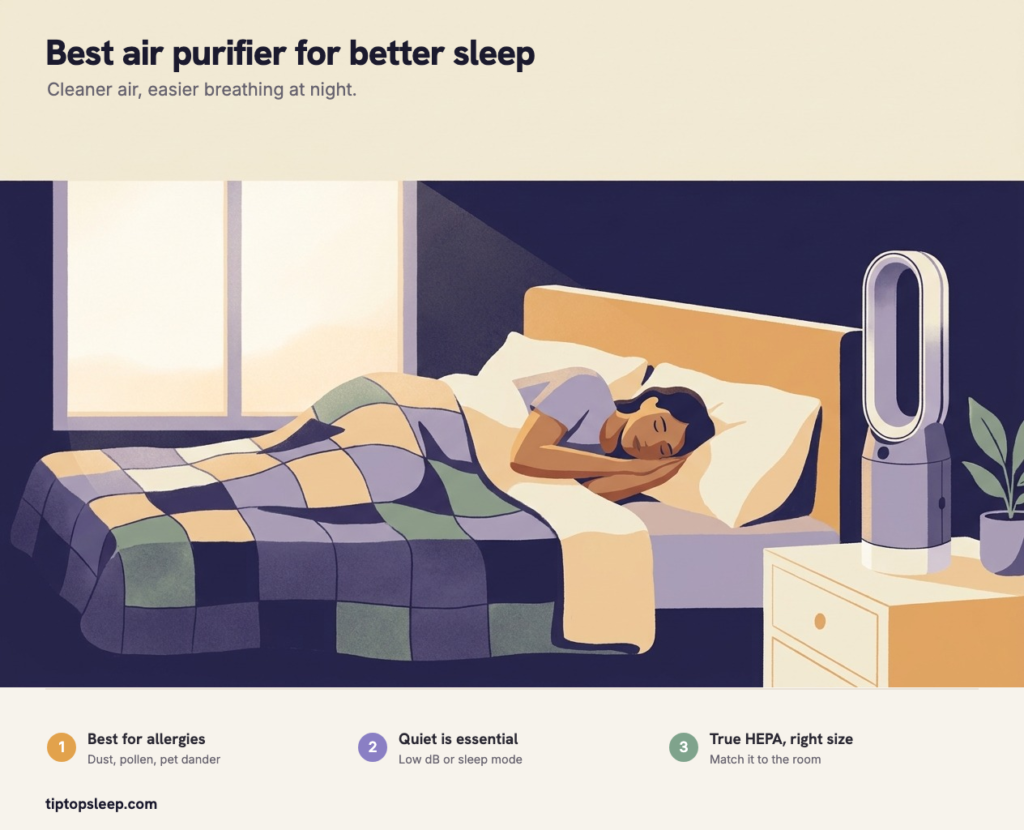
A bedroom air purifier can genuinely help you sleep better if allergies, pet dander, dust, or stuffy air are part of the problem - a true HEPA filter removes over 99.97% of airborne particles down to 0.3 microns, which can ease the congestion and nighttime sniffling that keep you tossing. It won't fix insomnia or cure a medical condition, and the wrong model can make things worse: pick one rated quiet enough for a bedroom (look for a low decibel "sleep mode"), sized for your room, and skip the ozone generators.
I didn't think much about the air in my bedroom until a friend with bad seasonal allergies stayed over and woke up stuffed up every morning of her visit, in a room that looked spotless. That's when I actually looked into what's floating around while we sleep - dust mite debris, pet dander, pollen tracked in on clothes - and why a purifier in the right spot can make a real difference for people whose sleep gets wrecked by that stuff. It's not magic, and it's not for everyone, but if you know allergies or dusty air are part of your sleep problem, it's one of the more evidence-backed gadgets you can put in a bedroom.
Can an air purifier actually help you sleep better?
For a specific group of people, yes - and it's worth being honest about who that is. If you deal with allergies, asthma, chronic congestion, or you live somewhere with wildfire smoke, traffic pollution, or strong pet dander, cleaner bedroom air can genuinely reduce the irritation that wakes you up or keeps you from settling. The EPA explains that a true HEPA filter "can theoretically remove at least 99.97% of dust, pollen, mold, bacteria, and other airborne particles with a size of 0.3 microns (µm)." That's the size range that includes most common allergens.
The Sleep Foundation frames the connection this way: "Pollutants and airborne particles in the bedroom can contribute to allergies and other problems that interfere with a good night's rest," and "High-Efficiency Particulate Air (HEPA) filters trap allergens and particulates in the air, making it less likely that they'll be inhaled during sleep." Fewer irritants in the air can mean less congestion, less coughing, and fewer 3am wake-ups to blow your nose.
What it won't do: cure insomnia unrelated to air quality, replace allergy medication your doctor has prescribed, or make a smoky or genuinely unsafe environment fully safe. It's a supporting tool for a specific problem, not a sleep cure-all. If your sleep struggles have nothing to do with allergens or air quality, an air purifier probably isn't the fix - our sleep hygiene checklist covers the broader basics worth checking first.
What should I actually look for in a bedroom air purifier?
- True HEPA filter. Not "HEPA-type" or "HEPA-like" - those marketing terms don't meet the same standard. A true HEPA filter is tested to the 99.97% at 0.3 micron benchmark.
- CADR rated for your room size. Clean Air Delivery Rate tells you how much filtered air the unit actually moves, matched to square footage. A purifier rated for a small office won't do much in a large bedroom, and running an oversized unit in a small room just means more noise than you need.
- Noise level, especially on the lowest or "sleep mode" setting. This is the factor most people overlook and the one that actually determines whether you'll use it at night. The Sleep Foundation's medical review notes that "the amount of noise it produces is an important consideration when choosing the right model." Look for a published decibel rating on the lowest setting, ideally in the low-to-mid 20s dB, which sits below a quiet library.
- Filter replacement cost. Cheap purifiers can have expensive filters. Check how often the filter needs replacing and what a replacement costs before you buy - it affects the real cost of ownership.
- Skip ozone generators and ionizers marketed as "purifiers." Some devices generate ozone as a byproduct or intentionally, which is itself a lung irritant. If a listing doesn't clearly say "ozone-free," look elsewhere for a bedroom unit.
The quiet-operation point deserves extra weight for sleep specifically. A purifier that's technically powerful but sounds like a box fan on high will either keep you awake or get switched off at bedtime, which defeats the purpose. Match the room size honestly rather than buying for hypothetical square footage.
Do air purifiers help with pet dander and dust mites specifically?
This is where HEPA filtration does its clearest work. Pet dander, dust mite waste particles, and pollen fall squarely in the size range HEPA filters are built to catch. If you sleep with pets, live somewhere dusty, or your allergies flare specifically at night in your own bedroom, a purifier running continuously near the bed - not across the room - gives the filter the best shot at clean air actually reaching you before it settles back into carpet and bedding.
It's not a substitute for basics like washing bedding weekly in hot water, vacuuming with a HEPA-filtered vacuum, or keeping pets off the bed if dander is a known trigger. Think of it as one layer in a stack of habits, not a replacement for them.
Which air purifier should I get for my bedroom?
Here are three real, currently available options depending on your room and priorities. None of these will show a price or rating here - check current pricing and reviews directly on Amazon before buying.

LEVOIT Core 200S-P
Built specifically around a low noise floor, with a manufacturer-listed noise level as low as 27dB and a dedicated HEPA sleep mode. Sized for a standard bedroom (roughly 140 sq ft at full refresh rate), with a true HEPA filter rated for 99.97% capture of common allergens. A sensible pick if quiet operation at night is your top priority.

WINIX 5510
Covers up to roughly 1,881 sq ft in an hour, which makes it a better match for open-plan bedrooms, primary suites, or rooms with high ceilings than a compact desktop unit. True HEPA filtration plus a carbon layer for odors, with a manufacturer-listed near-silent rating on its lowest speed and an automatic sleep mode that engages when the room goes dark.

LEVOIT Core Mini-P
A compact, desktop-sized purifier for a smaller bedroom, dorm, or nightstand setup where a full-size unit is overkill. Simple pre-filter plus main filter combination for dust, pet dander, and odors, with a quiet mode aimed at nighttime use. The right call if you want the basics covered without the footprint or cost of a large-room model.
Want more of the gear we actually recommend for specific sleep problems? Our Sleep Toolkit rounds it up in one place.
Frequently asked questions
Where should I put an air purifier in my bedroom for sleep?
Close enough to the bed that filtered air reaches you before it recirculates through the room, but not so close it's the loudest thing near your head. A few feet from the bed, off the floor if possible, works well for most rooms. Avoid tucking it in a corner or behind furniture, which restricts airflow.
Is it safe to run an air purifier all night?
Yes, true HEPA purifiers are designed for continuous operation, and running one overnight is when it does the most good since that's when you're breathing bedroom air for hours straight. Just make sure the model you choose has a genuinely quiet sleep or night mode.
Do air purifiers help with snoring or sleep apnea?
Not directly. Snoring and sleep apnea are caused by airway obstruction, not air quality, so a purifier won't treat either condition. If congestion from allergies is making snoring worse, reducing allergens might help a little, but a purifier isn't a treatment for sleep apnea and shouldn't replace a proper diagnosis.
What's the difference between HEPA and "HEPA-type" filters?
True HEPA filters are tested and rated to remove at least 99.97% of particles at 0.3 microns. "HEPA-type," "HEPA-like," or "99% HEPA" filters are marketing terms that don't meet that certified standard, so they're worth reading carefully before you buy if allergy relief is the goal.
Related reading:
- Best Diffusers for Sleep
- Best Plants for Your Bedroom
- Sleep Hygiene Checklist
- Benefits and Risks of Using a Humidifier While Sleeping
- Sleep Toolkit - the gear we actually recommend for situations like this
Sources & review: HEPA filter performance figures checked against the EPA's guidance on HEPA filters, and the sleep and air quality connection checked against Sleep Foundation's guide to air purifiers and sleep. This is general information, not medical advice, and doesn't replace guidance from your doctor about allergies, asthma, or other respiratory conditions.
📥 Free: The Post-Surgery Sleep Recovery Kit
Our 2-page PDF - the safe sleep position for your surgery, how to set up your bed, a night-by-night recovery timeline, and the red flags worth calling your doctor about. We'll email you the download link.
By subscribing you agree to our Privacy Policy.