

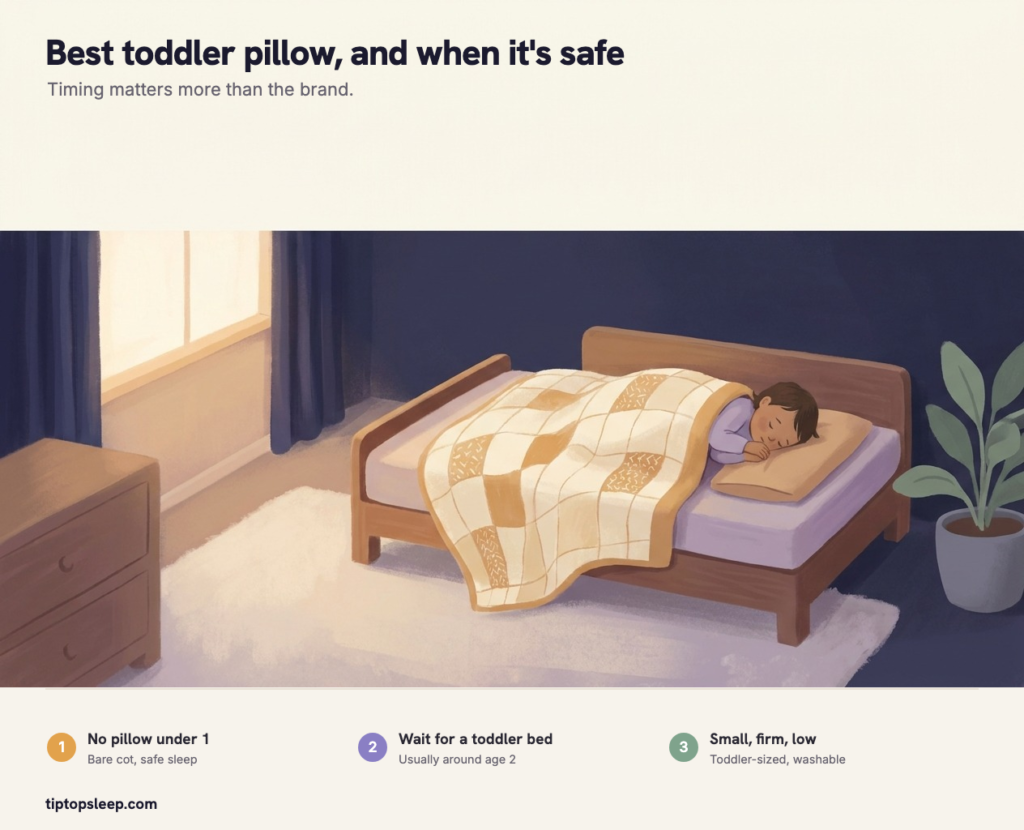
A pillow isn't safe for a baby under 12 months - the AAP and NHS both warn against pillows and soft bedding in an infant's sleep space because of suffocation risk. Most toddlers are ready for a pillow only once they've moved to a toddler bed, usually somewhere between 18 months and 2 to 3 years old. When they are ready, look for a small, low-loft, firm, toddler-sized pillow (roughly 13x18 inches) with a washable, breathable cover - not a scaled-down adult pillow.
I get asked this one a lot, usually by a parent who's just moved their toddler into a "big kid" bed and is standing in the bedding aisle wondering if a pillow is next. The honest answer is that timing matters here more than the pillow itself. Get the timing wrong and you've recreated the exact risk that safe-sleep guidance spends so much effort warning against. Get it right and a pillow is a small, ordinary comfort. Here's how to tell which stage your child is actually at.
Is a pillow safe for a baby under 12 months?
No. This is the one part of this topic that isn't a judgment call. Pillows, blankets, quilts, and soft toys are not safe in a crib or bassinet for babies under a year old, because of the risk of suffocation and Sudden Infant Death Syndrome (SIDS). The NHS is direct about it, listing what to keep out of a baby's sleep space:
"keep your baby's cot clear of anything that could cover their face and head - do not use pillows, duvets, cot bumpers, loose blankets, soft toys, or anything to keep your baby in place, like pods or nests."
The American Academy of Pediatrics takes the same position on soft bedding generally, warning that these items "can increase your baby's risk of entrapment, suffocation or strangulation. This includes pillows and pillow-like toys, quilts, comforters, mattress toppers, non-fitted sheets, blankets, toys, bumper pads or related products that attach to crib slats or sides." A firm, flat crib mattress with a fitted sheet and nothing else is the whole recipe for the first year. It feels bare. That's the point.
When can a toddler start using a pillow?
There's no single official cutoff, which is part of why parents ask. What guidance and pediatric practice generally agree on is that a pillow becomes appropriate once your child has moved out of a crib and into a toddler bed - typically somewhere in the 18 month to 2-year range, and for plenty of kids, closer to 2 or 3. The move to a pillow tends to line up with the move to a bed, not with a birthday. A few things worth checking before you introduce one:
- They're sleeping in a toddler or "big kid" bed, not a crib. This is the biggest single marker. If they're still in a crib, hold off regardless of age.
- They can move themselves freely. By this stage most toddlers can roll, sit up, and reposition on their own if something is in their way, which is a meaningful part of what makes a pillow lower-risk than it would be for a baby.
- They're asking for one, or clearly uncomfortable without one. Some toddlers happily sleep flat for another year. There's no rush to introduce a pillow the moment it's technically permitted.
If you're unsure whether your child is ready, or your child was born early or has a medical condition, ask your pediatrician before adding a pillow - they know your child's specific situation better than any general guideline can.
What should I look for in a toddler pillow?
An adult pillow is the wrong shape and far too thick for a toddler's smaller frame and shorter neck. A pillow sized for the job matters more than the brand name on it.
- Toddler-specific size. Around 13x18 inches is the standard toddler dimension, noticeably smaller than a standard adult pillow (usually 20x26 inches).
- Low loft and firm support. You want flat and supportive, not fluffy and sinkable. A toddler's head shouldn't disappear into it.
- Breathable, hypoallergenic filling. Cotton or polyester fill is a safer default than feather or down, which can trigger allergies and doesn't hold its shape the same way.
- A washable cover, ideally a washable pillow entirely. Toddlers spill, drool, and occasionally have accidents in bed. Machine-washable is not a luxury feature here.
- No loose decorative parts. Skip pillows with buttons, bows, or anything that could detach and become a choking hazard.

ZPECC Toddler Pillow with Pillowcase
Sized at 13x18 inches, which is the toddler-appropriate footprint rather than a shrunk-down adult pillow. The pillowcase is OEKO-TEX and Organic Content Standard certified cotton, and the whole thing is machine washable, which matters more than it sounds like it should once a toddler is actually sleeping on it every night. It's marked for age 2 and up, in line with general guidance to wait until a child is out of the crib before introducing one.
For more of the gear we actually trust for toddler and family sleep, our Sleep Toolkit rounds up picks by situation.
What are the signs my toddler is ready for a pillow?
- They've transitioned to a toddler bed or floor bed, and are no longer sleeping in a crib.
- They can already roll, sit up, and reposition themselves easily during the day.
- They're old enough that any pillow you'd give them is toddler-sized, firm, and low-loft, not a full adult pillow "because it was what we had."
- You've talked it through with your pediatrician if your child was premature, has low muscle tone, or has any condition that affects how easily they can move or reposition themselves at night.
If any of those don't line up yet, it's completely fine to wait. A flat mattress isn't uncomfortable for a toddler the way it would be for an adult, and there's no downside to introducing a pillow a few months later than "average."
Frequently asked questions
Can a 1-year-old have a pillow?
Generally no, if they're still in a crib. Safe-sleep guidance for infants applies through the first year regardless of the exact month, and a crib should stay free of pillows and soft bedding. Pillows are usually introduced once a child has moved to a toddler bed, which for most families is somewhere around 18 months to 2 years or later.
What size pillow does a toddler need?
Around 13x18 inches is the standard toddler size, noticeably smaller and flatter than a standard adult pillow. A smaller, firmer pillow supports a toddler's proportionally smaller head and neck better than a full-size one.
Is memory foam safe for a toddler pillow?
Firm, low-loft memory foam designed specifically for toddlers can be fine for a child who is already sleeping in a toddler bed and moving freely. Avoid soft, sink-in foam pillows, and skip memory foam entirely for any child still in a crib.
How often should I replace a toddler pillow?
Most toddler pillows are designed to be replaced every 18 to 36 months, depending on wear, washing frequency, and how the filling holds up. Machine-washable covers extend the useful life considerably.
Related reading:
- How to Sleep With Engorged Breasts
- Surviving Newborn Sleep Deprivation
- How to Sleep With an Ear Infection
- Learning to Sleep on Your Back (In 3 Easy Steps)
- Sleep Toolkit - the gear we actually recommend for family sleep situations
Sources & review: Safe-sleep guidance here is checked against the NHS page on Sudden Infant Death Syndrome (SIDS) and the American Academy of Pediatrics safe-sleep guidance. This is general information, not medical advice, and doesn't replace guidance from your pediatrician - always talk to them about what's right for your child, especially if your child was premature or has a medical condition.
📥 Free: The Post-Surgery Sleep Recovery Kit
Our 2-page PDF - the safe sleep position for your surgery, how to set up your bed, a night-by-night recovery timeline, and the red flags worth calling your doctor about. We'll email you the download link.
By subscribing you agree to our Privacy Policy.