

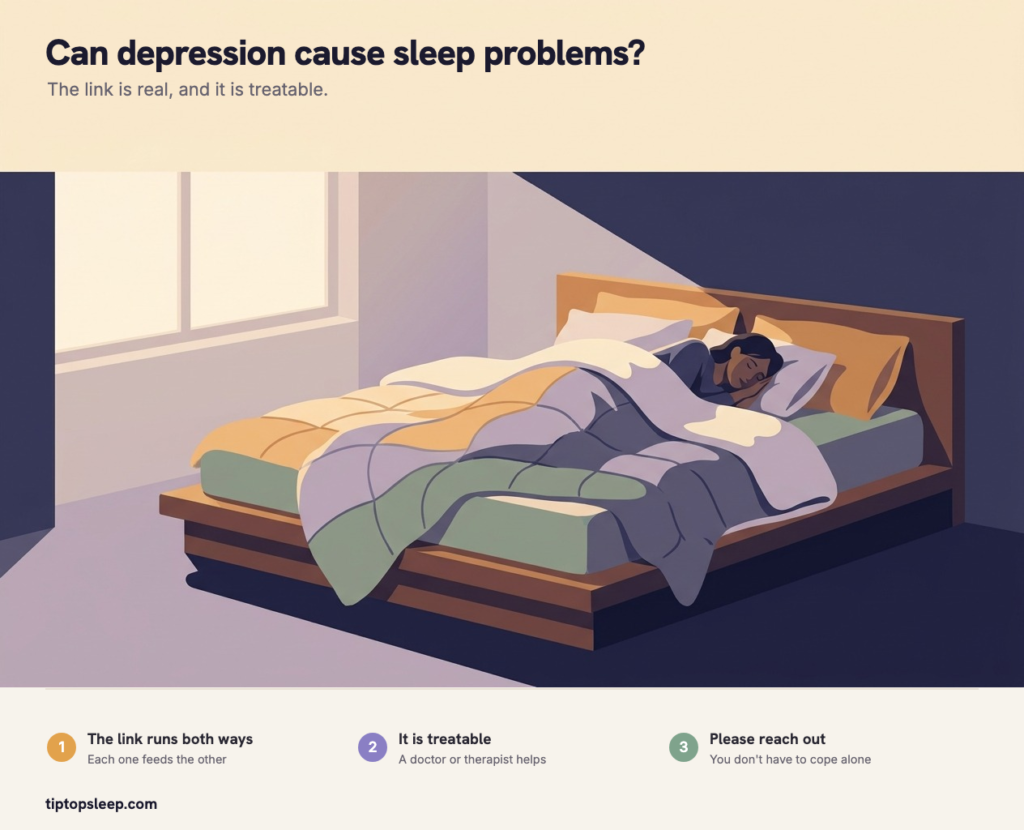
Yes. Depression and sleep problems are closely linked in both directions. Depression very often causes insomnia, especially waking up too early and not being able to get back to sleep, and for some people it causes the opposite: sleeping far more than usual. At the same time, ongoing poor sleep can make depression worse or raise the risk of it developing in the first place. The good news is that this is treatable, and treating one often helps the other.
If you've been lying awake at 4am with your mind looping, or you can barely get out of bed some mornings no matter how much you slept, you're not imagining the connection to how you've been feeling. I'm not a therapist or a doctor, just someone who writes about sleep and has watched people close to me go through this. What I can tell you is that the link between depression and sleep is well documented, it's not a character flaw or a sign you're "doing sleep wrong," and there are real, evidence based ways to get help with both.
Is there really a link between depression and sleep problems?
Yes, and it runs both ways. Sleep and mood share the same brain chemistry and circuitry, so a disruption to one tends to pull on the other.
- Depression can cause sleep problems. Difficulty falling asleep, early waking, and restless nights are extremely common symptoms of depression, not a side issue.
- Sleep problems can contribute to depression. Chronic poor sleep is a known risk factor for developing depression, and it can trigger relapse in people who've recovered from a past episode.
- The two can reinforce each other. Poor sleep lowers your ability to cope with low mood, and low mood makes it harder to sleep well, which can turn into a cycle without support.
The Sleep Foundation describes it plainly: "Depression and sleep issues have a bidirectional relationship. This means that poor sleep can contribute to the development of depression and having depression makes a person more likely to experience sleep troubles." That's worth sitting with, because it means neither problem is "just in your head" in a dismissive sense, and neither one is something you have to untangle alone.
What does depression actually do to sleep?
It doesn't look the same for everyone. Two patterns show up most often, and some people move between them during the same period of depression.
- Insomnia, especially early morning waking. This is the most classic pattern: trouble falling asleep, waking in the middle of the night, or waking hours before you need to and being unable to drift off again. The NHS lists "disturbed sleep, for example, finding it difficult to fall asleep at night or waking up very early in the morning" as a recognized symptom of depression.
- Hypersomnia, or sleeping too much. Some people with depression sleep far longer than usual and still wake up exhausted, or struggle to get out of bed at all. According to the Sleep Foundation, "sleep issues commonly associated with depression include insomnia, hypersomnia, and obstructive sleep apnea" and roughly 15% of people with depression experience hypersomnia specifically.
- Switching between the two. It's not unusual to have a stretch of barely sleeping followed by a stretch of oversleeping within the same depressive episode. As the Sleep Foundation puts it, "early wakening is closely associated with depression, as well as difficulty falling asleep at night. Those with depression may switch back and forth between insomnia and hypersomnia during a single period of depression."
Neither pattern means you're sleeping "wrong." Both are recognized parts of how depression shows up, and both are things a doctor or therapist can help you work through.
Why does depression disrupt sleep like this?
There isn't one single cause, but a few things tend to overlap:
- Shared brain chemistry. The same neurotransmitter systems involved in regulating mood, including serotonin and norepinephrine, also play a role in regulating sleep and wake cycles. When one system is disrupted, the other often is too.
- Circadian rhythm disruption. Depression is linked to changes in the body's internal clock, which can shift when you naturally feel sleepy or alert and contribute to that "wide awake at 4am" pattern.
- Rumination. Lying in bed replaying worries or self critical thoughts keeps the mind alert exactly when it needs to wind down, which is one of the most common reasons depression turns into insomnia.
- Loss of structure and daylight. Depression often reduces activity, time outdoors, and daily routine, all of which normally help anchor a stable sleep wake schedule.
None of this means the fix is simply "try harder to sleep." If anything, that pressure tends to backfire, which is a pattern covered in more detail in Fear of Not Sleeping: Stop Worrying About Not Sleeping. The more useful question is what actually helps, and that starts with treating the depression and the sleep problem together rather than picking one.
What actually helps, and who should I talk to?
This is the part I want to be really direct about: this isn't something to white knuckle through alone, and it isn't something a blog post can safely tell you how to fix. But it is treatable, and here's what evidence based care generally looks like.
- See a doctor or therapist. A GP, psychiatrist, or licensed therapist can properly assess what's going on and rule out other causes of poor sleep, rather than guessing from symptoms alone.
- Talk therapy helps both. Cognitive behavioral therapy (CBT) is a well established treatment for depression itself. A related, more targeted approach called CBT-I, cognitive behavioral therapy for insomnia, is considered a first line treatment for chronic sleep problems and is often recommended alongside depression treatment.
- Medication is a conversation with your prescriber, not a DIY decision. Some antidepressants can affect sleep, either making you drowsier or more wakeful depending on the medication and the person. Your doctor or psychiatrist is the right person to weigh that against your specific symptoms. This article isn't the place for drug or dosage advice, and you shouldn't take any from a website.
- Basic sleep habits still matter, but they're support, not a cure. Consistent wake times, daylight exposure, and winding down before bed can help, and a simple starting point is the Sleep Hygiene Checklist. Just know that habits alone usually aren't enough to treat clinical depression, and that's not a failure on your part.
If you're supporting someone older in your life who's dealing with both low mood and disrupted sleep, Elderly Insomnia: What You Can Do to Help Them Sleep covers some of the extra considerations that come with age. And if ADHD is also part of the picture, which is common alongside depression and can compound sleep difficulty, Can ADHD Cause Sleep Problems? goes into that overlap.
For general, evidence based sleep support tools while you're getting professional help sorted out, our Sleep Toolkit is a reasonable place to start. It isn't a treatment for depression and won't replace a doctor's care, but it's a starting point for the sleep environment side of things.
If you're struggling right now, please reach out
If you're having thoughts of suicide or self harm, please don't wait this out alone. Reach out right now, in whatever way feels most possible:
- In the US: Call or text 988 to reach the Suicide & Crisis Lifeline, available 24/7, free and confidential.
- In the UK: Call Samaritans at 116 123, free and available any time, day or night. The NHS also advises that if you have seriously harmed yourself or feel you may be about to, you should call 999 for an ambulance or go straight to A&E.
- Anywhere else: Contact your local emergency number, a doctor, or a crisis line in your country, or go to your nearest emergency department.
You don't need to have a "serious enough" reason to reach out, and you don't need to be in immediate danger to ask for help. Telling someone, whether that's a crisis line, a doctor, or a person you trust, is a reasonable first step, not a last resort.
Frequently asked questions
Can lack of sleep cause depression, or is it only the other way around?
Both directions are real. Depression commonly disrupts sleep, and separately, chronic poor sleep is a recognized risk factor for developing depression and for relapse in people who've recovered from it. It's genuinely bidirectional, not a one way street.
Why do I wake up so early when I'm depressed?
Early morning waking, sometimes called terminal insomnia, is one of the more classic and well documented sleep symptoms of depression. It's linked to changes in circadian rhythm and mood related brain chemistry, and it's a recognized pattern, not something unusual to you.
Does treating depression improve sleep?
Often, yes, especially when sleep is treated alongside it rather than assumed to fix itself. Many people find that as depression treatment takes effect, sleep improves too, though some people need a specific sleep focused approach like CBT-I in addition to depression treatment. A doctor or therapist can help figure out which combination fits your situation.
Should I just try to fix my sleep first before dealing with the depression?
It's generally better to address both together with a professional rather than treating them as separate problems to solve in order. Good sleep habits can genuinely help, but they're support alongside proper care, not a substitute for seeing a doctor or therapist if depression is present.
Related reading:
- Fear of Not Sleeping: Stop Worrying About Not Sleeping
- Can ADHD Cause Sleep Problems?
- Sleep Hygiene Checklist
- Elderly Insomnia: What You Can Do to Help Them Sleep
- Sleep Toolkit
Sources & review: Checked against the Sleep Foundation's page on depression and sleep and the NHS page on depression symptoms, with crisis guidance from the 988 Suicide & Crisis Lifeline and the NHS page on help for suicidal thoughts. This is not medical advice and doesn't replace a proper assessment from a doctor or mental health professional. If you're struggling, please reach out to one of them, or to a crisis line, directly.
📥 Free: The Post-Surgery Sleep Recovery Kit
Our 2-page PDF - the safe sleep position for your surgery, how to set up your bed, a night-by-night recovery timeline, and the red flags worth calling your doctor about. We'll email you the download link.
By subscribing you agree to our Privacy Policy.