

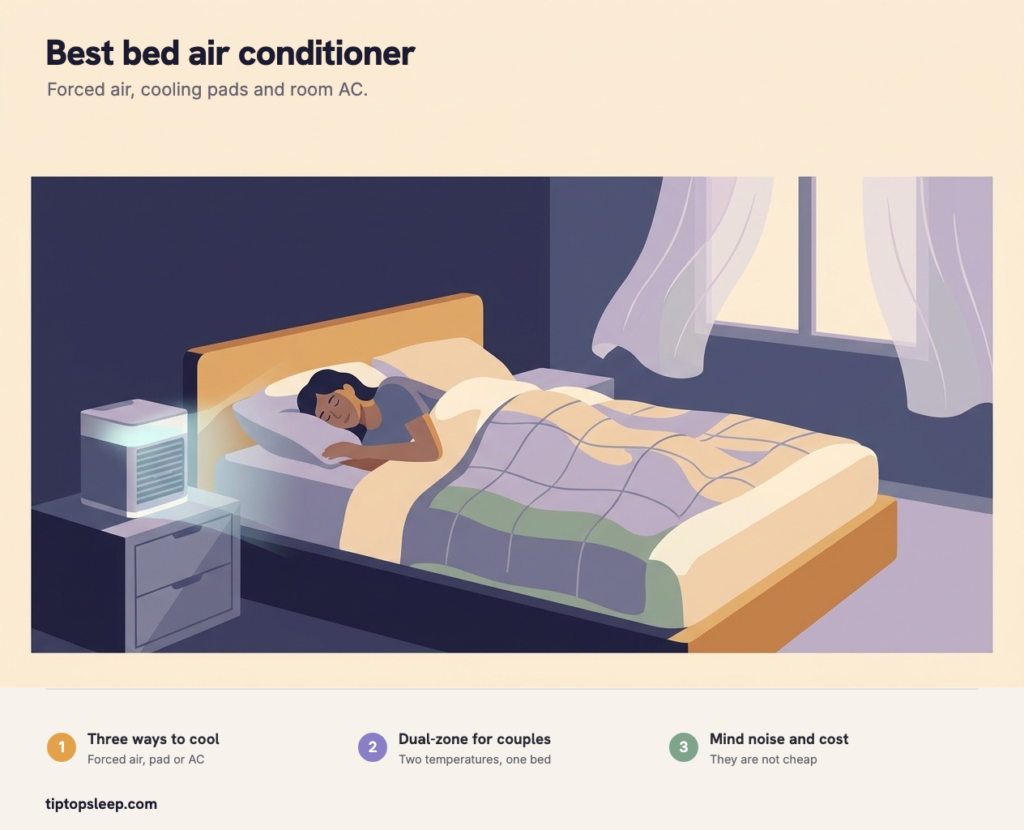
There's no single "bed air conditioner" - it's really three different categories. A forced-air system like BedJet blows conditioned air under your sheets and is the closest thing to true active cooling. A water-cooled mattress pad circulates chilled water through tubing for whole-bed temperature control, quieter but pricier. And a personal evaporative cooler is a small bedroom fan-cooler, cheap and portable but weaker and best for one person in a small room. Pick based on how hot you actually run, whether you share a bed, and your budget.
I get asked about "bed air conditioners" more than almost any other gear question, usually from people who are one hot, sweaty night away from sleeping on the couch. The honest answer is that the phrase covers a few genuinely different products, and picking the wrong one for your situation is how people end up disappointed. Let me walk through what actually works, what doesn't, and who each option is really for.
What is a bed air conditioner, really?
None of the products sold under this name are a window-unit air conditioner shrunk down to mattress size. They fall into three real categories, and knowing which one you're looking at changes everything about what to expect:
- Forced-air bed cooling systems. A unit sits beside the bed and pushes temperature-controlled air through a hose into a special fitted sheet, so air moves across your skin all night. BedJet is the best-known example. It's active cooling with a fan, not refrigeration, so it works best in rooms that aren't already sweltering.
- Water-cooled mattress pads. A pad on top of the mattress has water tubing running through it, connected to a bedside unit that chills (and can heat) the water. This is closer to true temperature control and tends to be the quietest option, but it's also the most expensive.
- Personal evaporative coolers. Small tabletop units that mist and blow air, sometimes marketed as a "mini AC" for a nightstand. They're cheap, portable, and genuinely help in a small room, but they're a personal fan-cooler, not a true air conditioner, and they add humidity to the air rather than removing it.
If you're dealing with heat as a symptom of something specific - night sweats during menopause is the most common one I hear about - the category you pick matters even more, because the goal isn't just "cooler room," it's fast, targeted relief right when you wake up overheated.
Why does bedroom temperature matter this much?
Your body needs to drop its core temperature to fall asleep and stay asleep, and a hot room actively fights that process. The Sleep Foundation puts a number on it: "most doctors recommend keeping the thermostat set between 65 to 68 degrees Fahrenheit (15.6 to 20 degrees Celsius) for the most comfortable sleep." If your room runs hotter than that and a fan alone isn't cutting it, that's the point where bed-specific cooling gear starts to earn its keep. For a broader look at why this range matters and how to get there, see our guide on the best temperature for sleep.
Forced-air bed cooling: who it's for
This is the category most people mean when they search for a "bed air conditioner," and BedJet is the product that defined it.

BedJet 3 Climate Comfort for Beds
This is the system to reach for if you want fast, active cooling right at the moment you wake up hot rather than a slow ambient shift. It pushes air through a fitted sleeve under your sheets, works on any mattress size including adjustable beds, and includes a Bluetooth app so you can schedule different temperatures for different points in the night. Worth knowing upfront: BedJet is honest that it's not a replacement for air conditioning in a bedroom that regularly runs above 78F - it's built to fine-tune the space right around your body, not cool an entire hot room from scratch.
What about couples who run different temperatures?
This is one of the most common reasons people start shopping this category at all - one partner is roasting, the other is cold, and the thermostat war never ends.

BedJet 3 Dual Zone System
Same forced-air technology as the single-zone BedJet, but it comes with two separate mini units and remotes so each side of the bed gets its own independent temperature. If you and your partner have genuinely different comfort points overnight, this solves the problem at the source instead of forcing a compromise setting that leaves one of you unhappy either way.
Is there a cheaper option that still helps?
Forced-air and water-cooled systems are an investment. If you want to test whether personal cooling helps before committing to that, or you just need something for a small bedroom, dorm, or guest room, a compact evaporative cooler is the realistic budget entry point.

Compact Personal Evaporative Cooler
Worth being clear-eyed about this one: it's a small fan-and-mist unit, not a true compressor air conditioner, so it works best in a small room and for one person nearby, not for cooling an entire house. It's genuinely useful as an inexpensive way to take the edge off a warm room, runs quietly enough for sleep, and is easy to pack away when the season changes. Just remember evaporative coolers add moisture to the air, so they're a better fit for dry climates than already-humid bedrooms.
Want more of what's actually worth having on your nightstand for hot nights? Our Sleep Toolkit rounds up the gear we trust, evidence-backed picks included.
Bed AC vs. a cooling mattress pad: which do I actually need?
- Choose forced-air (BedJet-style) if you want fast, adjustable cooling the moment you feel hot, and you don't mind a hose and unit at the bedside.
- Choose a water-cooled mattress pad if quiet, whole-mattress temperature control matters more to you than upfront cost, and you're comfortable with a bigger investment. Our best cooling pad for bed guide covers this category in more depth.
- Choose a personal evaporative cooler if you want a low-cost way to test whether extra cooling helps at all, or you only need to cool one small space.
- Skip all of it and start with the basics if you haven't already - breathable sheets, a fan, and a lower thermostat setting solve a lot of hot-sleeper problems on their own. Our guide on how to sleep when it's hot covers the free fixes first.
What about noise and running cost?
Forced-air units have a small fan running most of the night, which is a soft, steady whoosh rather than a hum - some people find it soothing white noise, others prefer silence. Water-cooled pads are generally the quietest of the three since the pump is smaller and further from your ear. Evaporative coolers vary a lot by model, but the compact ones built for bedrooms are designed to be sleep-friendly. On running cost, all three sit well below a full room air conditioner, since you're only conditioning the space right around your body instead of an entire room.
Frequently asked questions
Is a BedJet the same as an air conditioner?
No. BedJet is a forced-air system that circulates temperature-controlled air under your sheets using a fan, not a refrigerant-based compressor. It's very effective for personal cooling right where you sleep, but the manufacturer itself says it isn't meant to replace air conditioning in a bedroom that's regularly hotter than about 78F.
Do cooling mattress pads actually work?
Water-cooled pads with active pumps can meaningfully lower the surface temperature of your sleeping area, since they're circulating chilled water rather than just wicking heat passively. Passive gel or breathable-fabric pads help a little with airflow but won't do much in a genuinely hot room.
What temperature should my bedroom be for sleep?
Most doctors recommend a range of 65 to 68 degrees Fahrenheit, according to the Sleep Foundation. If you're consistently sleeping hotter than that and basic fixes like a fan or lighter bedding aren't enough, that's when bed-specific cooling gear starts to make sense.
Can a personal evaporative cooler cool an entire bedroom?
Not really. These compact units are built to cool the air immediately around one person, not an entire room, and they add humidity as they work. They're best as a budget-friendly, portable option for a small space, not a substitute for central air or a window unit in a large or humid bedroom.
Related reading:
- The Best Cooling Pad for Bed
- How to Sleep When It's Hot
- What Is the Best Temperature for Sleep
- How to Sleep During Menopause
- Sleep Toolkit - the gear we actually recommend for hot nights
Sources & review: Bedroom temperature guidance is from the Sleep Foundation. Product details reflect manufacturer specifications listed on Amazon at time of writing. This is not medical advice - if heat is disrupting your sleep due to a health condition like menopause or a medication side effect, talk to your doctor about options beyond bedroom gear.
📥 Free: The Post-Surgery Sleep Recovery Kit
Our 2-page PDF - the safe sleep position for your surgery, how to set up your bed, a night-by-night recovery timeline, and the red flags worth calling your doctor about. We'll email you the download link.
By subscribing you agree to our Privacy Policy.