

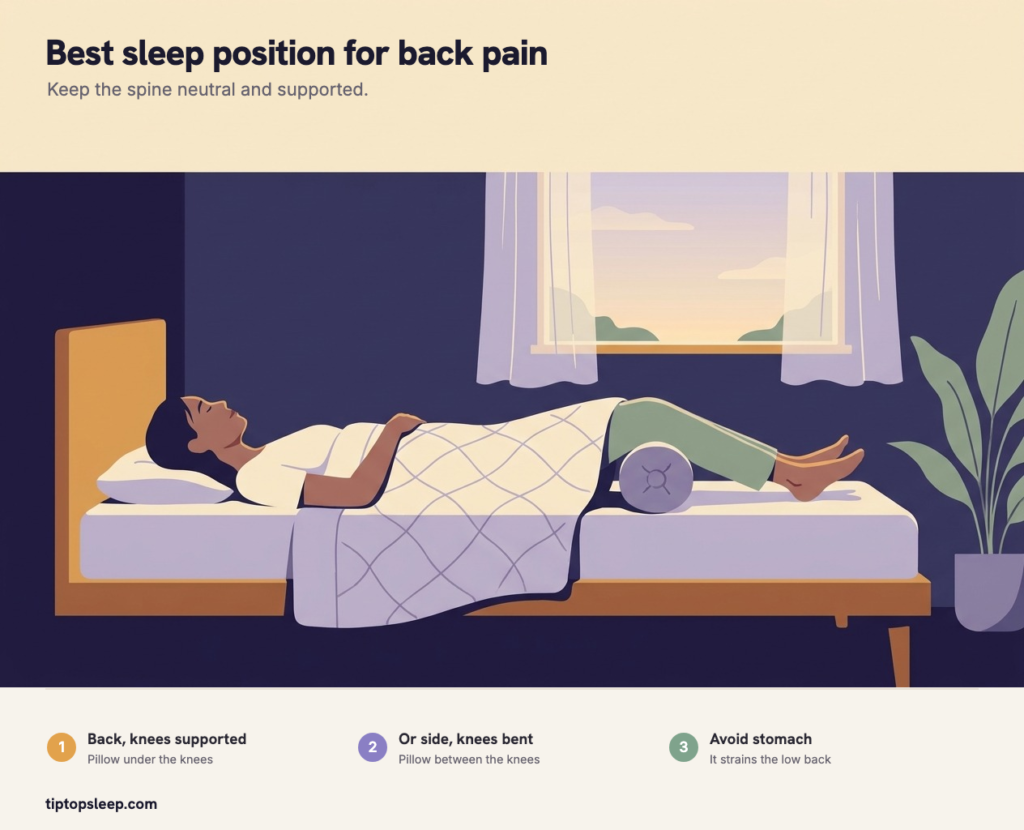
For most lower back pain, sleep on your side with a pillow between your knees, or on your back with a pillow under your knees - both keep your spine in a neutral line instead of arching your lower back. Skip stomach sleeping if you can; it flattens the natural curve in your low back and strains it overnight. A medium-firm mattress tends to suit most people with back pain best.
I've spent enough nights twisting into odd shapes trying to find a position that didn't leave my lower back aching by morning to know this isn't really about willpower - it's about geometry. Your spine has a natural curve, and certain positions hold that curve steady all night while others slowly pull it out of line. Here's what actually helps, and what I'd leave out.
What's the best sleeping position for lower back pain?
There are two positions worth trying first, and which one suits you often comes down to habit and comfort rather than one being universally "correct."
On your back, with a pillow under your knees
Lying flat on your back distributes your weight evenly across the mattress, which takes pressure off any single point along your spine. The trick is what you do with your knees. Sleep Foundation puts it plainly: "To reduce strain and support your spine, place a pillow or rolled-up towel under your knees." That small bend takes the pull off your lower back and keeps the curve where it should be, instead of letting your legs straighten out and tug your pelvis flat.
On your side, with a pillow between your knees
Side sleeping is the position most people with back pain end up gravitating toward, and there's good reason for that. Sleep Foundation notes that this posture "helps maintain the spine's natural alignment and reduces pressure on the lower back, especially when you place a pillow between your knees." Without that pillow, your top leg tends to drop forward and rotate your hips and lower spine out of alignment through the night. Cleveland Clinic makes the same point from a slightly different angle: "Placing a pillow between your legs can help prevent your upper leg from pulling forward and twisting your torso." A firm, shaped knee pillow holds that gap better than a folded regular pillow, which tends to flatten and slide by 3am.
The fetal position, for disc-related pain
If your pain feels like it's coming from a disc - sharp, sometimes shooting down a leg - curling onto your side with your knees drawn toward your chest can open the spaces between your vertebrae and ease pressure off a compressed disc. Keep the curl gentle rather than tightly tucked, and still use a pillow between your knees. Switch sides occasionally through the week so you're not loading one hip more than the other.
What sleeping position should I avoid with back pain?
Stomach sleeping is the one to be careful with. Lying face down usually forces your lower back into an arched, extended position and rotates your neck to one side for hours - both work against a sore lower back rather than for it. If it's genuinely the only position you can fall asleep in, a thin, flat pillow under your pelvis and lower abdomen reduces how far your spine arches. It's a compromise, not a fix - treat it as a stepping stone toward training yourself into back or side sleeping. Our guide to learning to sleep on your back has a gentler way to make that switch if stomach sleeping is your default.
Does mattress firmness matter for back pain?
It does, though "firmer is better" isn't quite right. A mattress that's too soft lets your hips sink and your spine sag out of alignment; one that's too hard doesn't cushion your shoulders and hips enough, which pushes your spine out of line the other way. For most people with lower back pain, a medium-firm mattress that supports the spine's curve without pressing back too hard works best. If your mattress is more than seven or eight years old and you wake up stiffer than you went to bed, that's worth looking at before anything else.
A pillow that actually holds its shape
Whichever position you land on, the pillow between or under your knees is doing real work - which is why a regular bed pillow that goes flat and slides off the mattress by midnight is frustrating. A shaped knee pillow keeps its form and stays put, so you're not waking up to reposition it every couple of hours.

ComfiLife Orthopedic Knee Pillow
A contoured memory foam wedge that holds its shape between your knees on your side, or under your knees on your back - keeps your hips and spine aligned without going flat overnight.
Want the full lineup of things that actually help you sleep better? See our Sleep Toolkit for the pillows, wedges and other gear worth having. If a rolled towel under your lower back sounds more like what you need, our best lumbar sleep roll guide covers that option too.
When lower back pain needs a doctor, not just a new pillow
Most everyday lower back pain responds to position changes and time. But some symptoms mean it's time to get checked rather than experiment further:
- Numbness, tingling, or weakness in one or both legs.
- Pain that started after a fall, accident, or other injury.
- Loss of bladder or bowel control - this needs urgent care.
- Pain that wakes you repeatedly at night or doesn't ease at all with rest.
- Fever along with back pain, or unexplained weight loss.
- Pain that's getting steadily worse over several weeks rather than settling down.
None of that is meant to alarm you - most back pain is mechanical and manageable. But those particular signs are your body asking for an exam, not just a different pillow.
If you're dealing with back pain after a specific procedure, our recovery guides for hip replacement and knee replacement cover position and timeline in more detail. And if you're simply curious why floor sleeping keeps coming up as a "fix" for back pain, we looked at the real evidence in why do Japanese sleep on the floor.
Frequently asked questions
Is it better to sleep on your back or side with lower back pain?
Both can work well. Back sleeping with a pillow under your knees keeps your spine flat and supported; side sleeping with a pillow between your knees keeps your hips and spine aligned. Try both and see which one leaves you less stiff in the morning - many people find side sleeping more naturally comfortable.
Why does stomach sleeping make back pain worse?
Lying face down tends to arch your lower back and flatten its natural curve, while also twisting your neck to one side for hours. If you can't give it up entirely, a thin pillow under your pelvis reduces how far your spine arches.
What kind of pillow should I use for lower back pain?
A firm, shaped knee pillow that holds its form works better than a regular pillow, which flattens and slips. Use it between your knees on your side, or under your knees on your back.
Should my mattress be firm or soft for back pain?
Medium-firm tends to work best for most people - firm enough to support your spine's alignment, soft enough to cushion your hips and shoulders. Very soft or very hard mattresses can both pull your spine out of a neutral line.
Related reading
- Learning to sleep on your back
- Why the Japanese sleep on the floor
- How to sleep after hip replacement surgery
- The Sleep Toolkit
Sources & review: Guidance here is general comfort information, researched against sleep position and back pain information from Sleep Foundation and Cleveland Clinic. It is not medical advice and does not replace a doctor's evaluation - if your back pain is severe, persistent, or comes with numbness or weakness, please see a healthcare provider.
📥 Free: The Post-Surgery Sleep Recovery Kit
Our 2-page PDF - the safe sleep position for your surgery, how to set up your bed, a night-by-night recovery timeline, and the red flags worth calling your doctor about. We'll email you the download link.
By subscribing you agree to our Privacy Policy.