

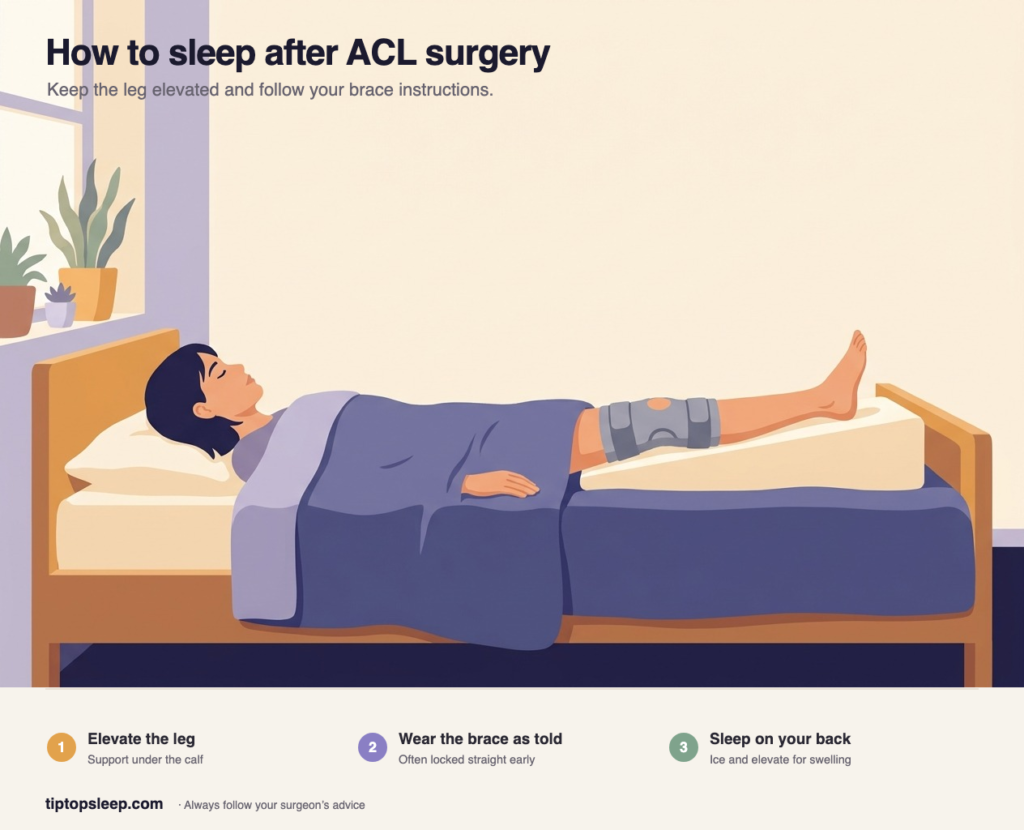
Sleep on your back with the operated leg elevated - a pillow or wedge under the calf and ankle, not under the knee - and keep wearing your knee brace exactly as your surgeon set it, including overnight if that's what you were told. Elevation controls the swelling that drives most of the early discomfort; the brace protects your new graft while it heals.
The first nights after ACL reconstruction catch a lot of people off guard - you expect the knee pain, but not the awkwardness of trying to sleep in a brace, propped up, afraid to move the wrong way. I've sat up with family through this kind of recovery, and the good news is that once you get the setup right, most of the fear melts away. Here's exactly how to do it, and why.
The best position: on your back, leg elevated, brace as directed
After ACL reconstruction, swelling is one of the biggest drivers of pain and poor sleep, and how you position the leg overnight makes a real difference to how much fluid drains away. Here's the setup:
- Lie on your back. This is the most reliable position in the early weeks, and the easiest one to keep your leg straight and elevated in.
- Raise the whole leg, not just the knee. Slide a pillow or wedge under your calf and ankle so your heel is off the mattress and the leg sits higher than your heart. As AAOS OrthoInfo notes for the post-operative course, "the knee is iced regularly to reduce swelling and pain" during the first 7 to 10 days (AAOS OrthoInfo) - elevation between ice sessions keeps that progress going through the night.
- Keep your brace on exactly as instructed. Many surgeons have patients wear a hinged knee brace locked straight for the first weeks, including at night, to protect the graft while it heals. Follow your own surgeon's settings and schedule - don't adjust the lock or timing yourself.
- Don't prop a pillow directly under the knee if you've been told to keep the leg straight. It feels tempting for comfort, but it bends the joint for hours at a time - elevate the whole leg from underneath the calf and ankle instead.
- Support your head and upper body with your usual pillows so you're not straining your neck to keep an eye on the leg all night.
ACL protocols vary quite a bit from surgeon to surgeon and depend on the graft used, so treat this as general orientation, not a substitute for your own instructions. If anything here conflicts with what your surgical team told you, theirs wins every time.
Your first weeks, night by night
Recovery isn't one fixed rule - it eases week by week as swelling settles and the graft heals. Many people notice their nights loosely follow this kind of pattern, though yours may move faster or slower:
- Days 1-3: Back-sleeping, leg elevated on a wedge or pillows under the calf, brace on as directed. This is when swelling is often at its worst, so consistent elevation and ice matter most.
- First 1-2 weeks: Still mostly on your back with the leg up, brace worn on the schedule your surgeon gave you. Many people are using crutches during the day through this stretch too.
- Weeks 2-6: As swelling and pain ease, some people find they need less elevation and start to feel more settled overnight - but the brace typically stays part of the routine until your surgeon says otherwise, sometimes several weeks in.
Positions to avoid at first
- A pillow wedged directly under the knee - if you've been told to keep the leg straight, this bends the joint for hours and works against that instruction. Elevate the calf and ankle instead.
- On your stomach - it's hard to keep the leg elevated or the brace comfortable in this position, and it can twist the knee awkwardly in your sleep.
- Adjusting or removing the brace on your own - even if it feels restrictive at night, changing the lock setting or skipping it without your surgeon's sign-off isn't a decision to make yourself.
The one thing that makes this easier
Ordinary pillows slide and flatten under a braced leg through the night, so you end up rebuilding the stack at 2am. A firm, adjustable wedge holds the elevation steady - and its shape works with a brace far better than a loose pile of pillows.

ROYALAY Leg Elevation Pillow
A firm, adjustable foam wedge raises the whole lower leg to drain swelling overnight - and its stable shape holds position better than a sliding stack of pillows while you are in a brace.
Want the full kit? See our Sleep Toolkit for the wedges, cooling packs and other helpers worth having during recovery.
When to call your surgeon
Some soreness and disrupted sleep is expected. These are not - contact your surgeon's office or seek care if you notice:
- Calf pain or swelling, especially in one leg more than the other, or chest pain or shortness of breath - these can be signs of a blood clot and need urgent attention.
- Signs of infection - fever, or redness, warmth, swelling or drainage around the incisions.
- Pain that isn't controlled by your prescribed medication, or that's getting worse rather than better.
- New numbness, tingling, or a foot that feels cold or changes color compared to the other side.
When in doubt, call. It's what your surgical team is there for.
Frequently asked questions
Do I have to wear my knee brace while sleeping after ACL surgery?
Many surgeons do have patients wear a hinged brace locked straight overnight for the first few weeks, to protect the graft while it heals. Not every protocol is the same, though - always follow the specific brace instructions your own surgeon gave you.
Should I put a pillow under my knee after ACL surgery?
Usually no, if you've been told to keep the leg straight - a pillow under the knee bends the joint for hours at a time. Elevate the whole leg instead, with support under the calf and ankle so the knee itself stays straight.
How long do I need to elevate my leg after ACL reconstruction?
Elevation matters most in the first 7 to 10 days, when swelling tends to be at its worst, and many people continue it at night for a few weeks as things settle. Let your swelling and your surgeon's guidance be the measure, not a fixed number of days.
Is it normal to have trouble sleeping after ACL surgery?
Yes - between the brace, the swelling, and getting used to a new position, disrupted sleep in the first couple of weeks is common. It typically improves as swelling goes down and you get more comfortable with the routine.
Sources & review: Guidance here is general comfort advice, researched against post-operative recovery information from AAOS OrthoInfo and Cleveland Clinic. It is not medical advice and does not replace your surgeon's instructions - always follow the specific brace, elevation and activity guidance you were given, and contact your care team with any concerns.
📥 Free: The Post-Surgery Sleep Recovery Kit
Our 2-page PDF - the safe sleep position for your surgery, how to set up your bed, a night-by-night recovery timeline, and the red flags worth calling your doctor about. We'll email you the download link.
By subscribing you agree to our Privacy Policy.