

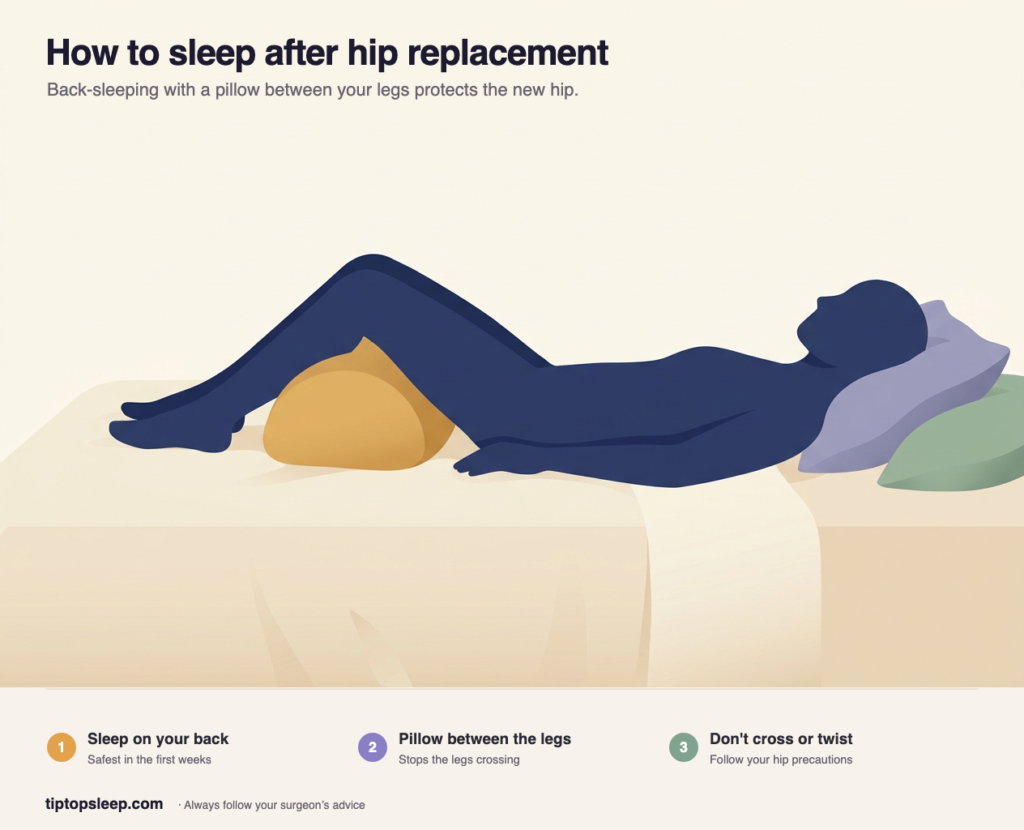
Sleep on your back with a pillow between your knees for the first several weeks after hip replacement. This keeps your legs slightly apart and stops you crossing them in your sleep. Don't cross your legs or ankles, don't bend the hip past 90°, and don't twist the operated leg inward - these protect the new joint from dislocating.
The hardest part of those first nights after a hip replacement usually isn't the incision - it's the fear of moving wrong in your sleep. I've sat up with family members who were terrified to even roll over, worried a wrong shift would undo the surgery. It won't, as long as you set your bed up properly and know the few things to avoid. Here's exactly how to sleep safely while your new hip heals.
The best position: on your back, pillow between the knees
For the first weeks, most surgeons want you sleeping flat on your back with a pillow or wedge between your legs. This keeps the operated leg from drifting inward or crossing over the other one while you're asleep and not paying attention. Here's the setup:
- Lie on your back with your body straight, not twisted toward either side.
- Place a pillow (or a contoured wedge) between your knees so your legs stay a few inches apart all night, even if you shift position.
- Support your operated leg with an extra pillow under the calf if it feels more comfortable, keeping the knee gently straight rather than pulled up toward your chest.
- Get in and out of bed on your surgical side first if that's what your physical therapist showed you, keeping the leg supported and avoiding any twisting at the hip.
Side-sleeping is usually off the table at first. When your surgeon does clear you for it, typically not for several weeks, always keep a pillow firmly between your knees so the top leg can't drop forward or inward onto the bed.
Your first weeks, night by night
Recovery timelines vary a lot by age, health, and surgical approach, so treat this as a general shape rather than a schedule. As AAOS OrthoInfo notes, "most patients should be able to do most of the 'don'ts' after 6 to 8 weeks without any impact on the implant" - and sleep precautions tend to follow that same arc:
- Days 1-7: Back-sleeping only, pillow between the knees at all times. Getting comfortable can take a few nights - keep pain relief timed to cover your longest sleep stretch, and don't be afraid to call for help getting in and out of bed.
- Weeks 2-6: Still mostly on your back for sleep. Many people find sitting up in bed and moving around gets noticeably easier during this stretch, even though the same leg precautions still apply.
- Weeks 6-8 onward: This is typically when surgeons start easing restrictions, if your recovery is on track. Some people are cleared for side-sleeping (always with a pillow between the knees) around now - but this is entirely your surgeon's call, not a fixed date.
Positions and movements to avoid
These "hip precautions" exist to stop the new joint from dislocating while the tissue around it heals. The specifics your surgeon gives you always come first, but the general rules most people are given are:
- Don't cross your legs or ankles - even briefly, and even just to get comfortable. It's an easy thing to do half-asleep, which is exactly why the pillow between your knees matters.
- Don't bend the hip past 90 degrees - avoid pulling your knee up toward your chest, curling into a tight fetal position, or sitting on very low or soft surfaces.
- Don't twist or rotate the operated leg inward - keep your toes and knee pointing forward rather than turning in, both when lying down and when changing position.
- Don't sleep on your operated side until your surgeon says it's fine to.
One important note: precautions are not identical for everyone. As AAOS OrthoInfo puts it, "both the specific precautions you need to take and the amount of time you need to follow them will vary depending on which surgical technique your surgeon used." A posterior approach (the more traditional entry point) usually comes with stricter, longer-lasting precautions, while an anterior approach often allows more movement sooner because it disturbs fewer of the muscles that stabilize the joint. Always follow the specific instructions your own surgeon gave you rather than generic advice - including this article.
The product that makes this easier
A stack of ordinary pillows works, but they flatten and slide apart through the night, which is exactly when your legs are most likely to drift together. A shaped wedge pillow holds its form and stays in place so you're not repositioning pillows at 3am.

ComfiLife Orthopedic Knee & Leg Pillow
A contoured memory-foam wedge that sits between your knees to keep your legs apart and stop them crossing - the exact positioning your surgeon wants to protect the new hip while you sleep.
Want the full kit? See our Sleep Toolkit for other helpers worth having during hip recovery.
When to call your surgeon
Some soreness and stiffness at night is expected. These signs are not, and need prompt attention:
- Signs of dislocation - sudden, severe hip pain, the leg looking shorter or turned outward, or being unable to bear weight or move the leg normally.
- Signs of infection - oozing or pus from the wound, or redness, swelling and tenderness around the hip or leg that is getting worse rather than better.
- Signs of a possible blood clot (DVT) - throbbing or cramping pain, swelling, warmth or redness in the calf or leg.
- Fever - a high temperature, or feeling hot, cold or shivery after recent surgery.
If you notice chest pain or sudden shortness of breath alongside leg swelling, treat this as an emergency and seek urgent care straight away - it can be a sign of a clot that has moved to the lungs. When in doubt about anything else, call your surgical team; that's exactly what they're there for.
Frequently asked questions
How long do I need to sleep on my back after hip replacement?
Many people are asked to sleep on their back with a pillow between their knees for the first 6 to 8 weeks, though this depends heavily on your surgical approach and your surgeon's specific instructions. Always follow the timeline you were personally given.
Can I sleep on my side after hip replacement surgery?
Only once your surgeon clears it, which is often several weeks out. When you do, keep a pillow firmly between your knees so the top leg can't drop forward or cross the bottom one.
Why can't I cross my legs after hip replacement?
Crossing your legs or ankles pulls the new hip joint into a position that raises the risk of dislocation while the surrounding tissue is still healing. A pillow between the knees is the simplest way to prevent this happening by accident while you sleep.
Do hip precautions differ depending on the type of surgery?
Yes. A posterior approach typically comes with stricter, longer-lasting precautions, while an anterior approach often allows more freedom of movement sooner because it disturbs fewer of the stabilizing muscles. Follow the specific rules your own surgeon gave you, not a generic list.
Sources & review: Guidance here is general comfort advice, researched against post-operative recovery information from AAOS OrthoInfo and the NHS. It is not medical advice and does not replace your surgeon's instructions - always follow the specific hip precautions you were given, and contact your care team with any concerns.
📥 Free: The Post-Surgery Sleep Recovery Kit
Our 2-page PDF - the safe sleep position for your surgery, how to set up your bed, a night-by-night recovery timeline, and the red flags worth calling your doctor about. We'll email you the download link.
By subscribing you agree to our Privacy Policy.