

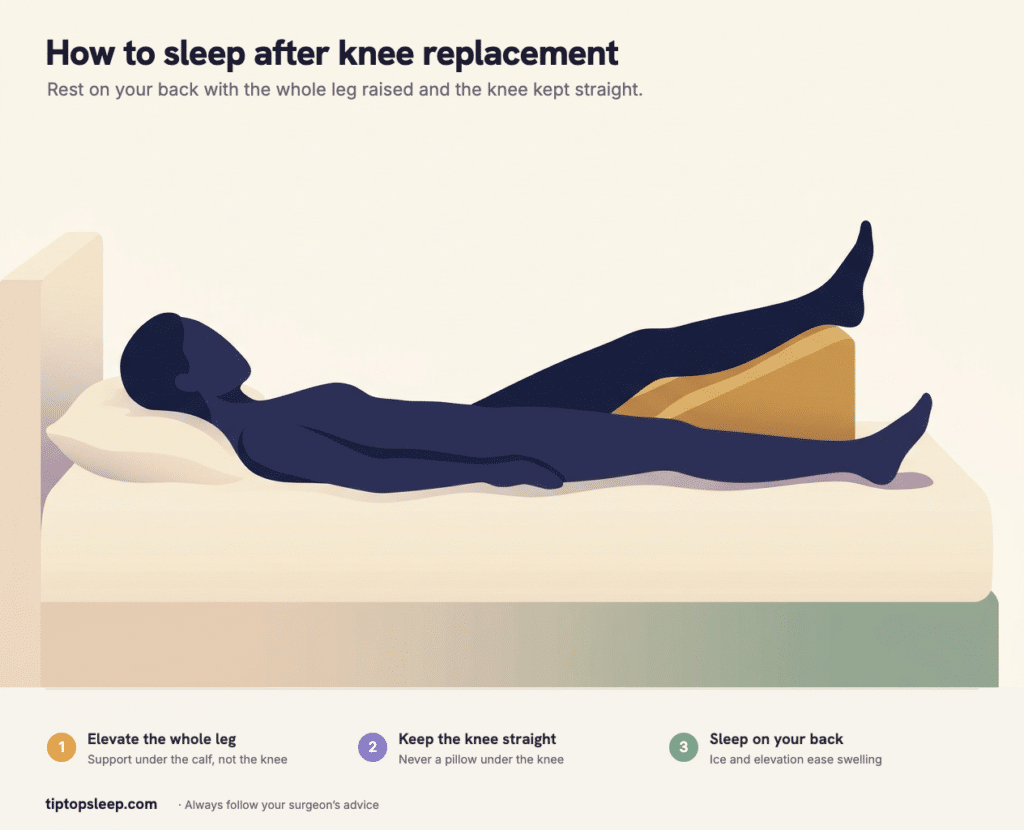
Sleep on your back with your whole operated leg raised and kept straight - a pillow or wedge under the calf and ankle, never under the knee itself. A pillow under the knee bends the joint and can stop it from fully straightening later. Elevation plus ice is what actually brings the swelling down.
The nights after a knee replacement are their own kind of strange - you're exhausted, the knee is throbbing and swollen, and every instinct says "prop it up on something soft." I've sat up with family through this exact recovery, and the one thing I wish someone had told them sooner is that where you put that pillow matters more than how many you use. Get the setup right and the swelling drains overnight instead of pooling. Here's exactly how to do it.
The best position: on your back, leg straight and elevated
After a total knee replacement, swelling is the enemy of a good recovery - it's what makes the joint stiff and painful. Elevation helps fluid drain away from the knee, but only if the leg stays straight while it does. Here's the setup:
- Lie on your back. This is the most reliable position in the first days and weeks, and the easiest to keep the leg straight in.
- Raise the whole leg, not just the knee. Slide a pillow or wedge under your calf and ankle so the heel is off the mattress and the leg is higher than your heart.
- Never put anything directly under the knee itself. This is the one detail that trips people up - it feels comfortable in the moment, but it holds the joint in a bent position for hours at a time.
- Keep the knee as straight as you comfortably can while it's elevated. Your surgeon or physical therapist may have you doing straight-leg exercises during the day for the same reason.
- Add ice on top of or alongside the elevation, as your surgical team recommends, to help bring swelling down further.
It's worth repeating, because it's the single most important thing in this whole article: a pillow tucked under the knee bends it. Held that way night after night, it can contribute to a flexion contracture - a knee that won't straighten all the way. Elevate the leg, not the bend.
Your first weeks, night by night
Every recovery moves at its own pace, and your surgeon's instructions always come first - but many people find their nights follow a broad pattern. As AAOS OrthoInfo notes, swelling and soreness after exercise or activity can happen in early recovery, and can be relieved by "elevating your leg and applying an ice pack or ice wrapped in a towel" (AAOS OrthoInfo).
- Days 1-3: Back-sleeping, leg elevated and straight, ice close by. Swelling is usually at its worst here, so keep the leg up as much as you're able even during the day.
- First few weeks: Still mostly on your back with the leg elevated, though many people need it less through the night as swelling settles. The NHS advises to "keep your leg raised as much as possible to reduce swelling" through this stretch of recovery.
- Once your surgeon gives the go-ahead: Some people move to gentle side-sleeping, with a pillow between the knees to keep the new joint aligned and comfortable. Don't rush this - ask at a follow-up appointment if you're unsure.
Positions to avoid at first
- A pillow directly under the knee - the single thing to avoid. It bends the joint and works against everything your surgical team is trying to achieve with your range of motion.
- Sitting or lying with legs crossed. The NHS specifically advises patients "do not sit with your legs crossed for the first 6 weeks" after knee replacement.
- On your stomach - hard to keep the knee straight and elevated in this position, and awkward on a fresh incision.
- Side-sleeping before your surgeon has cleared it - it's easy to let the top leg roll forward and bend the new knee without realizing it.
The one thing that makes this easier
You can stack ordinary pillows under your calf, but they flatten and slide out of place by 2am, and it's tempting to just wedge one under the knee instead - exactly what you don't want. A firm, adjustable wedge holds the whole leg up at the right height and keeps the knee out of the equation entirely.

ROYALAY Leg Elevation Pillow
A firm, adjustable-height foam wedge that raises the whole lower leg and keeps the knee straight - exactly what a new knee needs to drain swelling overnight without bending the joint.
Want the full kit? See our Sleep Toolkit for the cooling pads, wedges and other helpers worth having during recovery.
When to call your surgeon
Soreness, stiffness and swelling are all a normal part of this recovery. These are not - contact your surgical team or seek care if you notice:
- Signs of infection: a persistent fever, or increasing redness, tenderness, swelling or drainage from the knee wound.
- Signs of a blood clot (DVT): increasing pain in your calf, tenderness or redness above or below the knee, or new or increasing swelling in your calf, ankle or foot.
- Signs of a clot that has moved to the lungs: sudden shortness of breath, sudden chest pain, or chest pain that gets worse when you cough - these need urgent medical attention.
- Pain that is getting worse rather than better, or isn't controlled by your medication.
When in doubt, call. It's what your surgical team is there for.
Frequently asked questions
Why can't I put a pillow under my knee after knee replacement?
Because it bends the joint. Held in a bent position for hours every night, this can work against your range-of-motion progress and, over time, contribute to a knee that won't fully straighten (a flexion contracture). Elevate the calf and ankle instead, keeping the knee itself straight.
How do I elevate my leg properly after knee surgery?
Lie on your back and support your calf and ankle on a pillow or wedge so the whole leg is raised above the level of your heart, with the knee kept as straight as is comfortable. The goal is to let swelling drain away from the joint, not to prop the knee itself up on anything.
Can I sleep on my side after a knee replacement?
Many people can, once their surgeon gives the go-ahead - usually with a pillow between the knees to keep the new joint supported and aligned. Ask at a follow-up appointment if you're not sure it's time yet.
How long will swelling keep me up at night?
It varies person to person, but many people find the first couple of weeks are the most disruptive, easing gradually as recovery progresses. Consistent elevation, ice, and following your surgeon's exercise plan all help it settle faster.
Sources & review: Guidance here is general comfort advice, researched against post-operative recovery information from the NHS and AAOS OrthoInfo. It is not medical advice and does not replace your surgeon's instructions - always follow the specific guidance you were given, and contact your care team with any concerns.
📥 Free: The Post-Surgery Sleep Recovery Kit
Our 2-page PDF - the safe sleep position for your surgery, how to set up your bed, a night-by-night recovery timeline, and the red flags worth calling your doctor about. We'll email you the download link.
By subscribing you agree to our Privacy Policy.