

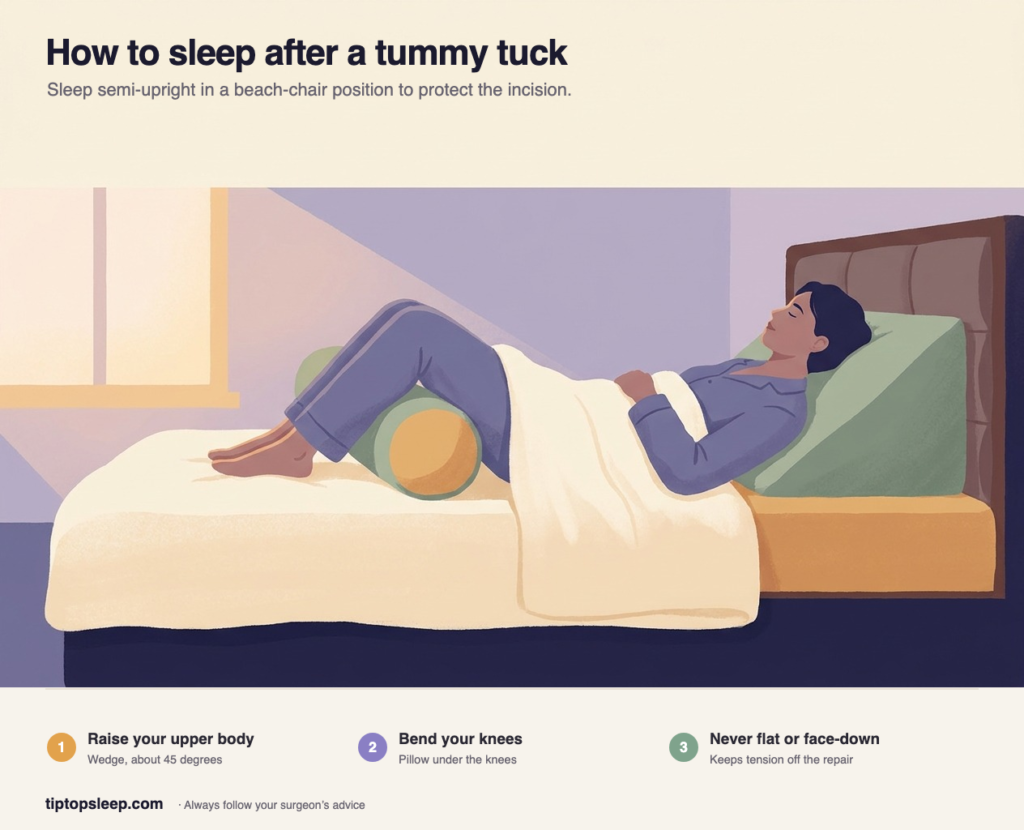
Sleep on your back in a "beach chair" position - upper body raised about 45°, knees bent and supported on a pillow. This keeps tension off your abdominal incision and the tightened muscles underneath. Don't lie flat, on your stomach, or on your side for the first few weeks; most people ease out of the semi-reclined position gradually over 2-4 weeks.
Of all the recoveries I've talked friends through, tummy tuck nights are some of the trickiest to get right, because it isn't just an incision you're protecting - it's a repair. Many tummy tucks stitch the abdominal muscles back together in the middle, and that repair pulls if you straighten out too soon or roll onto your front. I've sat with a friend propped up on the sofa at 3am because lying in bed felt impossible, and the fix was simpler than either of us expected: the right angle, and knees that stay bent. Here's exactly how to set it up.
The best position: back-sleeping in a "beach chair" recline
After abdominoplasty, your surgeon has usually done two things: removed excess skin and fat, and tightened (plicated) the abdominal wall muscles with internal stitches. That muscle repair is under some tension for weeks, and straightening your torso fully pulls on it. Sleeping on your back, upper body raised, hips and knees gently bent - sometimes called the semi-Fowler or "beach chair" position - keeps everything slack instead of stretched. Here's the setup:
- Raise your upper body to about 45°. A wedge pillow or adjustable bed base holds the angle better than a stack of ordinary pillows, which flatten and slide by 2am.
- Bend your knees and support them with a pillow or wedge underneath. This tilts your hips forward slightly, which is what actually takes the pull off your abdomen - resting at an angle like this for the first days, rather than lying flat, is standard plastic-surgery recovery advice, and the bent-knee part matters just as much as the raised upper body.
- Keep your neck supported with a normal pillow so your chin isn't tucked down toward your chest all night.
Getting in and out of bed matters too. Don't do a straight sit-up from flat on your back - it uses exactly the muscles you're trying to protect. Instead, roll onto your side first, then push yourself up with your arms while your legs swing off the bed. Many people also find they stand and walk slightly bent forward at the waist for the first stretch of recovery; that's normal, and you shouldn't force yourself upright before your body is ready.
Your first weeks, night by night
Recovery loosens gradually, not all at once, and sleep tends to follow the same curve as everything else. Cleveland Clinic explains that "it could take up to three months to see the final result," though day-to-day comfort improves much sooner than that:
- Days 1-7: Sleep fully reclined and propped, knees bent, most or all of the night. This is also when compression garments and any drains are typically still in place, so movement is slow and deliberate.
- Weeks 2-4: Many people gradually lower the incline as the muscle repair settles and discomfort eases, but stay on your back with knees at least a little bent.
- Weeks 4-6 and beyond: Most people can start easing flatter and, eventually, back to their normal sleep position, guided by their surgeon and by how the abdomen actually feels - not by the calendar alone.
Positions to avoid at first
- Flat on your back with no incline - straightens the torso fully and pulls directly on the muscle repair.
- On your stomach - puts direct pressure on the incision and the repair; avoid this until you're well healed, often several weeks out.
- On your side - tends to let the torso twist and the hips drop out of the supported, slightly-flexed position; most surgeons prefer strict back-sleeping in the early weeks.
- Sudden straightening - reaching overhead, twisting to grab something off a nightstand, or sitting straight up all load the same repair. Move slowly and deliberately, especially half-asleep.
The one thing that makes this easier
You can prop yourself up with ordinary pillows, but they compress and shift through the night, and you end up rebuilding the stack at 3am. A dedicated wedge set that supports both the back and the knees holds the beach-chair angle without the readjusting.

Ahpmeoa 3-Piece Bed Wedge Pillow Set
A back-plus-knee wedge set builds the exact beach-chair position surgeons ask for after a tummy tuck - upper body raised and knees supported - so your abdomen stays relaxed and slightly bent all night.
Want the full kit? See our Sleep Toolkit for wedge options, cooling pads and the other small things that make recovery nights easier.
When to call your surgeon
Some soreness and trouble getting comfortable is expected. These signs are not - contact your surgeon promptly, or seek urgent care, if you notice:
- Signs of infection: fever, spreading redness, warmth, or pus draining from an incision.
- A firm, swollen area near the incision that feels like a fluid pocket (a seroma) rather than ordinary post-surgical swelling.
- Calf pain, swelling, or tenderness in one leg - a possible sign of a blood clot.
- Chest pain, shortness of breath, or a racing heartbeat - seek emergency care immediately, as this can signal a clot that has moved to the lungs.
- Pain that keeps getting worse instead of easing, or bleeding that doesn't stop.
Cleveland Clinic advises patients to "contact a healthcare provider right away if you experience complications after surgery, like: severe pain, excessive bleeding, swelling, fluid or pus leaking from an incision site." When in doubt, call - your surgical team would rather hear from you unnecessarily than miss something real.
Frequently asked questions
How long do I need to sleep in a reclined position after a tummy tuck?
Most people stay propped up with bent knees for at least the first one to two weeks, then gradually lower the incline over the following weeks as the muscle repair settles. Your surgeon will guide the exact pace for your case.
Can I sleep on my side after a tummy tuck?
Usually not in the early weeks - side-sleeping lets the torso twist and the hips drop out of the supported position. Most surgeons ask patients to stay on their back, reclined, until cleared to change position.
Why do I need to bend my knees, not just raise my upper body?
Raising your upper body alone still lets your hips and torso straighten out. Bending your knees tilts the pelvis and takes additional tension off the abdominal wall repair, which is why both parts of the beach-chair position matter together.
What pillow setup is best after a tummy tuck?
A firm wedge to raise your upper body to about 45°, plus a wedge or pillow under your knees. Together they hold the angle steady through the night instead of flattening like a stack of regular pillows.
Sources & review: Guidance here is general comfort information, researched against post-operative recovery information from the American Society of Plastic Surgeons and Cleveland Clinic. It is not medical advice and does not replace your surgeon's instructions - always follow the specific guidance you were given, and contact your care team with any concerns.
📥 Free: The Post-Surgery Sleep Recovery Kit
Our 2-page PDF - the safe sleep position for your surgery, how to set up your bed, a night-by-night recovery timeline, and the red flags worth calling your doctor about. We'll email you the download link.
By subscribing you agree to our Privacy Policy.