

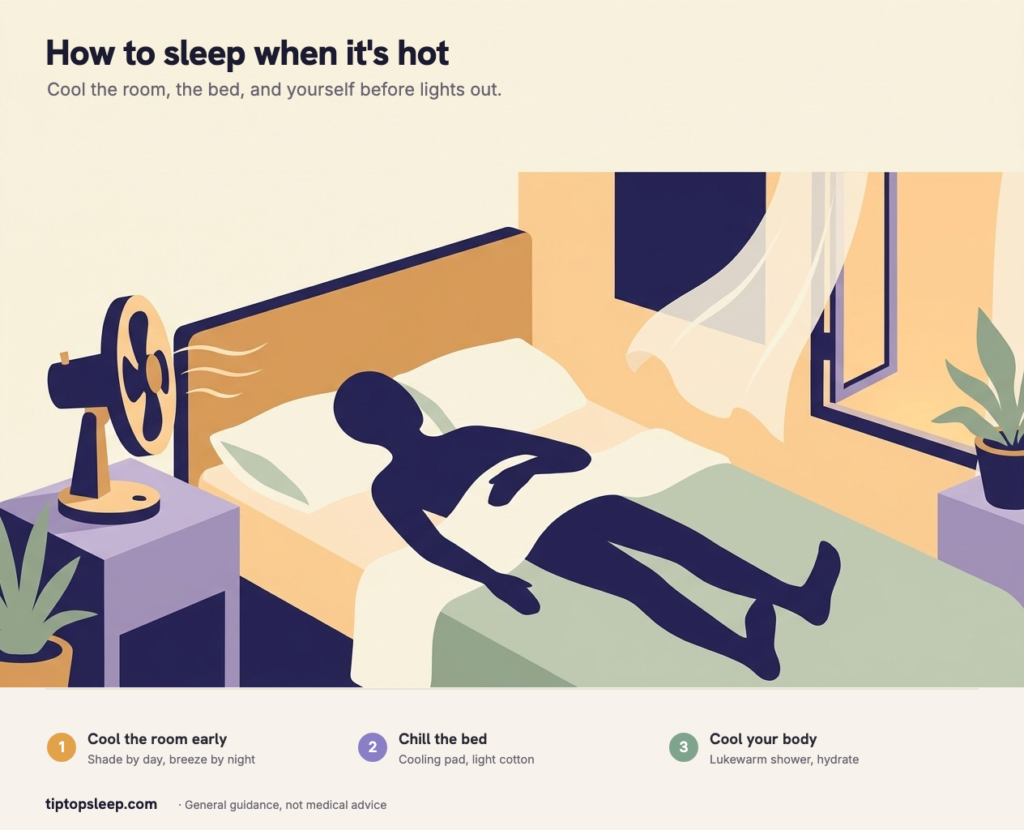
To sleep in the heat, focus on the room, then the bed, then your body. Keep curtains and blinds closed during the day to block the sun, then open windows at night for a cross-breeze; use a fan rather than fighting the heat with willpower. Switch to light cotton or linen bedding, take a lukewarm (not ice-cold) shower before bed, and keep sipping water through the day rather than gulping it right before you lie down.
Some of the worst nights I've ever had weren't after surgery or with a snoring husband next to me - they were flat on my back in July with the sheets stuck to me, wide awake wondering why lying still felt like hard work. Heat does something sleep-specific to your body, and once you understand what, it's much easier to work around it. Here's what actually helps, in the order I'd do it myself.
Why heat makes sleep so hard
To fall asleep, your core body temperature needs to drop by roughly a degree or two - part of the same internal signal that tells your brain it's time to wind down, alongside dimming light and melatonin release. A hot room or a hot bed fights that process directly - your body is trying to cool down and the environment won't let it. As the Sleep Foundation puts it, "a bedroom that is too warm can interfere with the body's thermoregulation abilities and cause fatigue," and it also cuts into deep and REM sleep, which is why a hot night leaves you groggy the next day even if you technically got your hours in.
What actually works
I think of this in three layers - the room, the bed, then your own body. Do them roughly in that order and each one takes a bit more of the heat off.
1. Cool the room
- Shut out the sun in the day. Close curtains and blinds on any window that gets direct light - it's far easier to keep heat out than to remove it once it's in the walls.
- Open up at night. Once the outside temperature drops below the inside one, open windows on opposite sides of the room (or the house) to create a cross-breeze.
- Use a fan. Moving air feels cooler even at the same temperature, because it helps sweat evaporate. A bowl of ice or a frozen bottle placed in front of the fan gives a small extra chill as the air passes over it - it's not dramatic, but on a bad night every degree counts.
2. Cool the bed
- Switch to breathable bedding. Light cotton or linen sheets breathe far better than synthetic or heavy blends, which trap heat and moisture against your skin.
- Try a cooling pad. A gel pad or cooling mattress topper gives you a genuinely cool spot to lie on without any power or plumbing involved.
- Give yourself space. On the hottest nights, sleeping apart from a partner (or just spreading out further) means less shared body heat under the sheets.
3. Cool your body
- Take a lukewarm shower before bed, not a cold one. An ice-cold shower can make your body work harder to warm back up afterwards, which defeats the point. Lukewarm water cools your skin without triggering that rebound.
- Use a damp cloth on your wrists, neck and feet. These are pulse points where blood sits close to the skin, so cooling them cools you faster than most other spots.
- Wear light cotton nightwear, or none at all. Less fabric means less trapped heat.
- Stay hydrated through the day, then ease off before bed. Keep drinking steadily from morning onward so you're not dehydrated by evening, but slow down in the hour before sleep so you're not up for the bathroom all night.
- Keep your normal wind-down. Heat is disruptive enough without also skipping the routine that tells your brain it's bedtime.
Your evening, hour by hour
A hot day doesn't have to mean a hot night if you get ahead of it early. The NHS heatwave guidance is genuinely useful here: "Close windows, curtains and blinds during the day and open them at night when the temperature outside has gone down."
- During the day: Keep curtains and blinds closed on sunny windows. Don't open the house up "for air" while it's hotter outside than in - you'll just let more heat in.
- Evening: Once it's cooler outside than in, open windows for a cross-breeze. Switch on a fan, and change into or lay out breathable cotton nightwear and sheets.
- At bedtime: Lukewarm shower, damp cloth on wrists and neck if you're still warm, a last small sip of water, then your normal wind-down routine.
Your hot-night kit
You're attacking heat on three fronts: the air, the bed, and your own body. One inexpensive item for each does most of the work.

Quilo Quiet Tower Fan
Moving air helps sweat evaporate and pushes heat away from the bed - the single most effective cheap fix. Set it for a cross-breeze from an open window once the outside air has cooled.

Cooling Gel Pad for Sleep
A gel cooling pad gives you an instantly cool spot on the bed with no power or refrigeration - the simplest way to take the edge off a hot mattress on the worst nights.

Chill Core Cooling Pillow
A hot pillow keeps your head and neck warm all night. A cooling pillow gives you a cool side to flip to - a small thing that makes a surprising difference when you're trying to drop off.
For more gear that actually earns its place on a hot night, see our Sleep Toolkit.
Common mistakes
- Taking an ice-cold shower right before bed. It feels good for a moment, but a shock of cold can make your body generate heat to compensate afterwards. Lukewarm works better.
- Not drinking enough water during the day. Being dehydrated makes it harder for your body to regulate its own temperature.
- Shutting the house up tight at night "to be safe." If it's actually cooler outside than in, keeping windows closed traps the day's heat indoors with you.
- Cranking a fan directly onto your face all night. It can dry out your eyes and throat - angle it across the room instead.
Frequently asked questions
What temperature is best for sleeping?
Sleep researchers generally point to a cool bedroom, well below normal daytime room temperature, as best for sleep. You don't need a thermometer to act on this though - if the room feels warm to you when you lie down, it's worth cooling before bed rather than after.
Does sleeping with a fan on actually help?
Yes - moving air helps sweat evaporate off your skin, which cools you even when the air temperature itself hasn't changed. It's one of the simplest, cheapest tools for a hot night.
Should I take a cold shower before bed when it's hot?
A lukewarm shower is usually better than an ice-cold one. Very cold water can make your body work to warm itself back up shortly after, which can undo the cooling effect just as you're trying to fall asleep.
When does hot weather stop being a sleep problem and become a health risk?
If you or someone else feels unwell with a high temperature, dizziness, or nausea during hot weather, that's beyond a sleep-comfort issue - see the safety note below and get help if symptoms don't improve.
Sources & review: Guidance here is general comfort advice, researched against the NHS heatwave guide, the Sleep Foundation, and the NHS on heat exhaustion and heatstroke. In a real heatwave, watch for signs of heat exhaustion or heatstroke - dizziness, nausea, a very high temperature, or hot skin without sweating - and check on anyone more at risk, including older people, babies and young children, and anyone with a long-term health condition. It is not medical advice and does not replace guidance from a doctor - always seek urgent help if symptoms are severe or don't improve.
📥 Free: The Post-Surgery Sleep Recovery Kit
Our 2-page PDF - the safe sleep position for your surgery, how to set up your bed, a night-by-night recovery timeline, and the red flags worth calling your doctor about. We'll email you the download link.
By subscribing you agree to our Privacy Policy.