

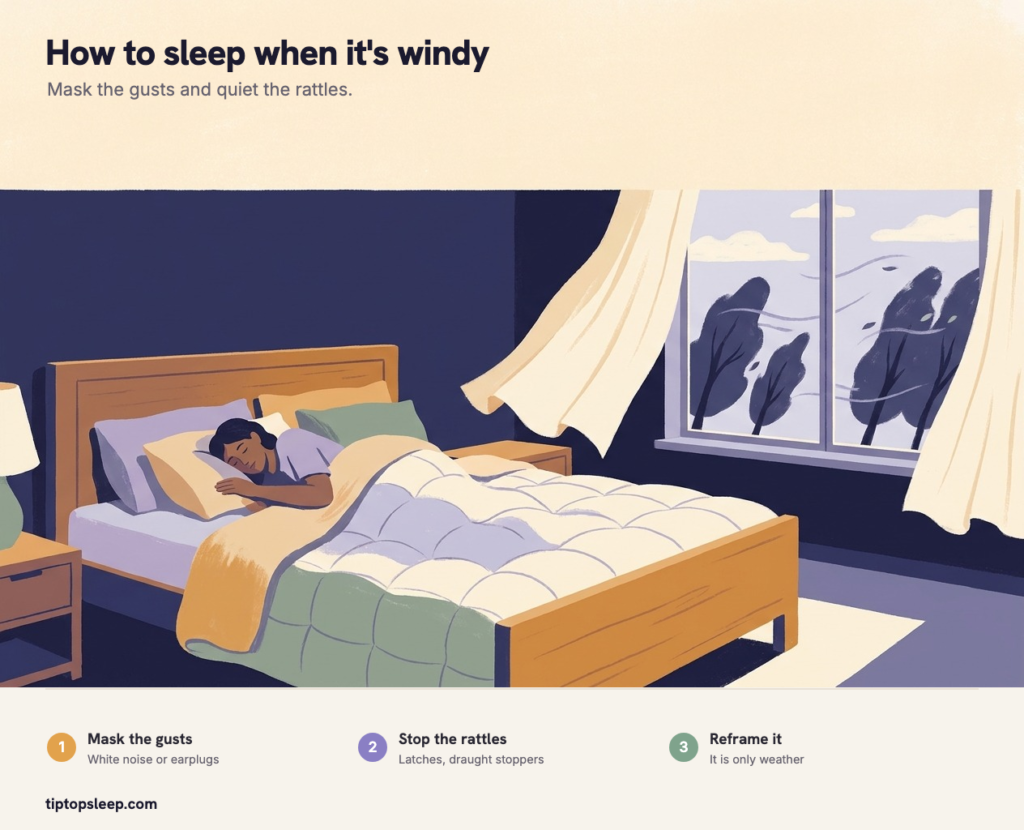
Windy nights keep you awake because the noise is irregular - gusts, lulls, rattles and whistles your brain can't predict, so it stays half-alert listening for the next one. The fix is to cover that unpredictable noise with a steady sound (a fan, white noise or brown noise), stop the rattles at the source with a draught stopper and secure windows, close the curtains, and remind yourself it's just weather. It's the same approach that works for sleeping through a thunderstorm.
I live somewhere the wind properly gets going a few nights a year, and I know the exact feeling: you're drifting off, and then a gust hits the house and every loose thing in it rattles at once. It's not really about volume - a wound-up wind isn't necessarily louder than traffic - it's that you never know when the next gust is coming. Here's what actually settles that down.
Why does wind make it so hard to sleep?
Wind noise is unpredictable, and unpredictable noise is what keeps a brain on alert, even when you're not consciously scared of it. A gust rises, drops, comes back stronger, stops - there's no rhythm to settle into the way there is with rain or traffic. On top of that, wind rattles the things around your house: a loose window, a door that isn't quite latched, a gutter, a branch against the siding. Each rattle is a fresh, sharp sound your brain has to evaluate. And for some people there's a layer of real worry underneath it too - about storm damage, about what's outside, about whether that branch is going to come down. All of that adds up to lying there listening instead of sleeping, which is exhausting in its own right even before you factor in the actual sleep you're losing.
What actually helps you sleep through a windy night?
The core idea is masking, not silence. You can't make the wind stop, but you can cover its unpredictable peaks with a sound that doesn't change - so your brain has something steady to settle into instead of something it has to keep monitoring. The Sleep Foundation explains the theory behind this directly: "Researchers are hopeful that the steady hum of white noise might reduce a sleeper's sensitivity to unpredictable noises from the environment." That's exactly the problem a windy night creates, and exactly why masking works better than trying to will yourself to ignore it.
- Run a fan or a white/brown noise machine. A steady mechanical hum is the simplest fix in the house - it fills the room with a constant sound that makes gusts less jarring by comparison. Brown noise (deeper, less hissy than white noise) is worth trying if wind itself already has a low rumble to it; some people find it blends in rather than competing.
- Wear soft earplugs. If a fan alone doesn't cut it, or you don't want the airflow, a comfortable pair of earplugs takes the edge off both the steady noise and the sudden gusts. This is the same strategy I'd point you to for sleeping through a thunderstorm - block what you can, mask the rest.
- Stop the rattles at the source. A cheap draught stopper along a rattly door, weatherstripping on a window that whistles, and making sure every window is properly latched (not just closed) removes a big chunk of the noise before it even starts. If you know which window or door does it every time you get wind, that's the one to fix first.
- Close heavy curtains. Beyond blocking light, curtains add a bit of sound dampening against whistling draughts and muffle the sense of movement outside, which helps psychologically as much as acoustically.
- Move to a quieter room if it's bad enough. If one side of the house catches the wind and another doesn't, a night on the sofa in a calmer room isn't giving up - it's just picking the option that lets you actually sleep.
What if it's not just the noise, it's the worry?
Some people aren't kept up by the sound so much as the thought behind it - is something going to blow over, is the roof okay, is a tree going to come down. If that's you, do a genuinely quick check before bed rather than lying there running through it: glance at the forecast so you know roughly what you're dealing with, make sure loose garden items are put away or secured, and then let that be enough. Reminding yourself "it's just weather, the house has handled this before" sounds simple, but naming the worry and closing the loop on it is often what lets your body actually stand down. If the anxiety is a regular pattern on windy nights rather than a one-off, it's worth treating it the same way you'd treat any pre-sleep anxiety - a short wind-down routine, dim lights, and something calming (reading, quiet music) in the half hour before bed, same as I'd suggest for a thunderstorm night.
The one thing that makes this easier
Of everything here, a steady masking sound does the most work for the least effort. You can use a bedroom fan you already own, but if you want something more portable and controllable, a dedicated white noise machine or a solid pair of sleep earplugs both do the job well and travel easily if you're somewhere without a fan.

Loop Quiet 2 Reusable Earplugs
Soft, low-profile earplugs comfortable enough for side-sleeping, which makes them an easy backup for a gusty night when a fan alone isn't quite enough. Small enough to keep in a bedside drawer for whenever the forecast turns.
Want the rest of what I'd pack for a noisy night, storm or otherwise? See the full Sleep Toolkit for the masks, sound machines and other gear worth having.
Frequently asked questions
Why does wind wake me up more than other noise?
Because it's irregular. Steady sounds like traffic hum or rain are easier for your brain to tune out, but wind rises, drops and gusts unpredictably, along with rattles from doors and windows, so your brain keeps checking in on it instead of settling.
Does white noise actually work for wind?
Yes, for most people - the idea is to mask the unpredictable gusts with a sound that stays constant, so there's less contrast for your brain to react to. A fan, white noise machine or brown noise all work on the same principle.
Should I sleep with earplugs on a windy night?
It's a reasonable option, especially if a fan or sound machine isn't cutting the noise down enough on its own. Soft, reusable earplugs are more comfortable for a full night than foam ones from a drawer.
How do I stop my windows and doors from rattling?
A draught stopper along the bottom of a rattly door, weatherstripping around a whistling window frame, and checking that windows are properly latched (not just pushed shut) fix most of the noise at the source.
Related reading
- How to Sleep Through a Thunderstorm
- What Is the Best Color Noise for Sleep?
- How to Sleep in a Noisy Hospital
- Sleep Toolkit - the gear worth having
Sources & review: Guidance here is researched against the Sleep Foundation's research on white noise and sound masking. It is general information, not medical advice, and doesn't replace guidance from your own doctor if noise-related sleep loss or anxiety is a regular, ongoing problem for you.
📥 Free: The Post-Surgery Sleep Recovery Kit
Our 2-page PDF - the safe sleep position for your surgery, how to set up your bed, a night-by-night recovery timeline, and the red flags worth calling your doctor about. We'll email you the download link.
By subscribing you agree to our Privacy Policy.