

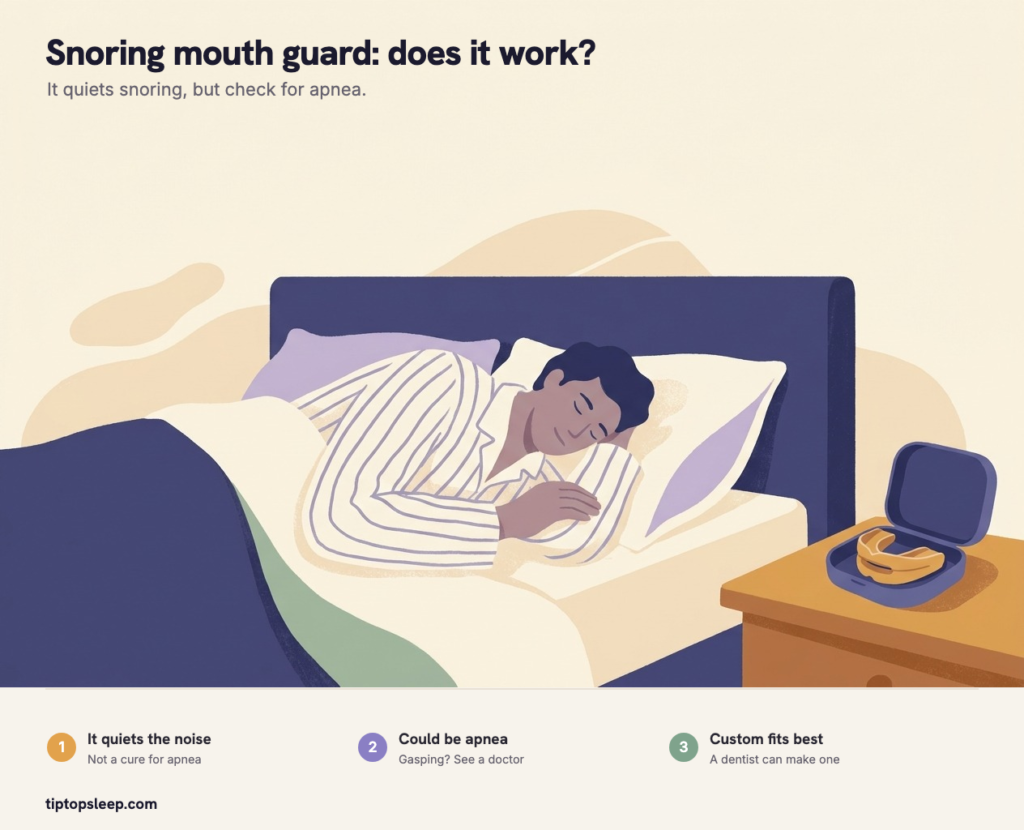
An anti-snore mouth guard (mandibular advancement device) holds your lower jaw slightly forward while you sleep, which opens the airway and reduces the tissue vibration that causes snoring. Boil-and-bite versions from the drugstore or Amazon work for simple, occasional snoring - but they treat the noise, not a diagnosis. If your snoring comes with gasping, choking, long pauses in breathing, or daytime exhaustion, that's a different problem, and it needs a doctor before it needs a mouthpiece.
My husband snored for eighteen years before anyone used the word "apnea" out loud. I mention that every time I write about snoring, because it's the thing I wish someone had told us early: not all snoring is the same, and a mouth guard is the right answer to some of it and the wrong answer to the rest. Let's sort out which is which before we talk about the device itself.
How does a snoring mouthpiece actually work?
Most over-the-counter anti-snore mouthpieces fall into one of two categories:
- Mandibular advancement devices (MADs). The Sleep Foundation describes these plainly: they "work by holding the lower jaw forward. Many are adjustable so that you can find a more comfortable and effective fit." Moving the jaw forward pulls the base of the tongue and surrounding soft tissue away from the back of the throat, which leaves more room for air to pass through without the flutter that makes the snoring sound.
- Tongue-retaining devices. These work differently - the Sleep Foundation notes they "help hold the tongue in place so that it does not slide back toward your throat" using gentle suction rather than repositioning the jaw. They tend to suit people whose snoring is mainly tongue-related, or who can't tolerate something wrapped around their teeth.
Both approaches target the same mechanical problem: soft tissue collapsing into the airway as your muscles relax overnight. The NHS explains the root cause simply: "Snoring is caused by things such as your tongue, mouth, throat or airways in your nose vibrating as you breathe." A mouthpiece doesn't fix that tissue - it just repositions things so the vibration has less room to happen.
Snoring or sleep apnea? This is the part not to skip
This is the single most important section on this page, so I'm not going to bury it. Simple snoring and obstructive sleep apnea (OSA) can sound identical from across the room, and only one of them is safely treated with a drugstore mouthpiece.
The NHS lists the warning signs plainly: get checked if "you feel sleepy during the day, your breathing stops and starts while you sleep, or you make gasping or choking noises while you sleep." The Sleep Foundation echoes this, flagging "snoring with gasping, choking, or snorting sounds" as a reason to see a doctor, alongside daytime drowsiness that doesn't improve with more time in bed.
If any of that sounds familiar - to you or to whoever elbows you at 2am - the right first step isn't a better mouthpiece, it's a conversation with your doctor about a sleep study. I've written more about what that experience is actually like in what it's like to live with obstructive sleep apnea, and about the diagnosed condition itself in our sleep apnea guide. An OTC anti-snore mouthpiece is a comfort product for noise. It is not a diagnosis, and it's not a substitute for one.
Who does an OTC mouthpiece actually help?
Boil-and-bite mouthpieces tend to work best for what sleep specialists call primary or simple snoring - snoring without the breathing pauses above. In practice, that usually means:
- Positional snorers whose snoring is worse on their back, where gravity lets the jaw and tongue drift backward.
- Mouth breathers whose snoring gets louder when nasal congestion or habit pushes them to breathe through an open mouth.
- People with a naturally recessed jaw or narrow airway, where a small forward shift makes a noticeable difference.
- Occasional snorers - after a late night, a few drinks, or a cold - who want something to try before assuming it's a bigger problem.
If you snore heavily every night regardless of position, or your partner has ever timed a pause in your breathing, an OTC device isn't the right starting point - a medical evaluation is.
Boil-and-bite vs a custom dentist-made device: what's the difference?
- Boil-and-bite (OTC). You soften the mouthpiece in hot water and bite down to create a rough mold of your teeth. Affordable, available same-day, and reasonable for a first trial - but the fit is approximate, and it can feel bulky until you get used to it.
- Custom dentist-fitted MAD. A dentist trained in sleep medicine takes an impression of your teeth and has a lab build a device to that exact mold, with the jaw advancement calibrated for you. This is the version typically prescribed for diagnosed mild-to-moderate OSA, not just snoring. The Sleep Foundation notes that "custom-fitted oral appliances are often a suitable alternative for OSA patients who cannot tolerate CPAP," and that mandibular advancement devices "have been shown to be effective in treating snoring and mild to moderate OSA." That's the medical-grade version of the same idea - built and monitored by a professional, for a diagnosed condition.
If you've already been diagnosed with OSA, the OTC route isn't the move - talk to your doctor or a dentist who specializes in sleep medicine about a custom device or another CPAP alternative.

ZQuiet Anti-Snoring Mouthpiece Starter Pack
This is a comfort trial for simple snoring, not a treatment for sleep apnea. What I like about ZQuiet for a first attempt is that it skips the boiling step - you wear it straight out of the box, and it comes with two jaw-advancement sizes so you can find which one actually quiets things down without feeling like you're clenching all night. The open-front hinge also lets you breathe through your mouth and swallow normally, which is where a lot of cheaper mouthpieces fail. If you already know or suspect you have sleep apnea, skip this and talk to your doctor instead.
Want more of what's actually worth having on your nightstand? Our Sleep Toolkit rounds up the gear we trust for specific sleep problems like this one.
What are the downsides and side effects?
- Jaw soreness or fatigue, especially in the first week or two while your muscles adjust to holding a slightly forward position all night.
- Excess drooling is common early on and usually settles as your mouth adapts to sleeping with something in it.
- Bite changes over time. Long-term, nightly use of any mandibular device can gradually shift tooth position or bite alignment - this is one reason dentist-supervised use includes periodic check-ins.
- Not a fit for everyone. If you have significant dental work (crowns, bridges, loose teeth), gum disease, or a TMJ (jaw joint) disorder, a forward-holding device can make things worse rather than better - check with your dentist before trying one.
None of this is a reason to avoid a mouthpiece if simple snoring is genuinely your problem. It's a reason to treat it like the medical-adjacent device it is - not a novelty item.
Frequently asked questions
Can a mouth guard cure sleep apnea?
An over-the-counter mouth guard is not a treatment for diagnosed sleep apnea. Custom dentist-fitted mandibular advancement devices can help mild to moderate OSA under medical supervision, but that's a different product with a different level of oversight than a drugstore mouthpiece.
How long does it take to get used to an anti-snore mouthpiece?
Most people need one to two weeks of nightly use before it stops feeling strange. Some jaw soreness or excess saliva in the first few nights is common and usually fades as you adjust.
Do anti-snoring mouthpieces actually work?
For simple or positional snoring, mandibular advancement devices can meaningfully reduce or quiet snoring by holding the jaw forward and keeping the airway more open. They're less predictable for snoring linked to nasal congestion, alcohol, or undiagnosed sleep apnea.
What if the mouthpiece doesn't stop my snoring?
If a properly fitted device doesn't help after a couple of weeks, that's worth mentioning to a doctor rather than just trying a stronger one. Persistent, unresponsive snoring - especially with gasping, choking, or daytime sleepiness - is a signal to rule out sleep apnea, not push through with more gear.
Related reading:
- Best Chin Strap for Snoring
- How Do You Treat Sleep Apnea Without CPAP?
- Sleep Apnea Demystified: A Comprehensive Guide
- What Is It Like to Live With Obstructive Sleep Apnea?
- Sleep Toolkit - the gear we actually recommend for situations like this
Sources & review: Checked against the NHS page on snoring and the Sleep Foundation's guide to snoring. This is general comfort and sleep-hygiene information, not medical advice, and it doesn't replace an evaluation from your doctor - especially if your snoring comes with gasping, choking, breathing pauses, or daytime sleepiness.
📥 Free: The Post-Surgery Sleep Recovery Kit
Our 2-page PDF - the safe sleep position for your surgery, how to set up your bed, a night-by-night recovery timeline, and the red flags worth calling your doctor about. We'll email you the download link.
By subscribing you agree to our Privacy Policy.