

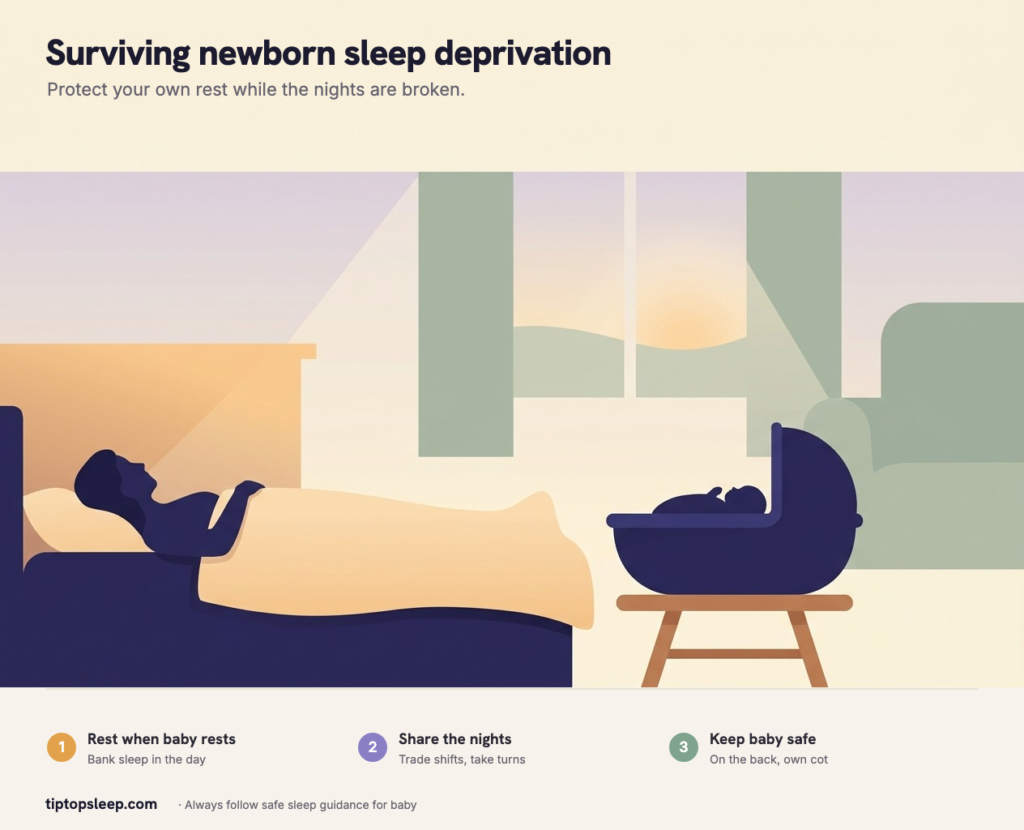
Fragmented sleep with a newborn is normal, not a sign you're doing something wrong - babies wake to feed every 2-3 hours because their stomachs are tiny. You can't fix that, but you can survive it: sleep when the baby sleeps, share the night with your partner in shifts, and lower the bar on everything that isn't feeding, sleeping and safety. Keep night feeds boring and dark so everyone resettles faster, and know the signs that mean it's time to call your GP or health visitor.
Nobody warns you how disorienting the fog actually feels. I remember sitting up at 3am with my own baby decades ago, then again with my daughter and her newborn, thinking I'd never string a full sentence together again. You haven't broken anything and your baby isn't "bad at sleeping" - newborns simply aren't built for long stretches yet. This is a season to get through, not a problem to solve. Here's what actually helps.
Why newborn sleep deprivation hits so hard
A newborn's stomach is tiny, so they need to feed roughly every 2-3 hours around the clock, day and night, for the first weeks. As the NHS puts it plainly, "newborn babies invariably wake up repeatedly in the night for the first few months, and disturbed nights can be very hard to cope with." That's biology, not a parenting failure. Add hormone shifts, a body still recovering from birth, and the novelty of caring for a tiny person, and it's no surprise this stretch feels harder than almost anything you've done. Knowing it's expected won't erase the tiredness, but it means you can stop treating exhaustion as evidence you're failing.
How exhausted parents can actually rest
You won't get eight unbroken hours for a while, but you can protect enough real rest to function. In rough order of impact:
- Sleep when the baby sleeps. Skip the washing and dishes if you have to choose - the NHS is direct: "try to rest when your baby sleeps... sometimes getting rest is more important than catching up with housework or other chores."
- Share the night in shifts. If there's a partner in the house, split the night into blocks so each of you gets one real stretch of sleep, rather than both waking for every feed. The NHS recommends this: "if you have a partner, ask them to help. If you're formula feeding, they could share the feeds."
- Express milk so a partner can take a feed too. Expressing a bottle lets your partner cover a night feed while you sleep through it - even one uninterrupted 4-5 hour block changes how you feel the next day.
- Lower the bar on everything else. This isn't the season for a tidy house or home-cooked meals. Survival mode is allowed.
- Get outside for a little daylight and movement. Even a short walk with the pram helps reset your body clock and lifts mood.
- Protect a short wind-down before bed. A few screen-free minutes helps you drop off faster in whatever window you get.
- Accept help when it's offered. A relative holding the baby so you can nap, or someone dropping off a meal, is how this stage is supposed to work.
Keep night feeds boring on purpose: dim lights, low voices, minimal stimulation. A baby who learns that night-time is quiet and uneventful resettles faster, so more of that fragmented sleep adds up to real rest for you too.
Keep it safe
However tired you are, a few safe-sleep basics matter every time your baby sleeps, day or night - this is the one place tiredness can be genuinely dangerous. Per NHS guidance:
- Always place your baby on their back to sleep, in the "feet-to-foot" position, never on their front or side.
- Use a separate, firm, flat sleep surface - their own cot or Moses basket in the same room as you, for every sleep, for at least the first 6 months.
- Keep the cot clear of pillows, duvets, cot bumpers, loose blankets and soft toys - anything that could cover your baby's face and head.
- Never sleep on a sofa or in an armchair with your baby. Exhaustion makes this the easiest accident to have, and it's one of the most dangerous. If you feel yourself nodding off while feeding, put your baby down in their own safe space first, even if it means waking fully.
These aren't arbitrary rules - they're the guidance shown to reduce the risk of sudden infant death syndrome (SIDS), and they matter most on the nights you're running on empty.
How this changes over the first months
It won't feel like this forever, even though 3am can make it seem that way. Roughly:
- The first weeks: Feeds every 2-3 hours round the clock, day blurring into night. Survival mode - sleep in fragments, accept help, keep expectations low. This is the hardest and shortest phase.
- Finding a rhythm (around 6-12 weeks): Many babies start stringing together one longer stretch, often earlier in the night, as their body clock develops. As the NHS notes, it's worth helping this along: teach your baby that "night-time is different from daytime" by keeping days bright and active and nights calm and dim.
- When to get help: If exhaustion is affecting your ability to cope, your mood, or your safety (or your baby's), reach out rather than push through alone.
Gear that protects your rest
You can't make a newborn sleep through the night, but you can protect the sleep windows you do get. Three cheap things help most - and note these are for helping YOU rest; your baby still sleeps on their back in a clear, separate cot as above.

Magicteam White Noise Machine
Steady white noise helps both baby and parent fall back asleep faster after a night feed - and masks household sounds so your precious sleep windows are not wasted.

Eclipse Blackout Curtains
Most of your catch-up sleep happens in the daytime now. Blackout curtains turn a bright afternoon room dark enough to actually nap when the baby does - the "sleep when they sleep" advice only works if the room lets you.

MZOO Contoured Sleep Eye Mask
When you can't darken the whole room, or you're grabbing 20 minutes while your partner takes the baby, a soft eye mask gets you to sleep faster - no waiting for your eyes to adjust to a bright room.
See our full Sleep Toolkit for more of the gear that actually earns its place in a newborn household.
When exhaustion needs a doctor
Being tired is normal. These signs are not, and deserve a call to your GP, midwife or health visitor rather than waiting it out:
- Low mood, tearfulness, or feeling unable to cope beyond the first couple of weeks - possible signs of postnatal depression or anxiety. Around 10-15% of new mothers experience it, and it's very treatable with support.
- Persistent negative or frightening thoughts - feeling you're a bad parent, disconnected from your baby, or thoughts that scare you.
- Confusion, or seeing or hearing things that aren't there - severe sleep deprivation can occasionally cause this, and it needs urgent medical attention.
- You can't function safely - falling asleep unexpectedly at the wheel, or so exhausted you can't safely care for your baby. Don't drive if you're that tired, and ask for help immediately.
If in doubt, call. A GP or health visitor would always rather hear from you early.
Frequently asked questions
Is it normal for a newborn to wake up every 2 hours at night?
Yes. Newborns have tiny stomachs and need frequent feeds, so waking every 2-3 hours is expected in the first weeks. It settles gradually over the coming months.
How do parents survive newborn sleep deprivation?
By protecting small windows of real rest rather than chasing a full night: napping when the baby naps, splitting night duty in shifts with a partner, lowering household expectations, and accepting help when offered.
Is it safe to fall asleep while feeding my baby on the sofa?
No - the NHS advises against ever sleeping on a sofa or in an armchair with your baby, as it significantly raises the risk of SIDS. If you feel yourself drifting off while feeding, put your baby down safely in their own cot first.
When should I worry that tiredness is something more than normal exhaustion?
If low mood, anxiety, frightening thoughts, or an inability to cope or function safely last more than a couple of weeks, talk to a GP, midwife or health visitor. These can be signs of postnatal depression or anxiety, which is common and treatable.
Sources & review: Guidance here is general comfort and coping advice, researched against NHS: sleep and tiredness after having a baby, NHS: reducing the risk of SIDS, NHS: helping your baby to sleep, and NHS: postnatal depression symptoms. It is not medical advice and does not replace guidance from your own doctor, midwife or health visitor - always contact them with any concerns about your baby or your own wellbeing.
📥 Free: The Post-Surgery Sleep Recovery Kit
Our 2-page PDF - the safe sleep position for your surgery, how to set up your bed, a night-by-night recovery timeline, and the red flags worth calling your doctor about. We'll email you the download link.
By subscribing you agree to our Privacy Policy.