

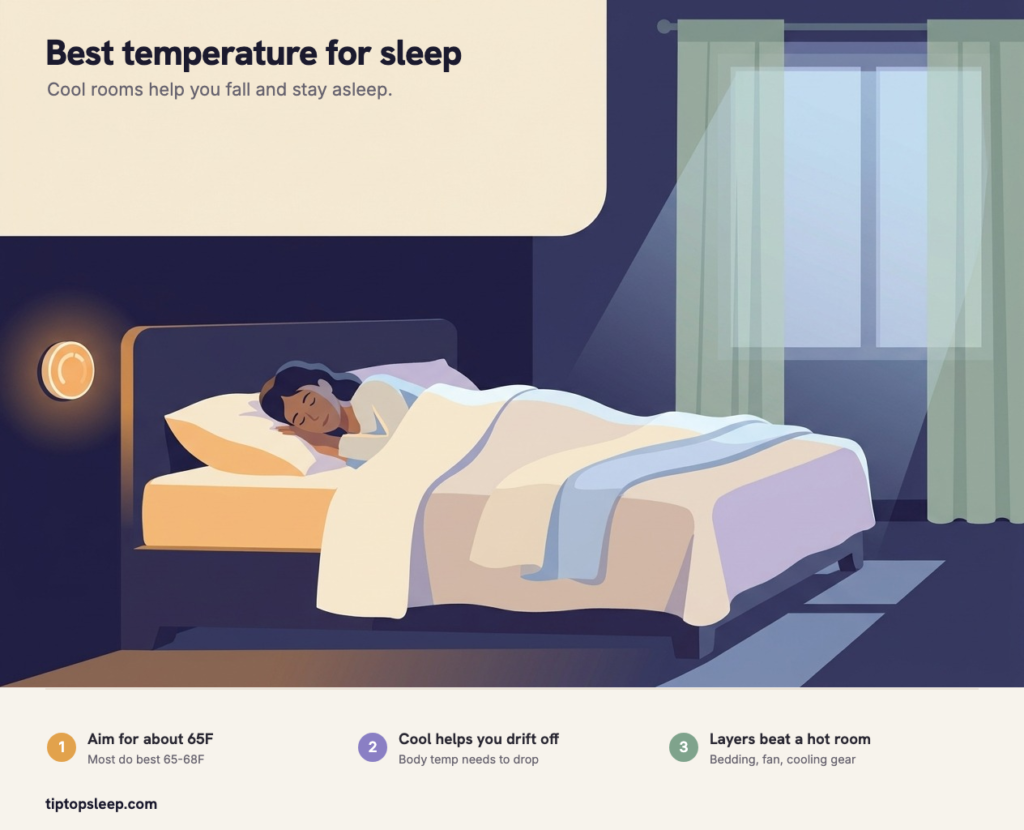
Most adults sleep best around 65F (18.3C), with a comfortable working range of about 65-68F. The exact number matters less than the direction: your bedroom needs to be cool enough to let your core body temperature drop, which is one of the signals your brain uses to start and stay in sleep. Babies and toddlers do better slightly warmer, closer to 68-72F.
I used to think "best sleep temperature" was one of those stats nobody actually checks, until I spent a July with a broken bedroom fan and found out the hard way. Two degrees warmer than usual and I was awake at 3am, kicking off the sheet, annoyed at nothing in particular. Temperature is one of the few sleep variables you can control completely, tonight, without buying anything - so it's worth understanding why it matters and where your own number probably sits.
What is the best temperature for sleep?
The Sleep Foundation puts a specific number on it: "The best room temperature for sleep is approximately 65 degrees Fahrenheit (18.3 degrees Celsius)." They also give a working range, noting "most doctors recommend keeping the thermostat set between 65 to 68 degrees Fahrenheit" for comfort.
Cleveland Clinic lands on a similar but slightly wider band, recommending you "keep your bedroom at 60 to 67° F (15 to 19° C)" for adults. Their sleep specialists also note that going much above or below that range tends to work against you - too warm and you'll wake up more; too cold and the same thing happens from the other direction.
So the honest answer is: aim for 65F as your starting point, and expect your personal sweet spot to land somewhere in the 60-68F range depending on your body, your bedding, and what you're used to.
Why does a cooler room actually help you sleep?
This isn't just comfort preference, it's physiology. Your body has to drop its core temperature to fall asleep and to stay in deep, restorative sleep - a cool room works with that process instead of against it.
- Core temperature drop. Cleveland Clinic explains that "when we sleep, our core body temperature decreases as part of the sleep initiation process." A warm bedroom fights this natural drop.
- Staying asleep, not just falling asleep. The same source notes "thermoregulation is very important for staying in restorative, slow-wave sleep." This is why a too-warm room doesn't just delay sleep onset, it fragments the sleep you do get.
- REM sleep specifically. Cleveland Clinic adds that the 60-67F range "is thought to actually help facilitate the stability of REM sleep" - the stage most linked to feeling mentally rested.
In practice, this is the same mechanism behind advice like how to sleep when it's hot: your body is trying to cool down all night regardless of the season, and a bedroom that fights that process is working against you every single night, not just in summer.
What temperature is best for babies and toddlers?
Nurseries run a little warmer than adult bedrooms, since infants regulate temperature less efficiently. Cleveland Clinic notes "the best sleeping temperature for babies and toddlers is a bit higher, between 65 and 70° F," explaining that "sleeping on the warmer end of the ideal sleep temperature scale is more conducive for those with smaller bodies that are still developing."
I'll say this briefly and then point you elsewhere: nursery temperature involves SIDS-risk guidance and overheating concerns that go beyond general sleep comfort. Treat the 65-70F range as a starting reference, and defer to your pediatrician's specific guidance for your child's age and health.
Does the ideal temperature change by season or by person?
Yes, on both counts.
- Seasonal variation. Your body acclimates somewhat to ambient temperature over weeks, which is part of why a 68F room feels fine in January but stuffy in July. Aim for the 65-68F range regardless of season rather than letting the thermostat drift with the weather outside.
- Individual variation. Age, sex, body composition, hormones (menopause and pregnancy both shift heat tolerance), and even your mattress and sheet materials all move your personal number a few degrees in either direction. If you consistently run hot or cold relative to a partner, that's normal and worth solving with bedding and gear rather than fighting over the thermostat.
- Illness and medication. Fevers, some medications, and hormonal changes can all shift what feels comfortable on a given night. Don't assume something is wrong if your ideal temperature moves around.
How do I actually hit the right temperature tonight?
A few practical levers, roughly in order of effort:
- Thermostat, if you have one. Set it and forget it - a programmable or smart thermostat dropping to 65-68F an hour before bed removes the guesswork entirely.
- A warm bath or shower about 90 minutes before bed. This sounds backwards, but it works: warming your skin causes blood vessels to dilate and release heat afterward, which accelerates the natural core-temperature drop once you're out and cooling down.
- Breathable bedding. Cotton, linen, and bamboo sheets move heat away from your body far better than synthetic blends. This matters as much as the thermostat setting in practice.
- Layer instead of committing to one weight of blanket. Two thin layers you can kick off beat one heavy comforter you're stuck with all night.
- A fan or bed-specific cooling gear for rooms without central air, or a partner who runs warmer than you do.
This is a topic we've built out a whole cluster of gear guides around, since "cool enough to sleep" usually comes down to a combination of tools rather than one fix. If you sleep hot specifically, how to sleep when it's hot goes deeper on positioning and habits, and sleeping with a fan on all night covers the tradeoffs of the simplest cooling tool there is.

ecobee Smart Thermostat Essential
If you're tired of manually adjusting the thermostat before bed, a smart thermostat does it for you - schedule a drop to 65-68F an hour before your usual bedtime and it happens automatically, every night, without you remembering. It also works with Alexa, Google Assistant, and Siri if you want to nudge the temperature down from bed without getting up.
Prefer to tackle cooling with bedding and airflow instead of a thermostat swap? Our Sleep Toolkit rounds up the cooling gear we actually trust, from mattress pads to bedroom AC units.
Frequently asked questions
Is 68 degrees too warm to sleep?
No, 68F is within the commonly recommended 65-68F range and is a reasonable upper limit for most adults. If you tend to sleep hot, you may prefer closer to 65F; if you run cold, 68F may already feel ideal.
Is 72 degrees too hot to sleep?
For most adults, a bit warm - 72F sits above the roughly 65-68F range both Sleep Foundation and Cleveland Clinic point to for adult sleep. It's not dangerous, but it's likely to nudge sleep quality down for an adult over time, so it's worth cooling the room a few degrees if you can.
What temperature should a baby's room be?
Cleveland Clinic notes babies and toddlers do better a bit warmer than adults, in the 65-70F range. Nursery temperature also involves overheating and SIDS-risk guidance beyond general comfort, so check current pediatric guidance for specifics.
Why do I sleep better in a cold room even in winter?
Because the mechanism is about your core body temperature dropping, not about matching the season outside. A well-heated house can still be kept in the 65-68F sleep range in your bedroom specifically, even while the rest of the home runs warmer.
Related reading:
- The Best Cooling Pad for Bed
- Best Bed Air Conditioner
- How to Sleep When It's Hot
- Should You Sleep With a Fan on All Night?
- Sleep Hygiene Checklist
- Sleep Toolkit - the gear we actually recommend for a cooler bedroom
Sources & review: Temperature guidance here is checked against the Sleep Foundation and Cleveland Clinic. It is general sleep hygiene information, not medical advice, and doesn't replace guidance from a doctor or pediatrician for infant sleep environments or any underlying health condition affecting temperature regulation.
📥 Free: The Post-Surgery Sleep Recovery Kit
Our 2-page PDF - the safe sleep position for your surgery, how to set up your bed, a night-by-night recovery timeline, and the red flags worth calling your doctor about. We'll email you the download link.
By subscribing you agree to our Privacy Policy.