

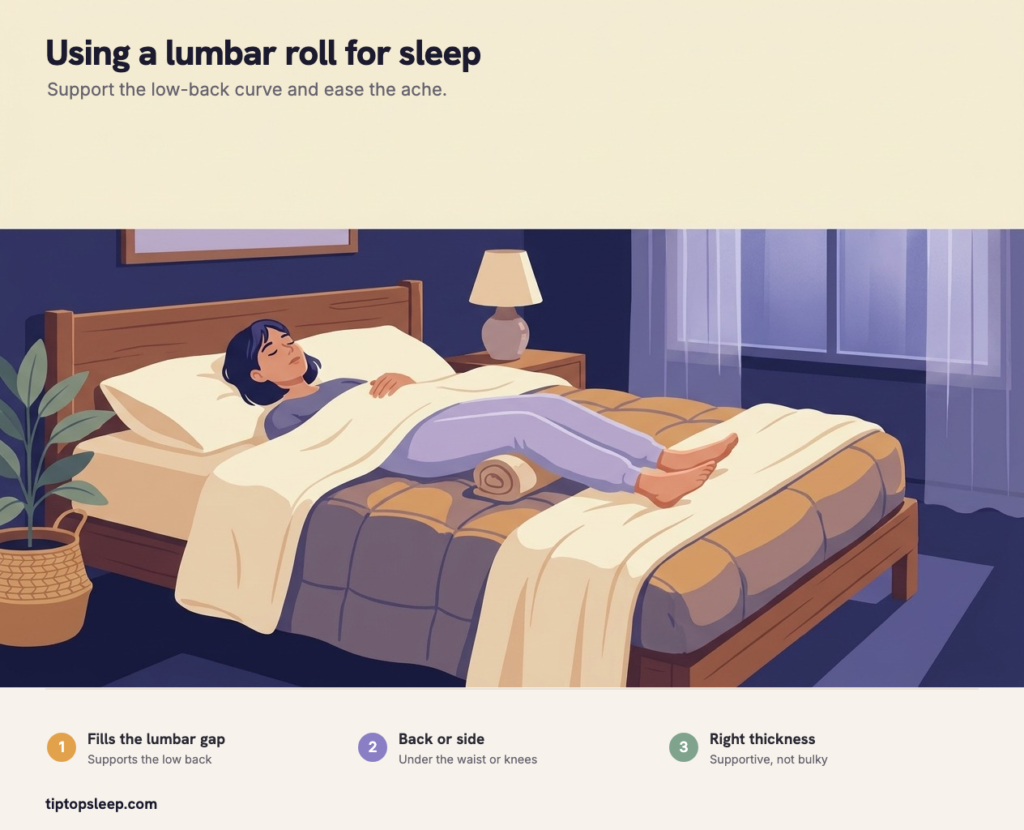
A lumbar sleep roll is a small firm cylinder (or a rolled towel) that sits under your lower back if you sleep on your back, or at waist height if you sleep on your side. It fills the gap your spine's natural curve leaves against the mattress, so your lower back isn't left unsupported all night. Go thin rather than thick - it should fill the gap, not force an arch - and it's a comfort aid, not a fix for a medical back problem.
I hear from the same kind of reader again and again: no diagnosed back problem, just a lower back that aches every morning no matter how good the mattress is. Usually the missing piece isn't the mattress at all - it's that empty gap between your lower back and the bed once you lie down. A lumbar roll is a simple, cheap way to close that gap. Here's who it actually helps, how to use one properly, and what to look for.
What is a lumbar sleep roll, and who is it for?
Your lower back has a natural inward curve. Lie flat on a firm surface and that curve leaves a small gap between your spine and the mattress - your back muscles end up doing quiet, low-grade work all night just to hold the position, which is a common reason people wake up stiff or sore even after a full night's sleep. A lumbar roll is simply something firm and rounded, roll-shaped or towel-shaped, that fills that gap so your lower back gets support instead of hanging unsupported.
It tends to help most if you recognise any of this:
- You wake up with lower back stiffness that eases once you're up and moving around.
- You sleep on a firmer mattress that doesn't contour to your lower back.
- You already know a pillow under the knees or between the knees helps a bit, but your lower back still aches.
- You spend the day at a desk or driving, and your lower back is already tired by bedtime.
It's not a fix for sciatica, a herniated disc, or pain that's spreading down a leg - those need a proper look from a doctor, not a roll. More on that below.
How do I actually use a lumbar roll while sleeping?
The setup is different depending on your sleep position, and getting it wrong (too thick, in the wrong spot) can make things worse, not better.
Back sleepers
Slide the roll under your lower back, roughly in line with your belt line - not higher, under your mid-back, and not lower, under your tailbone. It should sit in the hollow your spine naturally leaves, gently filling that space rather than pushing your back into an exaggerated arch. Sleep Foundation's guidance for back sleepers backs this up directly: "Back sleepers should consider a medium-loft pillow under the head and may find additional relief from placing a small pillow or rolled towel under the knees." A rolled towel under the knees does a similar job to a lumbar roll under the back - both are about closing gaps so your spine stays supported instead of unsupported.
Side sleepers
On your side, the roll sits at waist height, tucked into the gap between your waist and the mattress created by the curve of your hips and ribs. Combine it with a pillow between your knees to keep your hips level - the two together do more than either alone. If the roll pushes your spine visibly out of a straight line when you check in a mirror, it's sitting too high, too low, or it's too thick for your body.
Getting the thickness right
Bigger isn't better here. A roll that's too thick forces your spine into a curve it wouldn't naturally hold. Start on the thinner side - even a rolled hand towel - and only size up if you can still feel a gap. If your lower back feels pushed forward, size down.
What should I look for when buying one?
Not every "lumbar pillow" sold online is meant for sleeping - plenty are seated office or car cushions that are too tall and rigid to lie on comfortably. For sleep specifically:
- Low profile. You want a few inches, not a wedge. A sleep-specific roll or towel-thickness pillow works better than a tall seated-support cushion.
- Firm enough to hold its shape through a full night, but not hard - it should cushion, not dig in.
- Breathable cover. Memory foam traps heat; a roll sits against skin for eight hours, so a breathable or washable cover matters more than it sounds.
- Ties or a way to keep it in place if you move around in your sleep, so you're not hunting for it at 3am.
A roll built for exactly this
You can start with a rolled towel tonight for free, and plenty of people never need more than that. But a shaped roll holds its form better through a full night and doesn't flatten the way a towel does after an hour.

OPTP The Original McKenzie Night Roll
A firm foam roll that ties around your waist so it stays exactly in place under your lower back or side, all night, whichever way you turn. Low-profile by design - built for lying down, not sitting up.
If your lower back pain is really more about your overall sleep position than a gap issue, our guide to the best sleeping position for lower back pain covers the full picture - and see our Sleep Toolkit for the rest of the gear worth having.
What a lumbar roll won't do
Worth being honest about this: a lumbar roll is a comfort aid, not a treatment. It can ease the low-grade ache that comes from an unsupported lower back overnight. It will not fix a herniated disc, sciatica, spinal stenosis, or a structural back problem - those need proper diagnosis. Cleveland Clinic's general advice on sleep positioning notes that support like this "can help prevent your upper leg from pulling forward and twisting your torso" - the same supportive, not curative, role a lumbar roll plays. If your pain isn't easing after a couple of weeks, or it's severe, see a doctor rather than trying a bigger roll.
Frequently asked questions
Can I just use a rolled towel instead of buying a lumbar roll?
Yes. A firmly rolled bath towel, secured with a rubber band or tucked into a pillowcase, does the same job for free. A shaped roll just holds its form longer through the night and won't unroll or flatten as quickly.
Should the lumbar roll be under my back or under my knees?
Both help, in different ways. A roll under your lower back fills the gap your spine's curve leaves against the mattress. A pillow under your knees (back sleepers) or between your knees (side sleepers) keeps your hips and pelvis level. Many people use both together.
Is a thicker lumbar roll better for more support?
No - too thick is a common mistake. A roll that's too thick pushes your spine into an exaggerated curve instead of gently supporting its natural one. Start thin and only increase if you still feel an unsupported gap.
Will a lumbar roll fix sciatica or a herniated disc?
No. It's a comfort aid for ordinary positional back stiffness, not a treatment for a diagnosed spinal condition. If you have shooting pain, numbness, or tingling down a leg, see a doctor rather than relying on a roll.
Related reading
- Best sleeping position for lower back pain
- Learning to sleep on your back
- How to sleep after hip replacement surgery
- The Sleep Toolkit
Sources & review: Guidance here is general comfort information, researched against sleep position and back pain information from Sleep Foundation and Cleveland Clinic. It is not medical advice - a lumbar roll is a comfort aid, not a treatment, and if your back pain is severe, persistent, or comes with numbness or weakness, please see a healthcare provider.
📥 Free: The Post-Surgery Sleep Recovery Kit
Our 2-page PDF - the safe sleep position for your surgery, how to set up your bed, a night-by-night recovery timeline, and the red flags worth calling your doctor about. We'll email you the download link.
By subscribing you agree to our Privacy Policy.