
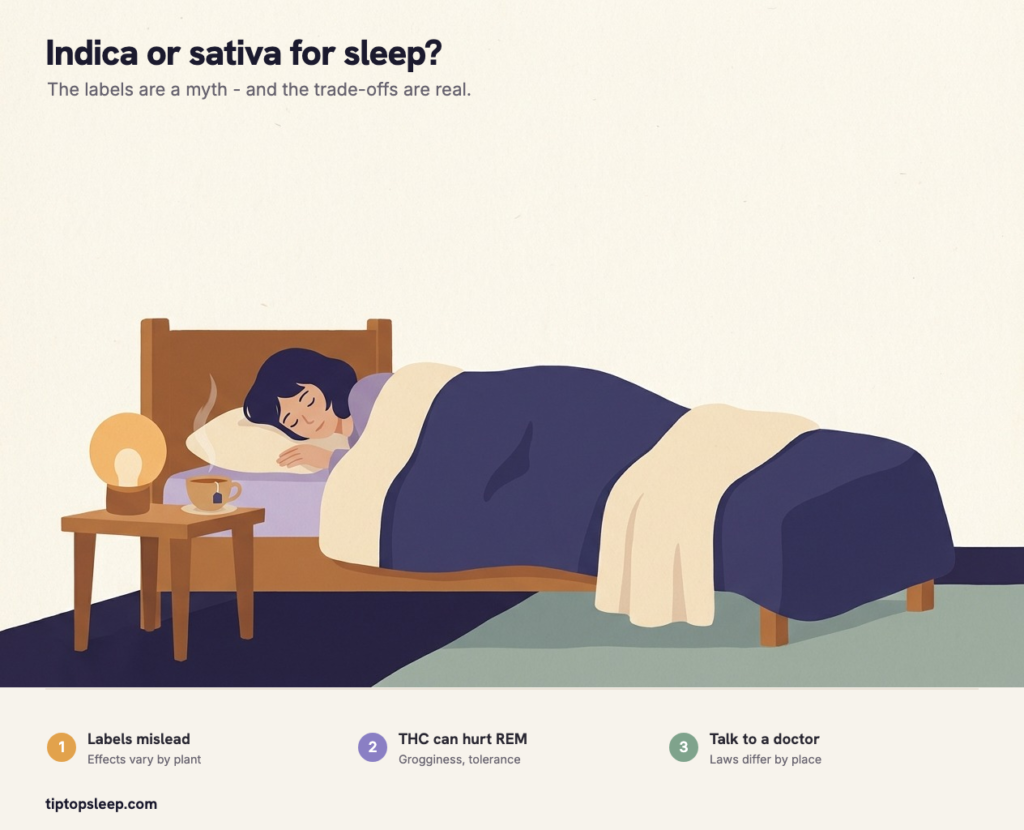
"Indica for sleep, sativa for energy" is a popular rule of thumb, but it's largely a myth. What actually drives whether a cannabis product feels sedating or energizing is its specific chemical makeup - the cannabinoid and terpene profile, sometimes called its chemovar - not whether the label says indica or sativa. THC can help some people fall asleep faster in the short term, but it also suppresses REM sleep, builds tolerance, and can leave you groggy or disrupt sleep further once you stop. This isn't medical advice, and it isn't a recommendation to use cannabis for sleep.
I get asked this a lot, usually by someone wondering whether the "indica" gummy a friend swears by is worth trying. I'm not a doctor and I'm not going to tell you to use cannabis, or which strain to pick - that's not something I can responsibly do, and honestly, the strain name matters less than most people think. Here's what the labels actually mean and what the evidence says.
Is it true that indica strains are more sedating than sativa?
Not reliably, no. The indica/sativa split started as a botanical description - indica plants short and bushy, sativa tall and lanky - and somewhere along the way it turned into shorthand for effects: indica relaxes you, sativa energizes you. A plant's height and leaf shape, though, have nothing to do with what it does to your brain. As Sleep Foundation puts it, "some researchers argue that the distinction between indica and sativa strains is less relevant than the variety in THC content and other ingredients in any particular product." Genetic and chemical analyses of commercial cannabis back this up: strains labeled indica and sativa don't reliably sort into distinct chemical groups, and two products with the same label can affect two people in opposite ways.
What matters more is the specific combination of cannabinoids (THC, CBD, and others) and terpenes - the aromatic compounds behind the scent - in that particular batch. Researchers increasingly use the term chemovar (chemical variety) for this, because it describes what's actually driving the effect. If a product genuinely helps someone sleep, it's more likely down to its THC-to-CBD ratio and terpene mix than the fact that someone called it an indica.
Does cannabis actually help you fall asleep?
For some people, in the short term, it can. THC has a sedating effect for many users, and some studies report people falling asleep faster. The NIH's National Center for Complementary and Integrative Health notes that "often, there's been evidence of better sleep quality, fewer sleep disturbances, or decreased time to fall asleep in people taking cannabis/cannabinoids" - but adds that it's often unclear whether cannabis is helping sleep directly, or whether people sleep better simply because a symptom keeping them awake, like pain or anxiety, has eased. If you don't have one of those underlying problems, the evidence that cannabis meaningfully improves sleep is much thinner - and the downsides below still apply.
What are the downsides for sleep?
This is the part that gets left out of most strain guides, and it matters most if you're already struggling with sleep.
- It suppresses REM sleep. Sleep Foundation is direct about this: "THC decreases the amount of time you spend in rapid eye movement (REM) sleep, when you spend more time dreaming, processing emotions, and cementing new memories." Less REM over time isn't a small thing - it's the stage most linked to memory consolidation and emotional processing.
- Tolerance builds with regular use. The sedating effect that worked the first few nights tends to fade as your body adjusts, which is why some people find themselves needing more to get the same effect.
- Stopping can disrupt sleep further. Sleep Foundation notes that "cannabis withdrawal can also produce sleep-related side effects, such as strange dreams, difficulty falling asleep, and less time spent in deep sleep." So the sleep problem you were trying to solve can come back, sometimes worse, once you stop or run out.
- Regular use can tip into cannabis use disorder. NCCIH describes this as a real, recognized condition: "some people who use cannabis develop cannabis use disorder, which has symptoms such as craving, withdrawal, lack of control, and negative effects on personal and professional responsibilities." It's not the outcome most people expect when they start using cannabis "just for sleep."
- Next-day grogginess is common, especially at higher doses or with edibles, which can linger well into the following morning.
What about CBD instead of THC?
CBD (the non-intoxicating cannabinoid) is often marketed as the "safer" sleep option, but the evidence is genuinely mixed - some people report falling asleep more easily, others notice no difference. Dosing is inconsistent across products, and CBD sleep formulas usually aren't regulated the way medications are, so what's on the label doesn't always match what's in the bottle. It's lower-risk than THC in terms of intoxication and dependence, but "lower-risk" isn't the same as "proven to work."
What I'd actually weigh before considering this
A few honest points, none of which are a recommendation either way. Laws vary enormously by country, state, and city, so check locally - I'm not going to guess your jurisdiction. Cannabis isn't a treatment for insomnia. If poor sleep is a persistent problem rather than an occasional bad night, cognitive behavioral therapy for insomnia (CBT-I) is the first-line, evidence-backed approach clinical guidelines recommend - not cannabis, and not sleeping pills either, which come with their own trade-offs worth knowing about. Medications, alcohol, existing mental health conditions, pregnancy, and age can all change how cannabis affects you, which is exactly the kind of thing to raise with your own doctor rather than decide from a blog post. And if anxiety about sleep itself is part of the problem, that's worth addressing directly - I've written about breaking the cycle of worrying about not sleeping, which for a lot of people does more than any product.
Lower-risk things to try first
Before reaching for anything that alters your brain chemistry, it's worth ruling out the boring, well-evidenced stuff: consistent sleep and wake times, cutting caffeine after early afternoon, a wind-down routine. If you want something to actually take, magnesium has the most reasonable evidence-to-risk ratio of the popular sleep supplements - see my honest look at whether magnesium actually helps sleep. For a broader rundown of what's worth trying and what's mostly hype, my Sleep Toolkit covers the low-risk options I'd try long before considering cannabis.
Frequently asked questions
Is indica really more relaxing than sativa?
Not reliably. The indica/sativa split describes plant shape, not chemical effect. What determines whether a product feels sedating or energizing is its specific cannabinoid and terpene profile, which varies a lot even within products carrying the same label.
Does THC help you fall asleep faster?
It can, for some people, in the short term - but it also reduces REM sleep, and regular use builds tolerance, so the same effect tends to fade over time.
Is CBD better than THC for sleep?
CBD doesn't carry the same dependence or next-day-grogginess profile as THC, but the evidence that it reliably improves sleep is mixed, and product dosing is inconsistent.
What should I try instead of cannabis for insomnia?
Cognitive behavioral therapy for insomnia (CBT-I) is the first-line, evidence-based approach for ongoing insomnia. For occasional poor sleep, consistent sleep timing, limiting caffeine, and a wind-down routine are the best-supported starting points - talk to your doctor if sleep problems persist.
Related reading
- Best Magnesium for Sleep: Glycinate, Dose & Honest Evidence
- Can Sleeping Pills Cause Memory Loss?
- Fear of Not Sleeping: How to Stop Worrying About Not Sleeping
- Sleep Toolkit: What's Actually Proven to Help You Sleep
Sources & review: Researched against Sleep Foundation's guide to cannabis and sleep and the NIH National Center for Complementary and Integrative Health's cannabis overview. This article is general information, not medical advice, and is not a recommendation to use cannabis. Cannabis laws vary widely by location and it remains illegal in many places - check your local laws. If you're considering cannabis for a sleep problem, or have any health condition or take medication, talk to your doctor first.
📥 Free: The Post-Surgery Sleep Recovery Kit
Our 2-page PDF - the safe sleep position for your surgery, how to set up your bed, a night-by-night recovery timeline, and the red flags worth calling your doctor about. We'll email you the download link.
By subscribing you agree to our Privacy Policy.