

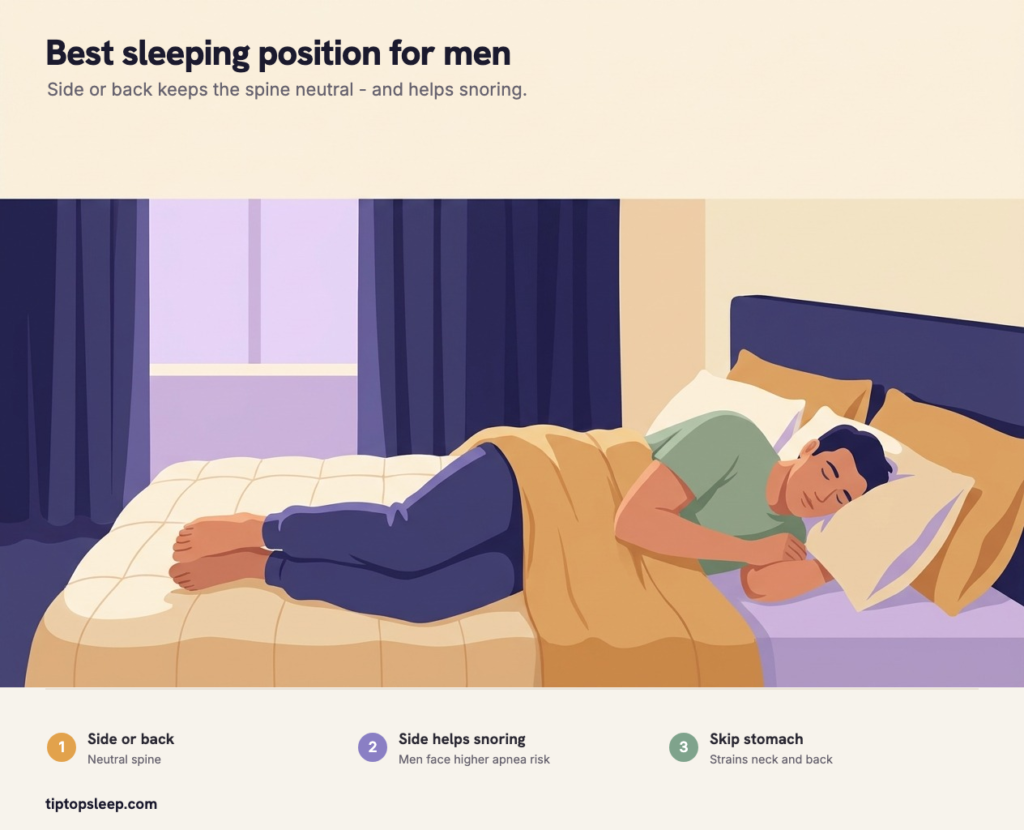
There's no separate "science" of sleep positions for men - the basics are the same for everyone: side or back sleeping keeps your spine in a neutral line, and stomach sleeping is the one to avoid if you can help it. Where it does matter more for men: side sleeping can ease snoring and mild sleep apnea, both of which are more common in men, and waking to urinate more than once a night is worth mentioning to a doctor as men get older. Beyond that, the "best" position is the one that lets you actually stay asleep.
I get asked some version of this a lot, usually by a wife emailing on behalf of her husband: "is there a best sleeping position for men?" The honest answer is that spines don't know your gender - what keeps a back pain-free in the morning works the same whether you're male or female. But I'm not going to pretend there's nothing to say here, because there genuinely are a couple of areas where men's sleep does look a bit different, and they're worth taking seriously rather than dressing up with fake statistics. Here's what's actually true.
What's the best sleeping position overall?
For most people, most nights, it comes down to two options.
On your side
Side sleeping is the position most adults end up in by default, and there's good reason for that. Sleep Foundation notes that "sleeping on the side or back is considered more beneficial than sleeping on the stomach" because "it's easier to keep your spine supported and balanced." If you sleep on your side, a pillow between your knees stops your top leg dragging your hips out of line overnight - the same fix whether you're male or female.
On your back
Back sleeping distributes your weight evenly and keeps your spine flat, which is why it's often recommended for people with back pain. A pillow under your knees takes the last bit of strain off your lower back. The trade-off: back sleeping can make snoring and mild sleep apnea worse for some people, because gravity lets the tongue and soft tissue at the back of the throat relax into the airway.
Why stomach sleeping is the one to skip
Lying face down usually forces your lower back to arch and twists your neck to one side for hours. It's not dangerous, but it's the position most likely to leave you stiff. If it's the only way you can fall asleep, our guide to learning to sleep on your back has a gradual way to retrain the habit.
Does sleep position matter more for men specifically?
In a few areas, yes - not because men's spines are different, but because certain sleep problems show up more often in men. Here's where it's genuinely worth paying attention.
Snoring and sleep apnea
Obstructive sleep apnea - where breathing repeatedly stops and starts during sleep - is more common in men than women, particularly earlier in adulthood. Sleep Foundation puts it directly: "Men or people assigned male at birth are generally more likely to have obstructive sleep apnea, especially in the earlier stages of adulthood." Side sleeping tends to help, since it stops the tongue and throat tissue collapsing backward the way they can when you're flat on your back: as Sleep Foundation notes, "sleeping on your side or stomach is typically best for sleep apnea."
That said, a pillow won't fix sleep apnea on its own. Loud, chronic snoring, gasping or choking during sleep, and daytime exhaustion despite a full night in bed are all worth raising with a doctor - sleep apnea is a real medical condition with real treatment (often CPAP), not something to just sleep your way around. I lived with an undiagnosed snorer for eighteen years before he finally got tested and treated, and I wish we'd taken it seriously years sooner.
Back and shoulder pain
Men are no more or less prone to back pain than women in general, but manual work, heavier training loads, and old sports injuries mean a lot of men are managing a cranky lower back or a shoulder that doesn't love certain positions. If that's you, side sleeping with a pillow between your knees or back sleeping with a pillow under your knees are both worth trying - see what actually leaves you less stiff in the morning. Our best sleeping position for lower back pain guide goes deeper if that's your main issue.
Getting up to urinate at night
This one gets skipped in a lot of sleep advice, but it's a genuine sleep disruptor: waking once or more a night to urinate (nocturia) becomes more common as men get older, often tied to prostate changes. It's not really a "sleep position" fix - no way of lying down prevents it - but it's worth mentioning because it's such a common reason for fragmented sleep in men over 50. If it's happening most nights, or getting more frequent, that's a conversation for your doctor rather than something to just live with.
A pillow that supports the position, not just the promise
Whether you land on side or back sleeping, the thing doing the real work is what's between or under your knees. A regular pillow flattens and slides by 3am; a shaped knee pillow holds its form and stays put.

ComfiLife Orthopedic Knee Pillow
A contoured memory foam wedge that holds its shape between your knees on your side, or under your knees on your back - keeps your hips and spine aligned without going flat overnight.
Want the full lineup of things that actually help you sleep better? See our Sleep Toolkit for the pillows, wedges and other gear worth having.
So what's actually the best position for you?
Mostly, it's individual. Try side sleeping with a knee pillow first - it's the safest default for spine alignment and it can ease snoring. If your back prefers lying flat, back sleeping with a pillow under your knees works just as well. Skip stomach sleeping if you can retrain the habit. And treat loud snoring, breathing pauses, or frequent nighttime bathroom trips as things to mention to a doctor, not just quirks to sleep around.
Frequently asked questions
Is there really a "best" sleeping position for men?
Not a separate one from women - spinal alignment works the same for everyone. Side or back sleeping with a supportive pillow is the general best practice. Where it differs is that men have higher rates of sleep apnea and snoring, so side sleeping carries a bit more practical benefit.
Does sleeping position affect snoring?
Yes. Back sleeping lets the tongue and soft throat tissue relax backward into the airway, which can make snoring worse. Side sleeping usually reduces it. If snoring is loud and constant, or comes with gasping or daytime fatigue, get it checked rather than relying on position alone.
Why do I need to pee so much at night?
Waking to urinate once or more a night (nocturia) becomes more common in men as they get older, often linked to prostate changes. It's not fixed by sleep position. If it's frequent or new, mention it to your doctor.
What's the worst sleeping position?
Stomach sleeping, for most people. It arches your lower back and twists your neck for hours at a stretch. It's not harmful in the short term, but it's the position most likely to leave you stiff and sore.
Related reading
- Best sleeping position for lower back pain
- Learning to sleep on your back
- Sleep apnea, demystified
- The Sleep Toolkit
Sources & review: Guidance here is general comfort information, researched against sleep position and sleep apnea information from the Sleep Foundation (sleep positions and sleep apnea). It is not medical advice and does not replace a doctor's evaluation - if you snore loudly, gasp or stop breathing during sleep, or notice a real change in nighttime bathroom trips, please see a healthcare provider.
📥 Free: The Post-Surgery Sleep Recovery Kit
Our 2-page PDF - the safe sleep position for your surgery, how to set up your bed, a night-by-night recovery timeline, and the red flags worth calling your doctor about. We'll email you the download link.
By subscribing you agree to our Privacy Policy.