

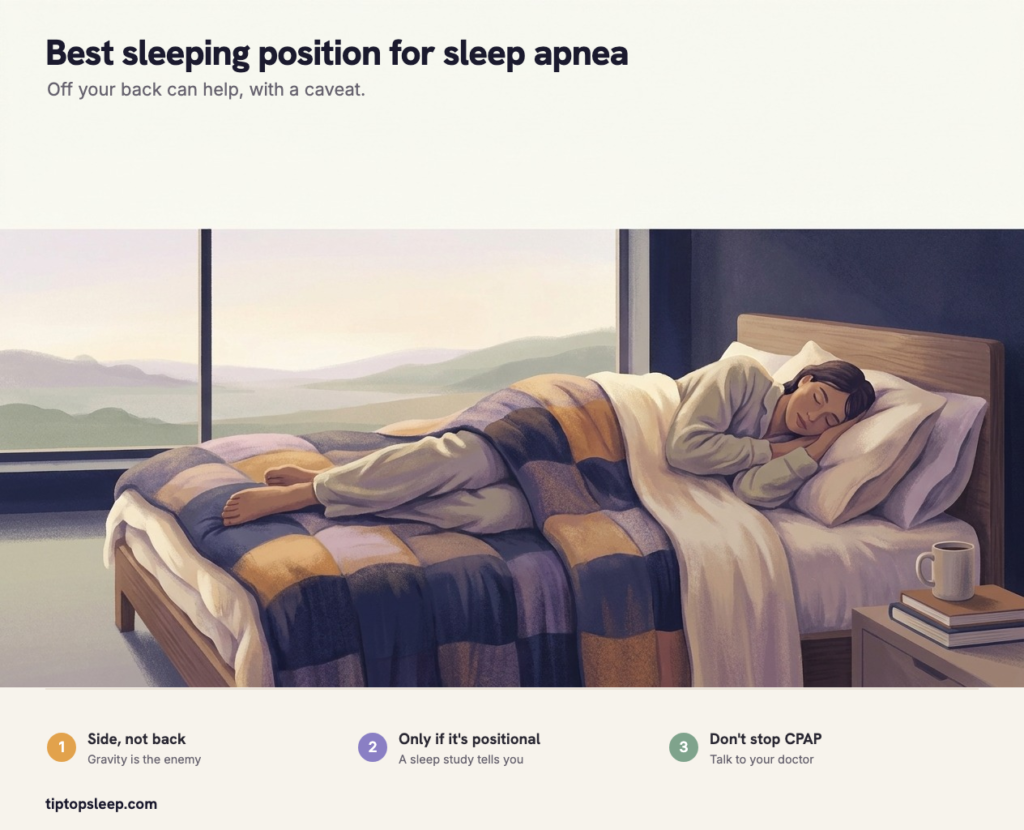
Side sleeping is the best default position for most people with obstructive sleep apnea (OSA), because lying on your back lets gravity pull the tongue and soft tissue backward into the airway. Raising your head and upper body a little adds a second layer of help. But positional therapy only works for positional OSA - apnea that's genuinely worse on your back - and only a sleep study can tell you if that's your pattern. It's a comfort strategy alongside treatment, not a replacement for CPAP or a diagnosis.
I hear from a lot of readers who've been told, somewhere between a partner's elbow and a late-night search, that "just sleep on your side" fixes sleep apnea. It can help - a lot, for some people - but it's not the whole story, and I'd rather be straight with you about what position actually changes and what it doesn't. I'm not a doctor. This is what the evidence says about sleeping position and OSA, and where the line is between a helpful habit and a false sense of security.
Why does back sleeping make sleep apnea worse?
It comes down to gravity. When you lie flat on your back, your tongue and the soft tissue at the back of your throat relax and fall backward, narrowing or partly blocking your airway. Add the normal muscle relaxation of sleep, and that's the setup behind the breathing pauses that define obstructive sleep apnea. On your side, gravity pulls that same tissue away from the airway instead of into it, which is why side sleeping tends to mean fewer and shorter breathing pauses for many people.
This is called positional OSA when the difference is significant - some people have a near-normal breathing pattern on their side and a clearly abnormal one on their back. The Sleep Foundation notes that "special products to avoid back sleeping may help some people reduce their symptoms from obstructive sleep apnea," while also being clear this approach hasn't been rigorously studied across the board. It helps some people meaningfully, it doesn't help everyone, and only a test can tell you which group you're in.
How do I know if my apnea is actually positional?
You can't diagnose this from a mattress or a partner's report alone. A sleep study - in a lab (polysomnography) or a home sleep apnea test - measures your Apnea-Hypopnea Index (AHI) in different positions. If your AHI on your back is much higher than your AHI on your side, that's positional OSA, and side-sleeping strategies have real evidence behind them for you specifically. If your numbers are similarly elevated in every position, staying off your back won't meaningfully treat your apnea, even if it feels like it's helping you sleep more comfortably.
This distinction matters because positional therapy has a real failure mode: feeling better rested because you're not waking yourself with snoring doesn't mean your oxygen levels and breathing are actually normalized overnight. That's the gap a sleep study closes and a comfortable pillow can't.
What's the best sleeping position for sleep apnea?
- Side sleeping (best default). Either side works; some people find one side more comfortable, and that's fine - the goal is simply off your back. Keep your body fairly straight rather than curled tightly, and use a pillow that keeps your neck aligned with your spine instead of tilted up or down.
- Head and upper-body elevation. Raising your head and chest slightly - with a wedge pillow or an adjustable bed base - can reduce airway crowding further, especially for people whose apnea is linked to nasal congestion, reflux, or a larger neck. It's a smaller effect than switching off your back, but the two combine well.
- Avoid stomach sleeping as a "fix." It doesn't have the same evidence as side sleeping, tends to strain the neck over a full night, and doesn't work with a CPAP mask if you're on one. Our piece on sleeping face down with sleep apnea goes into why it's not a reliable substitute.
- Back sleeping - the position to avoid if you know or suspect your apnea is positional. It's the position most associated with airway collapse for the reasons above.
What else affects how bad sleep apnea is at night?
- Alcohol and sedatives. The NHS advises to "not drink too much alcohol - especially shortly before going to sleep" and to "not take sleeping pills unless recommended by a doctor" - both relax throat muscles in a way that worsens airway collapse and can undo whatever benefit you'd get from side sleeping.
- Weight. Extra tissue around the neck can narrow the airway further. The NHS lists trying to "lose weight if you're overweight" among its standard advice for OSA - not a fast fix, and not relevant for everyone with apnea, but it measurably helps some people.
- Nasal congestion. A blocked nose pushes people toward mouth breathing and can make back sleeping feel like the only option. Treating congestion - allergy management, a saline rinse before bed - makes side sleeping easier to actually stick with.
None of these replace a prescribed treatment. They're what makes whatever your doctor has you on - or the sleep study you haven't had yet - work better.
Can positional therapy replace CPAP?
For a small number of people with confirmed, purely positional, mild OSA, a doctor may decide positional therapy is enough. For most people diagnosed with moderate or severe OSA, it's a helpful addition, not a substitute. If you're already using CPAP, don't stop or reduce it because you've started sleeping on your side - talk to the doctor who prescribed it first. We cover the full landscape of doctor-supervised alternatives, including oral appliances and surgery, in how sleep apnea is treated without CPAP, which is worth reading before assuming position alone is your answer.
A comfort aid for staying off your back
The old trick of taping a tennis ball to the back of your pajamas exists for a reason - it's annoying enough to keep you from rolling onto your back without fully waking you. Wearable positional aids are the modern, more comfortable version of the same idea.

ODOXIA Positional Sleep Apnea Device
An adjustable vest with a padded bump across the back that makes lying flat uncomfortable, so you settle back onto your side without needing to fully wake up. It's the modern version of the tennis-ball trick the NHS mentions for OSA - a comfort aid to support doctor-guided positional therapy, not a treatment on its own. Worth trying only if a sleep study or doctor has told you your apnea is specifically worse on your back.
Prefer a broader look at sleep gear before picking one thing? Our Sleep Toolkit rounds up what we trust for specific situations like this.
When should I stop relying on position and call a doctor?
If you haven't had a sleep study and you snore heavily, gasp or choke during sleep, or feel exhausted despite a full night in bed, that's the actual first step - not a pillow or a wearable. If you're already diagnosed and treated, loud gasping, worsening daytime sleepiness, or morning headaches are signs to raise with your doctor regardless of what position you've settled into. Position can make a real difference around the edges of positional OSA; it was never meant to replace a diagnosis or a prescribed treatment plan.
Frequently asked questions
Is side sleeping enough to treat sleep apnea?
Only if a sleep study confirms your apnea is specifically positional, meaning it's significantly worse on your back than your side. If your AHI is similarly elevated in every position, side sleeping alone won't adequately treat it, even if it feels more comfortable.
Which side is better for sleep apnea, left or right?
There isn't strong evidence that one side is consistently better than the other for OSA specifically. Pick whichever side you can comfortably maintain through the night - consistency matters more than left versus right.
Does raising the head of the bed help sleep apnea?
It can help somewhat, especially alongside side sleeping, since it reduces some airway crowding and can ease nasal congestion or reflux that make breathing harder at night. It's a smaller effect than avoiding back sleeping and works best as an addition, not a stand-alone fix.
Can I stop using CPAP if sleeping on my side stops my snoring?
No, not without talking to the doctor who prescribed it. Quieter snoring doesn't confirm your breathing pauses and oxygen levels are actually back to normal overnight - only follow-up testing can tell you that.
Related reading:
- How Do You Treat Sleep Apnea Without CPAP?
- Is It Okay for People With Sleep Apnea to Sleep Face Down
- Sleep Apnea Demystified: A Comprehensive Guide
- What Is It Like to Live With Obstructive Sleep Apnea
- Sleep Toolkit - the gear we actually recommend for situations like this
Sources & review: Checked against the NHS page on sleep apnoea and the Sleep Foundation. This is general information, not medical advice, and it doesn't replace a sleep study or guidance from your own doctor. If you use CPAP, do not stop or change your treatment without talking to the doctor who prescribed it.
📥 Free: The Post-Surgery Sleep Recovery Kit
Our 2-page PDF - the safe sleep position for your surgery, how to set up your bed, a night-by-night recovery timeline, and the red flags worth calling your doctor about. We'll email you the download link.
By subscribing you agree to our Privacy Policy.