

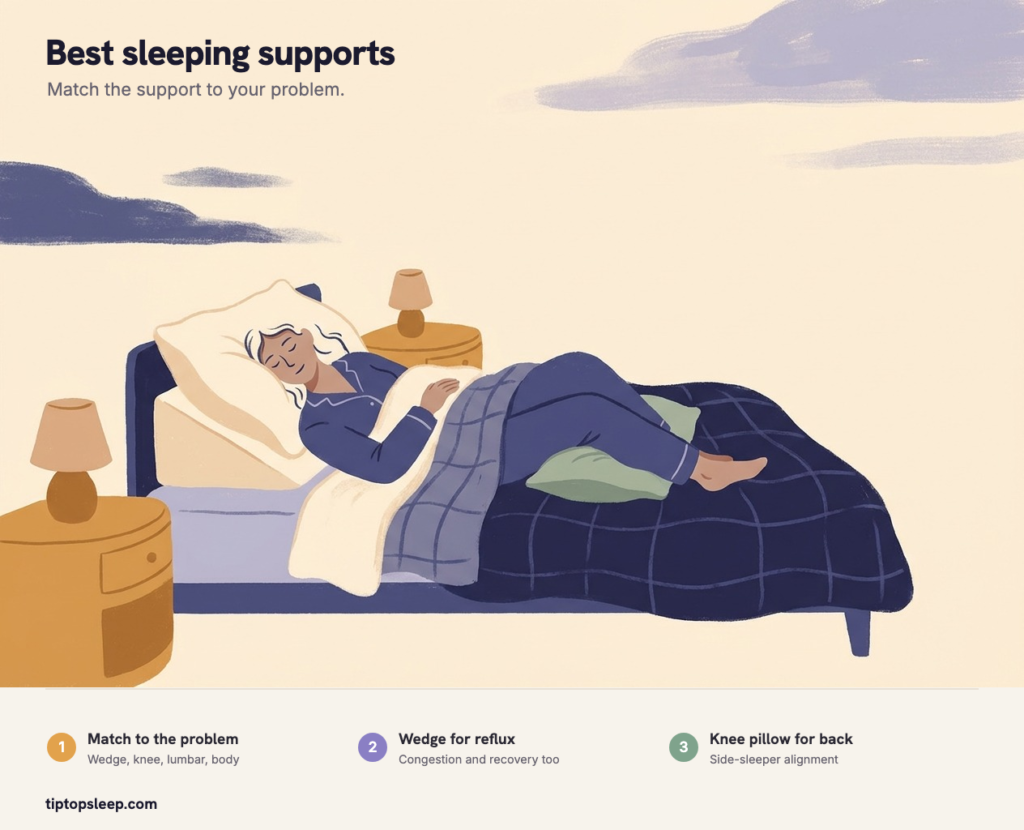
"Sleeping supports" isn't one product, it's a family of them, and the right one depends on what's actually bothering you. A wedge pillow elevates your upper body for reflux, congestion, or post-surgery recovery. A knee or leg pillow keeps your hips and spine aligned if you sleep on your side. A lumbar pillow fills the gap under your lower back. A body or pregnancy pillow gives side sleepers something to wrap around. A cervical or neck pillow supports your neck specifically. Match the support to the problem, not the other way around.
People ask me "what's the best sleeping support pillow" as if there's one universal answer, and I get why - the product pages all blur together after a while. But a wedge pillow and a knee pillow solve completely different problems, and buying the wrong one is how you end up with an expensive pillow shoved in a closet after two nights. Let's sort out which kind actually matches what's keeping you up.
What counts as a "sleeping support" anyway?
It's a broad category that breaks down into five main types, each built for a different job:
- Wedge pillows - a triangular foam incline that elevates your head, chest, or legs. Used for acid reflux, congestion, post-surgery elevation, and reducing snoring.
- Knee/leg pillows - a contoured pillow that sits between or under your knees. Used by side sleepers to keep hips level and take pressure off the lower back and hips.
- Lumbar support pillows - a smaller, firmer pillow or roll that fills the curve of your lower back. Used for lower back pain, often alongside a knee pillow.
- Body/pregnancy pillows - a long pillow (often C or U shaped) that supports your whole side, from head to knees. Used by side sleepers generally and by pregnant people specifically for belly and hip support.
- Cervical/neck pillows - a contoured pillow, usually with a center dip, shaped to support the neck's natural curve. Used for neck pain and stiffness.
The overlap confuses people. A body pillow and a knee pillow both help side sleepers, but a body pillow supports your whole torso and arms, while a knee pillow does one job: keeping your top knee from dragging your spine out of alignment. You don't need all five - just the one or two that match your actual problem.
How do I know which support I actually need?
Start from the symptom, not the product name.
- Reflux, heartburn, or waking up coughing: a wedge pillow that elevates your torso is the standard recommendation - gravity keeps stomach acid down.
- Congestion or a stuffy nose at night: the same upper-body elevation from a wedge helps drainage, which is why it's also common advice after sinus surgery.
- Recovering from surgery (tummy tuck, C-section, hernia repair): a wedge is often used to keep you propped at an incline, since lying flat can strain the area. Always follow your surgeon's specific instructions over generic advice.
- Lower back or hip pain, especially as a side sleeper: a knee pillow between your knees is the simplest fix. If you're a back sleeper, a lumbar roll or thin pillow under the knees serves the same purpose.
- Pregnancy, or you just sleep on your side and want more to hold onto: a full body pillow supports the belly, hips, and top leg all at once.
- Neck stiffness or waking up with a sore neck: a cervical pillow with contoured support, sized to your usual sleep position, addresses that directly - a flat pillow that's too soft or too high is a common hidden cause of neck pain.
The Sleep Foundation puts the underlying logic simply: "The best sleep position is one that promotes healthy spinal alignment from your hips all the way to your head." Every support in this list exists to close a gap somewhere along that line - under the knees, under the lower back, or under the neck - that your body can't close on its own.
Does a knee pillow actually help back pain?
For side sleepers, yes. When you sleep on your side without anything between your legs, your top leg drops forward and pulls your pelvis and lower spine out of their neutral position overnight. A pillow between the knees keeps the hips stacked.
The Sleep Foundation is specific about this: "Many side sleepers like to put a thin pillow between their knees, which helps hold the hips in a more aligned position." They also note it for back pain: "Putting a small pillow between your knees may take additional strain off of your lower back." If you deal with hip or lower back discomfort and sleep on your side, this is usually the highest-value, lowest-effort support to add - more so than a mattress upgrade, which is what most people reach for first.
If lower back pain is your main issue, it's worth reading our full breakdown of the best sleeping position for lower back pain, since position matters as much as the pillow itself.

ComfiLife Orthopedic Knee Pillow
A contoured memory foam wedge shaped specifically to sit between the knees without sliding out overnight, which is the main failure point of a flat pillow used for the same job. Straightforward pick if hip or lower back pain is your main complaint and you sleep on your side.
What's a wedge pillow actually good for?
A wedge pillow's whole job is elevation, which is useful for a narrower set of problems than people expect. It's a tool for specific situations: keeping your upper body raised to reduce reflux and nighttime coughing, helping sinus drainage during a cold or after sinus surgery, and giving surgical recovery patients an incline that's gentler than propping up loose pillows that slide apart by 2am. It's also commonly used to reduce snoring, since elevation can help keep the airway more open for some people - though it's not a substitute for a sleep apnea evaluation if snoring is severe or you're waking up gasping.
What it's not good for: fixing hip or lower back alignment on its own, or replacing a proper mattress. It solves an elevation problem, not an alignment problem.

TANYOO Bed Wedge Pillow
A dual-layer foam incline with a softer top layer over a firmer base, so the elevation holds shape all night instead of flattening under your weight by morning. Useful for reflux, congestion, or as a gentler incline during recovery - check with your doctor first if you're using it post-surgery.
What's the difference between a body pillow and a pregnancy pillow?
Mostly marketing. A "pregnancy pillow" is usually a C or U-shaped body pillow, sized to support the belly, back, and top leg simultaneously so a pregnant side sleeper isn't juggling three separate pillows. The same shape works for anyone who sleeps on their side and wants something substantial to wrap around, pregnant or not - it just gets marketed toward pregnancy because that's when people go looking for one.
If you already sleep with something between your legs and like the effect but want more support along your whole side, a body pillow is the natural next step up.

Momcozy U-Shaped Body Pillow
A full-length U shape that supports the belly, back, and both legs at once, so side sleepers aren't stacking multiple pillows to get the same coverage. Removable, washable cover matters here more than with smaller pillows, since this one gets slept on every night.
Not sure any of these three are quite right for your situation? Our Sleep Toolkit rounds up the gear we actually trust across every sleep problem, not just this one.
How do I pick pillow loft (thickness) correctly?
This trips people up more than the pillow type itself. A support pillow that's too thick or too thin for your body makes alignment worse, not better. The Sleep Foundation's guidance for cervical and neck pillows is direct: "Choose a pillow with a loft, or thickness, that matches the distance between your neck and your shoulder." Side sleepers generally need a higher loft than back sleepers, since there's more distance to fill between the ear and the mattress. Our guide on pillows for back sleepers covers the loft question from the other angle.
Frequently asked questions
Can I use a wedge pillow and a knee pillow at the same time?
Yes, they solve different problems and don't conflict. A wedge elevates your upper body; a knee pillow keeps your hips aligned if you're on your side. Using both is common for people recovering from surgery who also sleep on their side.
How long does it take to get used to sleeping with a support pillow?
Usually a few nights to a week. Your body has to unlearn whatever position it's defaulted to for years, so some restlessness in the first few nights is normal and doesn't mean the pillow is wrong for you.
Do sleeping supports actually work, or is it placebo?
For alignment-based supports like knee and lumbar pillows, there's a straightforward mechanical reason they help: they close a gap your body would otherwise leave unsupported. That said, no pillow fixes a genuine medical issue - if pain persists, it's worth seeing a doctor or physical therapist rather than pillow-shopping indefinitely.
Related reading:
- Should You Sleep With a Pillow Between Your Legs?
- Best Pillows for Back Sleepers
- Best Sleeping Position for Lower Back Pain
- How to Avoid Sleep Problems After Surgery
- Sleep Toolkit - the gear we actually recommend for situations like this
Sources & review: Sleeping position and alignment guidance checked against the Sleep Foundation's sleeping positions guide. This is general comfort information, not medical advice - if you're recovering from surgery or managing a chronic condition, follow your doctor's or surgeon's specific instructions over any generic recommendation here.
📥 Free: The Post-Surgery Sleep Recovery Kit
Our 2-page PDF - the safe sleep position for your surgery, how to set up your bed, a night-by-night recovery timeline, and the red flags worth calling your doctor about. We'll email you the download link.
By subscribing you agree to our Privacy Policy.