

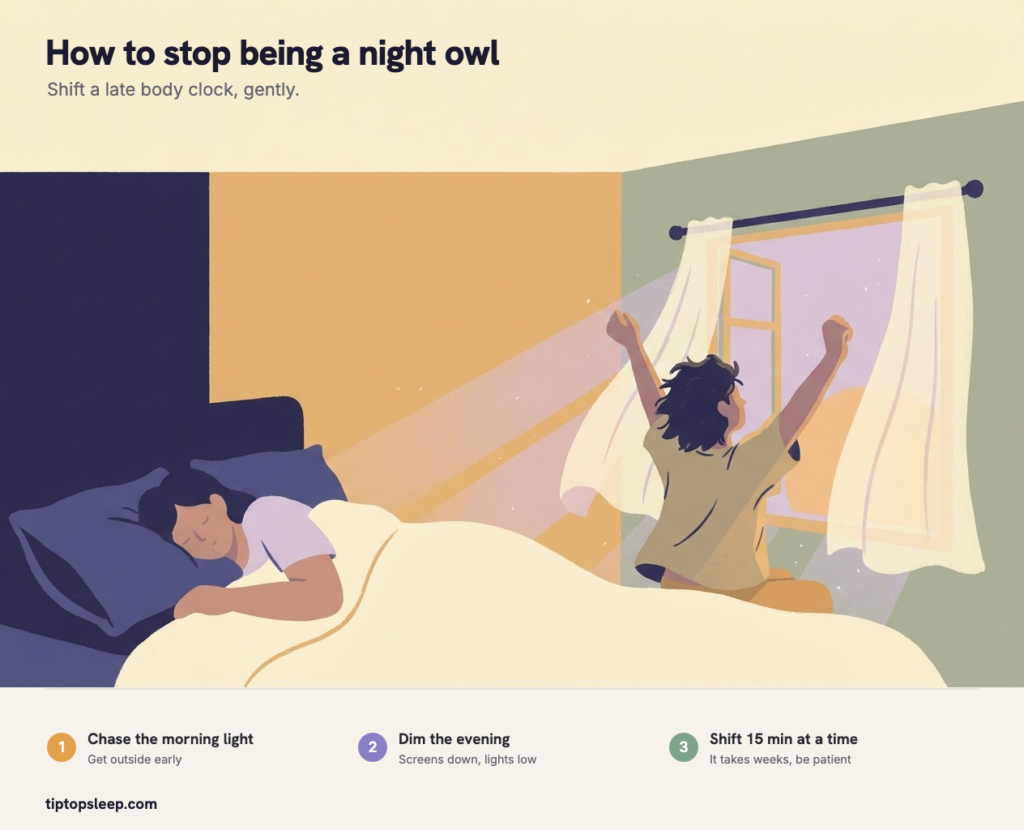
The biggest lever is bright light right after you wake up, paired with dim, warm light in the evening and a fixed wake time you keep every single day, weekends included. Shift your bedtime and alarm earlier in small 15-minute steps every few days rather than all at once. It typically takes a couple of weeks of consistency to feel the shift, not one rough night of forcing yourself to bed early.
I used to think being a night owl was just a personality quirk I could override with enough willpower and a stronger alarm clock. It doesn't work that way. Your body has an actual internal clock, and yelling at it with a 5am wake-up call the day after months of midnight bedtimes just leaves you exhausted and back where you started by Thursday. What actually works is quieter and slower than that, and it starts with understanding that some of this is genuinely not your fault.
Is being a night owl genetic, or is it just a bad habit?
Both, honestly - and that's worth sitting with before you try to change anything. Sleep Foundation explains that "chronotype is the natural inclination of your body to sleep at a certain time, or what most people understand as being an early bird versus a night owl," and that "emerging evidence shows that chronotype likely has a strong genetic component." Some people are simply wired to feel alert later and fall asleep later. That's not a character flaw, and if your schedule allows it, there's nothing wrong with staying a night owl.
This guide is for the other situation: you need to shift earlier because of work, school runs, or a life that starts before your body wants to. The honest news is that your underlying chronotype is mostly genetic and, as the Sleep Foundation puts it, "very difficult to purposely change." What you can shift is the timing of your schedule, nudging when you naturally get sleepy and wake, using light and habits. Think of it as moving a dial that resists you, not flipping a switch, and expect it to move slower than you would like.
What's the single most effective way to shift my body clock earlier?
Morning light, by a wide margin. Sleep Foundation is direct about this: "exposure to bright light in the morning is considered one of the best ways to become more of a morning person and shift your chronotype earlier." Light is the main signal your brain uses to set its internal clock, and getting it early in the day tells your body "the day has started" - which nudges everything else, including when you'll feel sleepy that night, earlier too.
- Get outside within 30-60 minutes of waking if you can. Even a cloudy morning outdoors is brighter than any indoor lighting.
- If you wake before sunrise or can't get outside, a light therapy lamp at breakfast or your desk gives you a strong dose without needing daylight to cooperate.
- Open the curtains immediately instead of lying in a dim room scrolling your phone - that's a missed window every single day.
Do this daily and consistently, not just on the days you remember. It's the one habit on this list that does the most work.

Philips SmartSleep Wake-up Light
Simulates a sunrise before your alarm goes off, so your body starts getting a light signal before you're even fully awake. Useful year-round, but especially in winter or if your bedroom doesn't get early sun. Doubles as a reading lamp and has a gentler wind-down sunset mode for the evening side of this whole plan.
Building out the rest of your setup? Our Sleep Toolkit has the gear we actually trust for shifting and protecting your sleep schedule.
How do I actually shift my bedtime without lying awake for hours?
Trying to move your bedtime three hours earlier tonight almost never works - you'll just lie there wide awake, annoyed, and prove to yourself that "it doesn't work for me." Instead, treat it like resetting your sleep schedule in stages:
- Shift by 15 minutes every few days, not all at once. Sleep Foundation recommends this exact approach: "start shifting your bedtime earlier, using increments of 15 minutes. At the same time, adjust your alarms to wake up 15 minutes earlier. Make the change gradually, taking at least a few days in between each new shift."
- Only move forward once the current time feels manageable. If 15 minutes earlier still feels rough after three or four days, hold there a bit longer before shifting again.
- Expect the first week to feel like nothing is happening. The visible progress usually shows up in week two or three.
Do I really have to wake up at the same time on weekends too?
Yes, and this is the rule most people quietly ignore. Sleeping in on Saturday and Sunday resets the clock you spent all week shifting - sleep researchers sometimes call this "social jet lag," and it's a real reason so many people feel like Monday is starting over from scratch. Sleep Foundation puts the underlying principle simply: "it is best to set regular sleep and wake times and follow them daily."
You don't have to be rigid to the minute. Aim to keep your wake time within about an hour of your weekday time, even after a late Friday night. If mornings already feel like a fight, training your body to wake up without an alarm is a good sign your new schedule has actually taken hold.
What should I do in the evening to make this easier?
Morning light does most of the heavy lifting, but the evening side matters too - it's where a lot of night owls accidentally undo their own progress.
- Dim the lights and switch to warmer tones an hour or two before your target bedtime. Overhead bright lighting keeps signaling "daytime" to your brain.
- Set a screen cutoff, or at minimum turn on night mode. It's less about blue light alone and more about the stimulating content screens tend to deliver - a group chat or a video autoplay queue keeps your brain alert regardless of screen color.
- Watch your caffeine cutoff. Sleep Foundation notes that "drinking caffeine up to six hours before bedtime can disrupt your sleep and make it harder to drift off" - if you're targeting an earlier bedtime, your last coffee needs to move earlier too.
- Eat dinner earlier if you can. A heavy meal right before bed keeps digestion active when your body should be winding down, which can work against an earlier bedtime.
- Get some activity earlier in the day. Morning or daytime exercise "may help them bring their sleep cycles approximately 30 minutes earlier," per Sleep Foundation - late-evening intense workouts can have the opposite effect for some people.
How do I deal with the "second wind" that hits right when I should be winding down?
That sudden burst of energy around 10 or 11pm - often called revenge bedtime procrastination when it's paired with "just one more episode" - is one of the most common reasons night owls stay night owls. A few things help:
- Start winding down before the second wind hits, not after. Once you're deep in it, willpower alone rarely wins.
- Give yourself a real evening, even a short one. A lot of revenge procrastination comes from feeling like the day never had any time that was yours - build in 20-30 minutes of something enjoyable earlier in the evening instead of stealing it from your sleep window.
- Move your body earlier, not later. If you feel wired at 10pm, a workout at 9pm probably isn't going to fix it - a walk after breakfast will do more for tonight's bedtime than anything you do right before it.
Is melatonin worth trying?
It can help as a small nudge in the right direction, but timing matters more than most people realize. Taken too close to your desired bedtime, melatonin mostly just makes you drowsy at the wrong time rather than actually shifting your clock. For shifting a late chronotype earlier, a small dose taken in the early evening, several hours before your target bedtime, is generally how it's used to help move the body's rhythm - not as a sleeping pill taken right before you turn off the light. Doses and timing vary by person, so this is genuinely worth a quick conversation with your doctor or pharmacist rather than guessing, especially if you're combining it with anything else.
When is this more than just being a night owl?
If you've tried a consistent, patient shift for several weeks and your sleep timing still won't budge - or if it's severely delayed (think falling asleep at 3-4am no matter what) and it's seriously disrupting work, school, or daily life - it may be delayed sleep phase disorder rather than an ordinary late chronotype. Sleep Foundation describes it this way: "delayed sleep phase disorder (DSPD), or delayed sleep-wake phase syndrome, is characterized by the inability to fall asleep, difficulty waking up on time, and, in some cases, daytime sleepiness or depression." Their guidance is straightforward: "if you think you have DSPD, talk to your healthcare provider about your symptoms. They can diagnose the disorder and help you determine an appropriate treatment plan." A sleep specialist has tools like sleep diaries and actigraphy that can tell the difference between "stubborn habit" and "clinical circadian disorder" far better than trial and error can.
Frequently asked questions
How long does it take to stop being a night owl?
Most people notice real movement after two to three weeks of consistent morning light and gradual bedtime shifts. Full adjustment, especially for a long-standing late schedule, can take four to six weeks. Rushing it with a sudden big change tends to backfire and just costs you sleep.
Can I fix my sleep schedule in one weekend?
Not reliably. A single early night rarely resets a circadian rhythm that took months or years to settle where it is. You can get a short-term boost from one good night, but the shift that sticks comes from repeating small changes daily, including on weekends.
Does exercise really change what time I feel sleepy?
Yes, timing just matters. Morning or daytime exercise tends to nudge your body clock earlier, which is what you want. Vigorous exercise very late at night can be stimulating for some people and work against an earlier bedtime, though this varies person to person.
Is it bad to be a night owl if my schedule allows it?
No. Chronotype has a real genetic component, and a late chronotype isn't a problem on its own. This whole guide is only relevant if your circumstances - work, school, family - require an earlier schedule than your body naturally prefers.
Related reading:
- How to Reset Sleep Schedule
- How to Wake Up Without an Alarm
- Sleep Hygiene Checklist
- Can ADHD Cause Sleep Problems?
- Sleep Toolkit - the gear we actually recommend for building a consistent sleep routine
Sources & review: Guidance here is general sleep hygiene information, checked against Sleep Foundation's page on chronotypes, their guide on how to become a morning person, and their page on delayed sleep phase disorder. It is not medical advice and doesn't replace guidance from your doctor, especially if a shifted schedule isn't budging after a genuine few weeks of effort.
📥 Free: The Post-Surgery Sleep Recovery Kit
Our 2-page PDF - the safe sleep position for your surgery, how to set up your bed, a night-by-night recovery timeline, and the red flags worth calling your doctor about. We'll email you the download link.
By subscribing you agree to our Privacy Policy.