

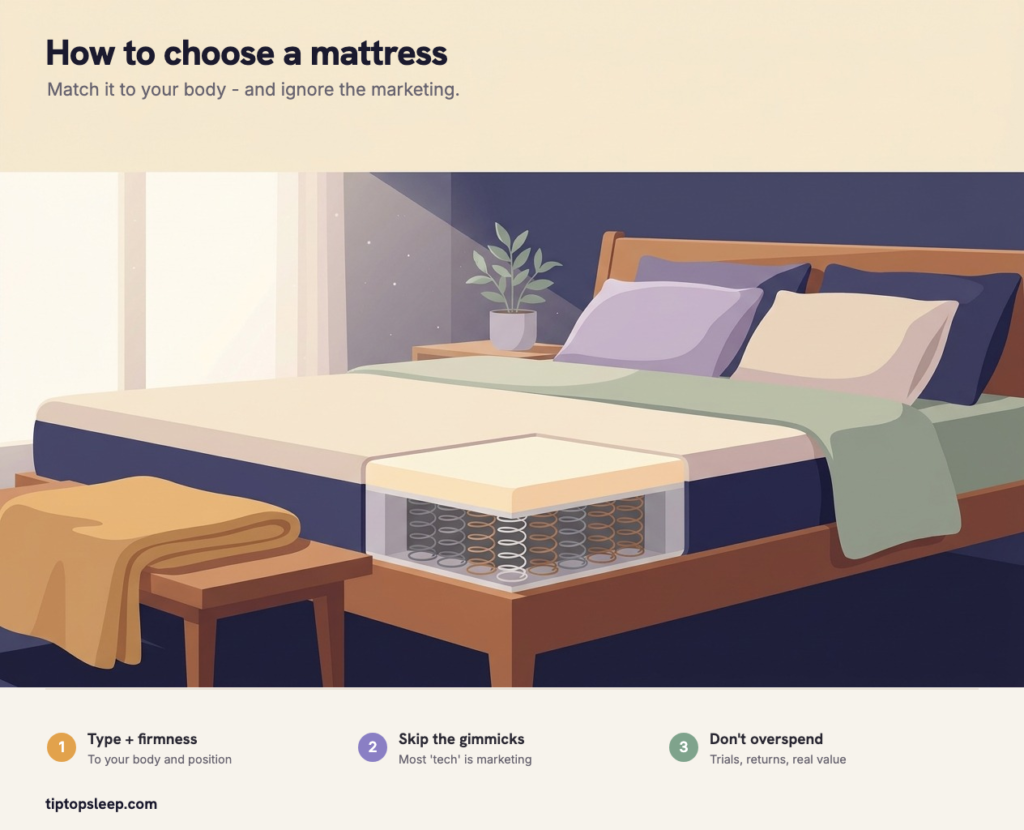
There is no single "best mattress" - only the right match for your body, sleep position and budget. Research on chronic back pain found medium-firm mattresses outperform firm ones; heavier bodies need firmer support, lighter bodies do fine softer. A good mattress lasts 7-10 years. Most shoppers overspend on marketing spec-sheet gimmicks, not sleep quality.
I've spent more hours than I'd like to admit reading mattress marketing copy, and most of it is nonsense dressed up as science. "AI-optimized comfort layers." "NASA-grade cooling gel." "Clinically proven" claims with no study attached. Underneath the noise, mattress shopping comes down to a handful of facts that don't change: your body weight, your sleep position, how hot you sleep, and how much you're willing to spend. Everything else is either genuinely useful (pressure relief, support, temperature regulation) or a spec-sheet trick to justify a bigger price tag. Here's the honest version - types, firmness, sizes, conditions, budget, care, and the accessories that can buy you time before you need a new mattress.
What are the different types of mattresses, and which is honestly worth it?
Every mattress on the market is a variation on five basic builds. None of them is universally "best" - each is a bundle of trade-offs.
- Memory foam. Dense polyurethane foam that slowly conforms to your body and contours around pressure points. Excellent motion isolation and strong pressure relief for side sleepers. Downside: it sleeps hot and can feel like you're "stuck in" the bed. Gel-infused and open-cell versions help a bit - don't expect miracles, see the marketing section below. Lifespan: roughly 7-10 years before it loses support.
- Latex. Natural or synthetic rubber foam. Bouncier than memory foam - pushes back rather than slowly sinking - and sleeps cooler thanks to a more breathable cell structure. Naturally resistant to dust mites and mold. Costs more, especially GOLS-certified organic latex, but often lasts longest: 10-15 years for natural latex.
- Innerspring. The classic steel-coil mattress under a thin comfort layer. Responsive, sleeps cool, usually the cheapest option. Trade-off: weaker pressure relief and more motion transfer. Coils sag and squeak with age - expect 5-8 years of good support.
- Hybrid. A coil core topped with a few inches of foam or latex - the honest middle ground: better pressure relief than plain innerspring, cooler and more supportive than all-foam. Commonly recommended for combination sleepers. Lifespan around 6-8 years.
- Airbeds (adjustable-firmness). Air chambers you inflate or deflate by remote, sometimes dual-sided so partners can set different firmness. Genuinely useful if you disagree on firmness or your needs change (pregnancy, recovery, aging). The pump and remote are one more thing that can break, and repairs aren't cheap.
- "Smart" or AI mattresses. Be skeptical. These add sensors, an app, and language like "AI-optimized" or "learns your body." Strip the branding and most are still standard foam, hybrid or airbed cores with sleep-tracking bolted on - the mattress isn't smarter, the marketing is. A wearable or under-mattress sensor pad usually gives the same tracking for far less, without tying it to a $2,000+ purchase.
What firmness is actually right for your body and sleep position?
Firmness is rated on a 1-10 scale, and it matters more than brand name. Sleep Foundation's educational firmness guide defines the scale this way: "Medium firm surfaces do not sink much, but they conform moderately" (a 6), while "firm mattresses have virtually no sinkage and minimal conforming" (7-8), and "soft surfaces sink and conform considerably" (2-3). Most people land comfortably in the 4-7 range; very few people actually want or need a true 9-10 "extra firm."
Firmness needs to match two things: how you sleep, and how much you weigh.
| Sleep position | Best firmness range | Why |
|---|---|---|
| Side | Soft to medium (3-6) | Cushions the shoulder and hip so your spine stays level, not angled |
| Back | Medium to firm (5-7) | Needs enough support to stop the lower back sagging, but some give at the shoulders |
| Stomach | Medium-firm to firm (6-8) | Prevents the hips sinking and pulling the lower back out of line |
| Combination | Medium (5-7) | A middle-ground firmness that doesn't punish any one position |
| Body weight | Typical preference |
|---|---|
| Under 130 lbs | Soft to medium (2-5) - lighter bodies don't compress foam enough to get support from a firm surface |
| 130-230 lbs | Medium to medium-firm (4-6) |
| Over 230 lbs | Medium-firm to extra firm (6-10) - heavier bodies sink deeper and need more resistance to avoid excess sag |
The strongest evidence for "medium-firm" as a default isn't marketing - it's a randomised controlled trial. A multicentre study of 313 adults with chronic low-back pain, published in The Lancet, opened by noting that "a firm mattress is commonly believed to be beneficial for low-back pain, although evidence supporting this recommendation is lacking." The trial then compared firm mattresses against medium-firm ones and concluded plainly: "a mattress of medium firmness improves pain and disability among patients with chronic non-specific low-back pain." Patients on the medium-firm mattress had meaningfully better outcomes for pain in bed, pain on rising, and disability than the firm-mattress group. Cleveland Clinic cites similar figures in its own patient guidance, noting a medium-firm mattress "can improve sleep quality by 55% and help reduce chronic back pain." The old advice that back pain always means "buy the firmest mattress you can find" simply isn't well supported.
For more on the position side of this, see our guide to the best sleeping position for lower back pain and our piece on learning to sleep on your back.
What mattress size do you actually need?
Here are the standard U.S. dimensions, plus the RV sizes that trip people up because they don't match household bedding.
| Size | Dimensions (W x L) | Best for |
|---|---|---|
| Twin | 38" x 75" | Kids, single sleepers in small rooms, guest rooms |
| Twin XL | 38" x 80" | Taller single sleepers, dorm rooms, common in adjustable/split-king setups |
| Full / Double | 54" x 75" | A single adult who wants more width, tight couples on a budget |
| Queen | 60" x 80" | The default for most couples - about half of all mattress sales |
| King | 76" x 80" | Couples who want more shoulder width, especially with kids or pets in bed |
| California King | 72" x 84" | Taller sleepers who need extra length more than width |
| Split King | 2x Twin XL (76" x 80" combined) | Couples who want independently adjustable bases or different firmness per side |
Full vs. queen: the difference isn't just size on paper - it's 6 extra inches of width and 5 extra inches of length in a queen. For one adult, a full is usually fine. For two adults sharing regularly, a queen (or larger) gives each person roughly the same per-person width as a single sleeper on a twin - a full splits that same width in half.
RV and specialty sizes: RV mattresses are frequently shorter or narrower than household equivalents (short queen at roughly 60" x 75", RV king around 72" x 80") to fit vehicle frames - always measure your actual sleeping platform before ordering, since "RV queen" isn't standardized across manufacturers.
Biggest standard bed size: California King is the longest at 84 inches; standard King is the widest at 76 inches. Neither is "biggest" outright - it depends whether you need length or width more.
What actually helps specific conditions - and what's just marketing?
I want to be careful here: nothing below is medical advice, and I'm not a clinician. These are honest, general patterns - see your doctor for an actual diagnosis or treatment plan.
- Lower back pain: the evidence above points to medium-firm as the reasonable starting point for most people, not maximum firmness. If pain is chronic or worsening, that's a conversation for a doctor or physical therapist, not a mattress purchase.
- Scoliosis: no mattress corrects spinal curvature - it can only support you without adding extra strain. Medium to medium-firm, keeping the spine as neutral as possible, is the general principle; a physical therapist familiar with your curve is a better guide than any mattress marketing.
- Arthritis: pressure relief around joints often matters more than raw firmness - memory foam or a plush hybrid tends to help more than a firm innerspring. Cold, hard surfaces can also aggravate joint stiffness.
- Fibromyalgia: widespread pressure sensitivity usually points toward softer, more conforming surfaces that don't concentrate pressure on tender points. This is trial and error more than a formula.
- Side sleepers: need cushioning at the shoulder and hip so the spine stays level. Softer to medium firmness, per the table above.
- Stomach sleepers: need enough firmness that the hips don't sink and pull the lower back out of alignment - generally the position most likely to strain the neck and back regardless of mattress.
None of this replaces medical care. If pain is new, severe, or getting worse, see a doctor before assuming a new mattress will fix it.
How much should you actually spend on a mattress?
The honest answer: probably less than the industry wants you to believe.
- Under $500 (twin/queen basic): a serviceable innerspring or basic all-foam mattress. Fine for a guest room, kid's room, or a rental. Don't expect much beyond 5-6 years, and pressure relief will be basic.
- $500-$1,500: where most decent hybrids and mid-tier memory foam mattresses live. For a queen, this range covers genuinely good pressure relief, reasonable cooling, and 7-10 years of realistic lifespan - most people shopping for a primary bed should expect to land here.
- $1,500+: buys premium materials (natural latex, higher coil counts, denser foam) and sometimes marginally better durability. Past a certain point you're paying for brand name and showroom experience more than sleep quality - there's no good evidence a $4,000 mattress sleeps meaningfully better than a well-reviewed $1,200 one for most people.
You do not need to spend $2,000+ to sleep well. The mattress industry runs on markups that would embarrass most retail categories - list prices are set high so a "50% off Presidents Day sale" (which runs essentially year-round under different names) still nets a healthy margin. If a mattress is "always on sale," the sale isn't the signal - the price you'd pay any day of the year is.
What actually matters vs. what's a marketing gimmick?
This is the section I feel strongest about, because it's where most shoppers get talked into overpaying.
What genuinely matters:
- Pressure relief - does it cushion your hips and shoulders without letting you sink so far you feel stuck?
- Support / spinal alignment - does your spine stay roughly level, or does the middle sag or arch?
- Temperature regulation - does it trap heat against your body, or let it dissipate?
- Motion isolation - if you share a bed, does a partner's movement wake you?
- Edge support and durability - does it hold its shape at the edges, and does it sag prematurely?
What's mostly marketing:
- "Gel infusions" - a thin layer of gel beads or gel-swirl foam modestly helps heat dissipation over plain memory foam, but it's often oversold as a full cooling solution. An incremental tweak, not a transformation.
- "AI-powered" or "smart" mattresses - as covered above, usually a sensor and an app bolted onto a conventional foam or hybrid core. The comfort layer isn't smarter; the pricing usually is.
- "NASA foam" / "space-grade" claims - memory foam traces to NASA-funded research in the 1960s-70s, but that history is now used as a marketing label on foam with no other aerospace connection. An origin story, not a quality certification.
- Thread-count-style spec games - coil counts, foam "density" numbers, and layer counts are sometimes real quality signals and sometimes just numbers chosen to look impressive. A high spec-sheet number isn't a substitute for actually testing the mattress.
- Most "cooling" claims - "cooling cover," "phase-change material," "breathable fabric" all help marginally, but none overcome a dense memory foam core that traps heat. If you sleep hot, the base material matters more than the marketing layer on top.
- Sleep-trial and return-policy games - a 100-night "risk-free" trial sounds generous until you read the fine print: mandatory break-in periods, return/pickup fees, or store-credit-only refunds. Read the actual terms, not the banner headline.
- Showroom vs. online buying - five minutes on a showroom mattress tells you little about how it feels after a year of actual sleep. Online mattress-in-a-box companies with real trial periods often give a more honest test, provided you read the return terms.
How long does a mattress actually last, and how do you care for it?
| Type | Typical realistic lifespan |
|---|---|
| Memory foam | 7-10 years |
| Latex | 10-15 years (natural), less for synthetic blends |
| Innerspring | 5-8 years |
| Hybrid | 6-8 years |
Cleveland Clinic's general guidance is that "it's best to change mattresses about every 10 years - especially if you've experienced physical changes such as an injury or a significant weight gain or loss." Sagging, waking up with new aches, or visible body impressions are the practical signs it's time, regardless of the calendar.
Basic care that extends life: rotate head-to-foot every 3-6 months (most modern mattresses don't need flipping, but check the label), use a mattress protector from day one, vacuum periodically, and keep it on a properly-spaced foundation - a worn box spring or slats too far apart will sag a good mattress prematurely.
Removing stains: blot (don't rub) with a clean cloth, use a mild water-and-dish-soap solution or diluted enzyme cleaner for organic stains, and let it air-dry fully before putting sheets back on - trapped moisture invites mold.
Storing a mattress: keep it flat where possible (not leaned on its side long-term, which distorts foam and coils), in a breathable cover rather than sealed plastic, off the floor, in a dry, climate-controlled space - a damp garage or storage unit is a fast route to mold.
What to do with an old mattress: most mattresses are recyclable - coils, foam and wood frame can be separated and reused - but they can't go in normal curbside trash in most areas because of their bulk. Look for a local mattress recycling program, or check if your new-mattress delivery includes old-mattress haul-away, a common and often free service.
Is it safe to buy a used mattress?
Generally, no - and this is one of the more overlooked hygiene risks in home shopping. A consumer protection alert from Montgomery County, Maryland's Office of Consumer Protection put it plainly, noting that "recent reports about bed bugs have generated concern related to used bedding products," and recommending that "consumers avoid purchasing used mattresses without a written guarantee that they are disinfected." The same alert is direct about the riskiest source: never re-use mattresses that have been abandoned or are being given away by strangers.
Beyond bed bugs, a used mattress carries other real risks: invisible mold and mildew, dust mite accumulation, no manufacturer warranty (most are non-transferable), and no way to know how much the support core has already broken down - you could be buying the tail end of its useful life at a "bargain" that isn't one. Regulation is thinner than most assume: the same consumer alert notes "currently, there is no State law requiring used mattresses to be disinfected" in Maryland, and that patchwork is typical of most U.S. states. If you go the secondhand route anyway, get it from a retailer offering a written disinfection guarantee, inspect seams closely for reddish-brown stains or small black specks (signs of bed bugs), and budget for a protector and thorough cleaning before it touches your bedroom.
What about off-gassing and VOCs in new mattresses?
New foam mattresses - especially memory foam - often have a noticeable chemical smell out of the box. This is off-gassing: the release of volatile organic compounds (VOCs) from the foam, adhesives, and fabric treatments. The EPA defines VOCs simply: "Volatile organic compounds (VOCs) are emitted as gases from certain solids or liquids," and identifies "building materials and furnishings" as common indoor sources that "release organic compounds while you are using them, and, to some degree, when they are stored." It also flags relevant context: "concentrations of many VOCs are consistently higher indoors (up to ten times higher) than outdoors."
Reported symptoms tied to VOC exposure generally include eye, nose and throat irritation and headaches - typically at exposure levels well above what one mattress in a ventilated bedroom produces. Practically: unwrap a new foam mattress in a well-ventilated room, let it air out a few days if the smell is strong, and look for CertiPUR-US certified foam, which screens for a defined list of chemicals. If you're chemically sensitive, latex generally off-gasses less than polyurethane memory foam.
Can accessories fix a bad mattress - or do you just need a new one?
Sometimes an accessory genuinely buys you time. Sometimes it's a bandage on a mattress that needs replacing. Here's the honest split.

iSoCore 2.0 Gel Infused Foam Mattress Topper
A topper can genuinely extend the life of a mattress that's a bit too firm or has started to feel worn but isn't actually sagging or broken down structurally - it adds a fresh comfort layer without replacing the whole bed. It will not fix a mattress with sagging, broken support, or a body impression; that's a support-core problem no topper solves.

Zippered Waterproof Mattress Protector
This one isn't about comfort - it's about protecting your investment and your warranty. A fitted, zippered waterproof protector keeps spills, sweat, and dust mites off the mattress itself, which matters both for hygiene and because most manufacturer warranties are void if the mattress is stained. Put one on the day the mattress arrives, not after the first accident.
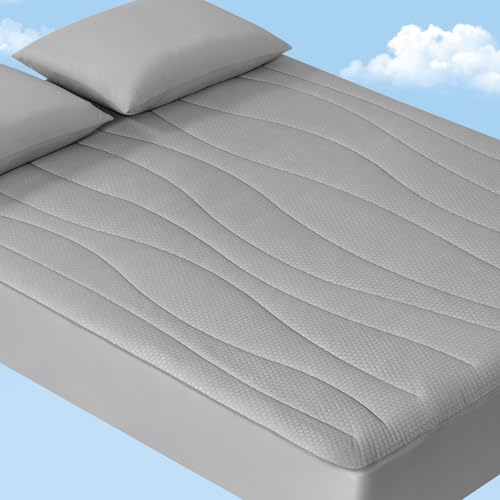
Elegear Cooling Mattress Pad
If your mattress itself is fine but you sleep hot - especially common with denser memory foam - a cooling pad sits on top and pulls heat away from your body more effectively than a "cooling-infused" foam layer usually does on its own. Genuinely useful for hot sleepers; it will not fix poor support or sagging. See our guide on how to sleep when it's hot for more on temperature control beyond the mattress itself.
One more accessory worth a mention: adjustable bases. These raise the head or foot of the bed electronically - genuinely useful for reflux, mild snoring, reading in bed, or recovery from certain surgeries (we cover positioning for specific recoveries in our recovery sleep guides). They're an expensive add-on though, and not every mattress type is rated to flex with one - check compatibility before buying, especially with some latex and traditional innerspring builds.
Want the fuller kit - sleep masks, earplugs, cooling gear and more? See our Sleep Toolkit.
How we think about mattress picks
We don't run a "top 10 best mattresses" ranking, and we're skeptical of sites that do - most of that content is paid placement dressed up as independent testing. What we do instead: point you to the accessories and principles that genuinely help, tell you honestly when something is marketing over substance, and send you to Amazon to check current prices, specs and reviews for yourself before you buy. We'd rather be useful than pretend to have tested three hundred mattresses in a warehouse.
Frequently asked questions
Is a firmer mattress always better for back pain?
No. A randomised controlled trial published in The Lancet found that medium-firm mattresses improved pain and disability more than firm mattresses in people with chronic low-back pain. "Firmest possible" is outdated advice for most people.
How often should I replace my mattress?
Roughly every 7-10 years depending on the material, or sooner if you notice sagging, new aches on waking, or a visible body impression. Cleveland Clinic recommends replacing "about every 10 years," especially after a significant weight change or injury.
Is it safe to buy a used mattress?
Generally not without a written disinfection guarantee. Bed bugs, mold, dust mites, no transferable warranty, and no way to know how much of its support life is already gone are all real risks. Consumer protection guidance specifically warns against mattresses given away by strangers.
What size mattress do most couples buy?
Queen (60" x 80") - it's the single most common size sold in the U.S. King (76" x 80") gives more width if you want it; California King (72" x 84") gives more length instead.
Do "cooling" mattresses actually work?
Some cooling features (breathable covers, gel-infused foam, phase-change materials) modestly help, but none fully overcome a dense memory foam core that traps heat. A separate cooling mattress pad on top is often more effective for hot sleepers than paying extra for a "cooling" mattress.
Should I buy a mattress topper instead of a new mattress?
A topper can extend a mattress that's slightly too firm or a bit worn, but it can't fix sagging or a broken support core. If you wake up with new aches or see a visible dip where you sleep, that's a new-mattress problem, not a topper problem.
Sources & review: Researched and checked against: Kovacs FM, et al., "Effect of firmness of mattress on chronic non-specific low-back pain: randomised, double-blind, controlled, multicentre trial," The Lancet via PubMed; Cleveland Clinic, "How To Choose a Mattress for Better Sleep"; Sleep Foundation's educational firmness scale (educational reference only, not their product rankings); U.S. EPA on volatile organic compounds and indoor air quality; and the Montgomery County Office of Consumer Protection alert on new and used mattresses. This is general information, not medical advice, and not a substitute for professional guidance on back pain, arthritis, fibromyalgia, scoliosis or any other health condition - talk to your doctor about your specific situation.
📥 Free: The Post-Surgery Sleep Recovery Kit
Our 2-page PDF - the safe sleep position for your surgery, how to set up your bed, a night-by-night recovery timeline, and the red flags worth calling your doctor about. We'll email you the download link.
By subscribing you agree to our Privacy Policy.