

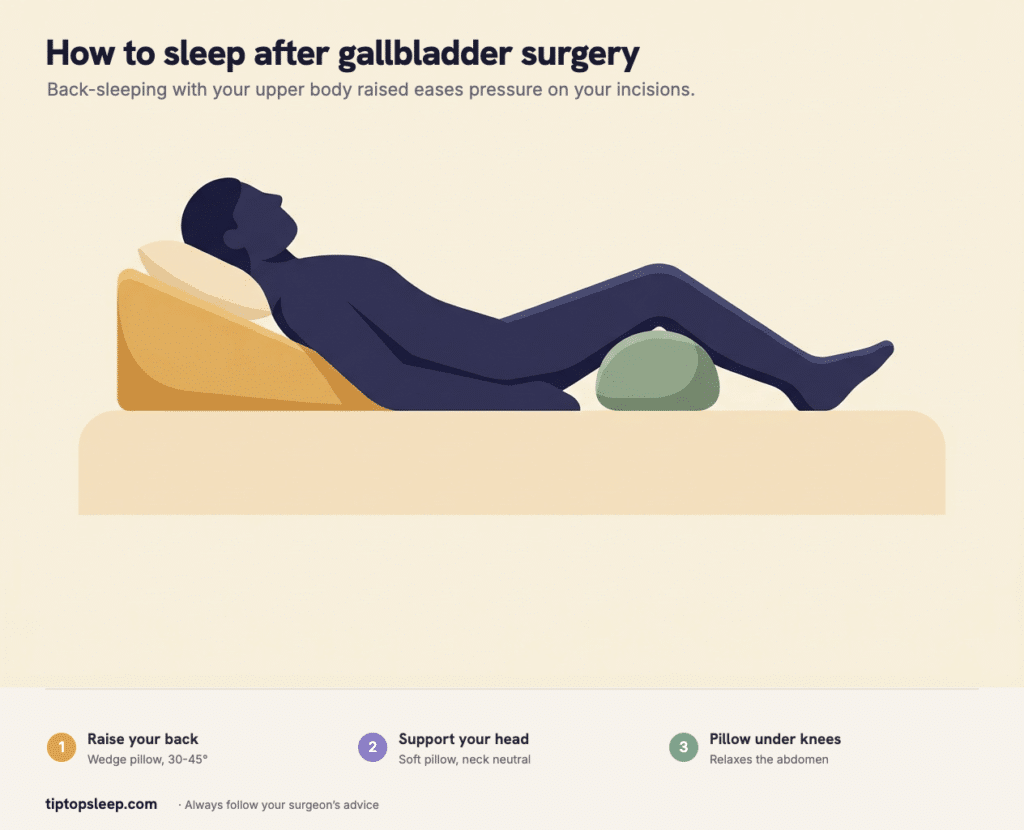
Sleep on your back with your upper body raised about 30-45° on a wedge pillow, and put a pillow under your knees. This keeps pressure off the incisions across your upper-right abdomen. Avoid sleeping on your stomach or lying completely flat until you've healed; most people ease back to gentle side-sleeping within a couple of weeks.
The first few nights after gallbladder surgery are rarely about the pain you expected - they're about finding a way to lie down that doesn't tug at your incisions every time you breathe or shift. I've been the person staring at the ceiling at 2am trying to get comfortable, and I've sat up with family after their operations too. The good news: a few small changes to how you set up your bed make an enormous difference. Here is exactly what to do.
The best position: on your back, upper body raised
After a laparoscopic cholecystectomy (keyhole gallbladder removal) your incisions sit across your upper-right abdomen. Lying flat, or rolling onto that side, pulls on those small wounds and on the muscles underneath. Sleeping on your back with your upper body gently raised keeps everything relaxed and takes the pressure off. Here's the setup:
- Raise your back to about 30-45°. A wedge pillow is the easiest way; a firm stack of bed pillows or an adjustable base works too. This is the single most helpful change.
- Support your head with a soft pillow so your neck stays in a neutral line - not chin-to-chest.
- Put a pillow under your knees. Bending your knees slightly slackens the abdominal wall, so there's less tension across your incisions.
If you're a die-hard side sleeper, the left side (away from the incisions) with a pillow hugged against your tummy is the usual next-best option once the first tender days have passed - but check with your surgeon first, and let comfort be your guide.
Your first weeks, night by night
Recovery isn't one fixed rule - it changes week to week. As the NHS puts it, after keyhole gallbladder removal "it usually takes around 2 weeks to return to your normal activities." Your sleep tends to follow that same curve:
- Days 1-3: Back-sleeping, well propped up. Keep pain relief timed so a dose covers your longest sleep stretch. Getting in and out of bed via your side (roll, then push up with your arms) protects your core.
- Days 4-14: Still mostly on your back, but you can lower the incline as it feels comfortable. Many people start easing onto their left side around now.
- Weeks 2-6: Gradually return to your normal position as the soreness fades. Most people are back to comfortable side-sleeping within a few weeks; give stomach-sleeping the longest.
Positions to avoid at first
- On your stomach - it puts direct pressure on healing incisions. Leave this until you're well healed.
- Flat on your back with no elevation - fine for some, but many find it makes getting up harder and can worsen post-surgery shoulder-tip discomfort from the gas used in keyhole surgery.
- On your right side - directly on the incisions - until it genuinely feels comfortable.
The one thing that makes this easier
You can build the incline from ordinary pillows, but they slide and flatten through the night. A proper bed wedge holds the angle so you're not rebuilding your setup at 3am - it's the item readers tell me made the biggest difference to their first week.

Kölbs Bed Wedge Pillow
A firm foam wedge that holds a 30-45° incline all night - the comfortable-recovery workhorse. Also great later for reflux or reading in bed.
Want the full kit? See our Sleep Toolkit for the masks, cooling pads and other helpers worth having during recovery.
When to call your surgeon
Trouble sleeping from soreness is normal. These are not - contact your surgeon or seek care if you notice:
- A fever, or redness, swelling or fluid leaking from an incision (possible infection).
- Pain that is getting worse rather than better, or isn't controlled by your medication.
- Yellowing of the skin or eyes, or persistent nausea and vomiting.
- Shortness of breath or chest pain - seek urgent help.
When in doubt, call. It's what your surgical team is there for.
Frequently asked questions
How long after gallbladder surgery do I need to sleep sitting up?
Most people are most comfortable propped up for the first few days to a week, then gradually lower the incline as the soreness eases. There's no fixed rule - let comfort guide you.
Can I sleep on my side after gallbladder removal?
Usually yes, once the first tender days have passed - the left side (away from the incisions) with a pillow against your tummy tends to be most comfortable. Ease into it and stop if it pulls.
Why does my shoulder hurt when I lie down?
Keyhole surgery uses gas to inflate the abdomen, and leftover gas can irritate a nerve that refers pain to the shoulder tip. It's common, harmless, and passes within a few days; gentle walking and an upright position help.
What pillow is best after gallbladder surgery?
A firm bed wedge to raise your upper body, plus a normal pillow under your knees. That combination keeps your abdomen relaxed and the angle stable through the night.
Sources & review: Guidance here is general comfort advice, researched against post-operative recovery information from the NHS and the Mayo Clinic. It is not medical advice and does not replace your surgeon's instructions - always follow the specific guidance you were given, and contact your care team with any concerns.
📥 Free: The Post-Surgery Sleep Recovery Kit
Our 2-page PDF - the safe sleep position for your surgery, how to set up your bed, a night-by-night recovery timeline, and the red flags worth calling your doctor about. We'll email you the download link.
By subscribing you agree to our Privacy Policy.