

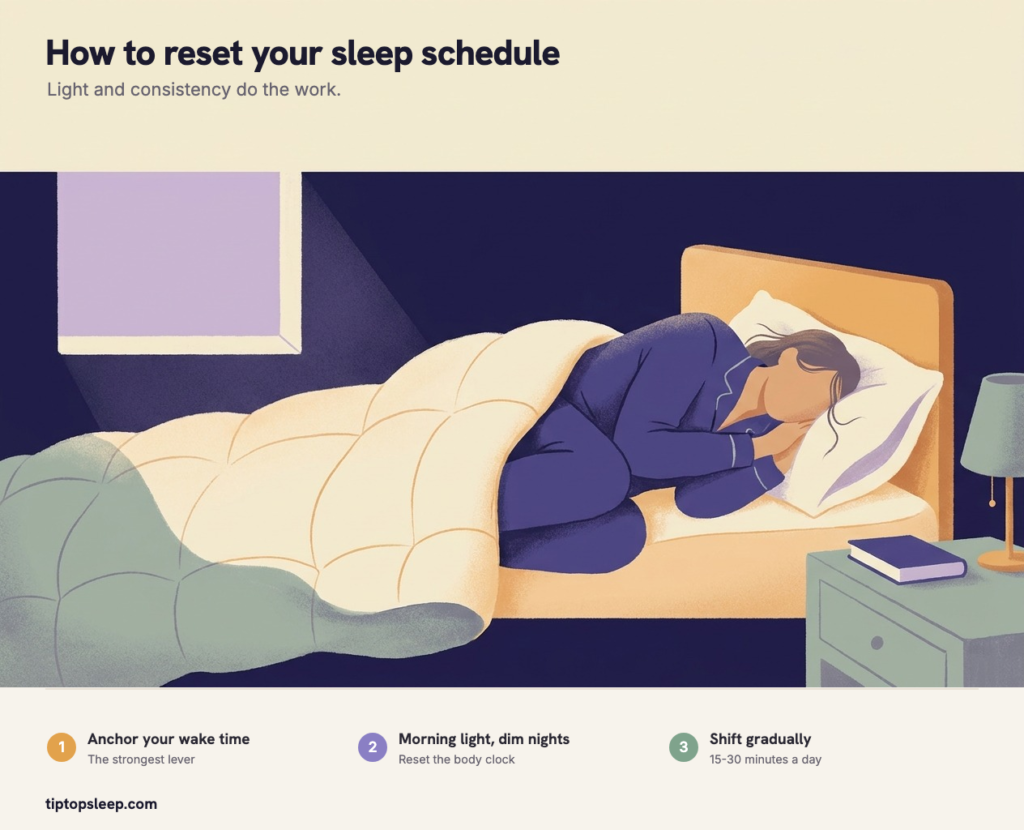
You reset a messed-up sleep schedule mainly with light and a fixed wake time, not with one dramatic "early night." Get bright light soon after waking, dim the lights in the evening, and pick a wake-up time you can hold every single day, weekends included. If your schedule is badly off, shift your bedtime gradually by 15 to 30 minutes a day rather than trying to jump 4 hours at once. There's no genuine overnight fix - most people need 3 to 7 days of consistency before it feels normal again.
I've wrecked my own sleep schedule more times than I'd like to admit - a long-haul flight, a week of deadlines that turned into all-nighters, one too many "just staying up for the finale." My first instinct was always to force an early bedtime and will myself to sleep. It never worked. What actually works is slower and less satisfying to hear, but it's the same handful of levers every time: light, timing, and patience.
Why does my sleep schedule get so messed up in the first place?
Your body clock, the circadian rhythm, is mostly set by light. The Sleep Foundation explains the mechanism plainly: "In the morning, as exposure to light increases, melatonin production stops and body temperature rises, promoting wakefulness." Flip that around at night - dim light lets melatonin rise again and your body starts winding down.
Travel, shift work, all-nighters, and even a few late nights all interrupt that light pattern, and your internal clock drifts out of sync with the actual clock on your wall. The good news: the same mechanism that got you off track is what gets you back on it. You're not fighting your biology, just resending it the right signals at the right times.
What's the single most effective thing I can do?
Anchor a fixed wake-up time and protect it, even on weekends. This is the lever that matters most, more than bedtime itself. Your wake time sets off a chain reaction: it determines when you get morning light, when your body starts producing melatonin later that evening, and when you'll naturally feel sleepy. A wandering wake time keeps that whole chain unstable.
This is also why the classic "sleep in on Saturday to catch up" habit backfires. Sleeping in shifts your body clock later, essentially mini jet lag you give yourself every weekend, then you're fighting to reset it again by Monday. If that loop sounds familiar, it's worth reading about why you might not be able to sleep more than a few hours straight once your rhythm gets this inconsistent.
How do I actually shift my schedule if I'm badly off track?
- Move gradually, not all at once. Shift your bedtime and wake time by 15 to 30 minutes a day in the direction you need to go, rather than trying to force a 4-hour jump overnight. Your body clock adjusts in small steps far more reliably than in one leap.
- Pick your wake time first, then work backward. Decide what time you need to be up, hold it firmly, and let bedtime follow from there as your body catches up.
- Get bright light within the first hour of waking. Outdoor light is ideal, even on a cloudy day it's far brighter than indoor lighting. This is the single strongest morning signal you can send your circadian rhythm.
- Dim the lights 1 to 2 hours before your new bedtime. Lamps instead of overhead lights, screens down or on night mode. This lets melatonin start rising instead of getting suppressed.
- Keep meals and exercise on the new schedule too. Your body clock isn't only reading light, it's also reading when you eat and move. Consistent timing on both reinforces the shift instead of working against it.
If your drift is severe, like after a long flight, this same gradual approach is the backbone of how to beat jet lag too - the tools are identical, just applied to a bigger gap.
What about naps and caffeine while I'm resetting?
- Keep naps short and early. If you're exhausted while adjusting, a nap under 30 minutes, taken before mid-afternoon, is far less likely to undo your progress than a long or late one. A longer or later nap can push your bedtime back exactly when you're trying to pull it earlier.
- Better yet, skip the nap if you can. Being appropriately tired at your new bedtime is what makes the new schedule stick. If you're curious whether a short nap actually helps at all, we've looked at whether a five-minute nap does anything.
- Cut caffeine earlier than you think you need to. Caffeine can still be affecting your system 6+ hours after you drink it. While you're resetting, an early afternoon cutoff gives your body a cleaner shot at falling asleep at the new target time.
Should I use melatonin to help reset my schedule?
Melatonin can help, but timing and dose matter more than most people realize, and it's not a substitute for the light and timing work above. The Sleep Foundation notes that "taking melatonin about 30 minutes before bedtime may help," and that "doctors usually recommend dosages in the 1 to 5 milligram range," generally advising to "start with the lowest possible dose and to increase as needed."
Their guidance is also clear that this isn't a decision to make alone: "Before you begin taking melatonin supplements, make sure to talk to your doctor about potential interactions," and they suggest you "ask your doctor or a pharmacist to suggest a trusted brand." If you're pregnant, on other medications, or considering it for a child, that conversation matters even more. Think of melatonin as a nudge in the right direction, not the thing doing the actual work - light and timing are still what reset the clock.
How long does it actually take to reset a sleep schedule?
Longer than a single night, no matter what a headline promises. As a rough guide, a small shift of an hour or two can settle in a couple of days. A bigger disruption, like a week of night shifts or a long-haul flight across several time zones, more realistically takes the better part of a week of consistent effort. The CDC's core advice for good sleep habits starts with the basics: "Going to bed and getting up at the same time every day," alongside "keeping your bedroom quiet, relaxing, and at a cool temperature" and "avoiding caffeine in the afternoon or evening." None of that is exciting advice, but consistency is genuinely what does the work here, not any single trick.

Philips SmartSleep Wake-Up Light
Since morning light is the strongest lever for resetting your body clock, a sunrise-simulating alarm is one of the few gadgets that actually does something useful here, especially in winter or if your new wake time falls before sunrise. It brightens gradually before your alarm so you're waking into light instead of darkness, and it doubles as a dimmable lamp in the evening to help you wind down. Not a substitute for real outdoor light during the day, but a solid assist on the days you can't get outside fast enough.
Want more of what's actually worth having on your nightstand? Our Sleep Toolkit rounds up the gear we trust for situations like this one.
Frequently asked questions
Can I reset my sleep schedule in one night?
Not really. You can force yourself to fall asleep early or stay up all night to "reset," but your circadian rhythm doesn't move that fast. A one-night fix usually just leaves you tired at the wrong time again within a day or two. Gradual shifts and a fixed wake time work better and actually last.
Is it better to stay up all night or go to bed early to fix my schedule?
Neither is ideal on its own. Staying up all night to "reset" tends to backfire because the exhaustion pushes you to sleep in, which shifts your clock later, not earlier. Gradually moving your bedtime and wake time in the direction you need, 15 to 30 minutes a day, is more reliable than either extreme.
Why do I keep waking up at the wrong time even when I go to bed earlier?
Your wake time is largely driven by your body clock's light exposure pattern, not just how early you got into bed. If your morning light and wake time haven't shifted yet, your body may still wake you at the old time regardless of when you fell asleep. Anchoring the wake time is usually more effective than only adjusting bedtime.
Does sleeping in on weekends undo a reset?
It can. Sleeping in shifts your body clock later, similar to mild jet lag, which makes it harder to wake at your target time on Monday. Holding a consistent wake time, even on weekends, is one of the more effective (if least fun) parts of keeping a reset schedule in place.
Related reading:
- How to Beat Jet Lag: A Practical Plan to Reset Your Body Clock
- How to Stop Being a Night Owl
- How to Wake Up Without an Alarm
- Sleep Hygiene Checklist
- Sleep Toolkit - the gear we actually recommend for situations like this
Sources & review: Guidance here is checked against the Sleep Foundation's circadian rhythm guide, the Sleep Foundation's melatonin guide, and the CDC's sleep and healthy habits page. It is not medical advice and doesn't replace guidance from your doctor or pharmacist, especially before starting melatonin or if a sleep-schedule disruption doesn't resolve with consistency over a week or two.
📥 Free: The Post-Surgery Sleep Recovery Kit
Our 2-page PDF - the safe sleep position for your surgery, how to set up your bed, a night-by-night recovery timeline, and the red flags worth calling your doctor about. We'll email you the download link.
By subscribing you agree to our Privacy Policy.