

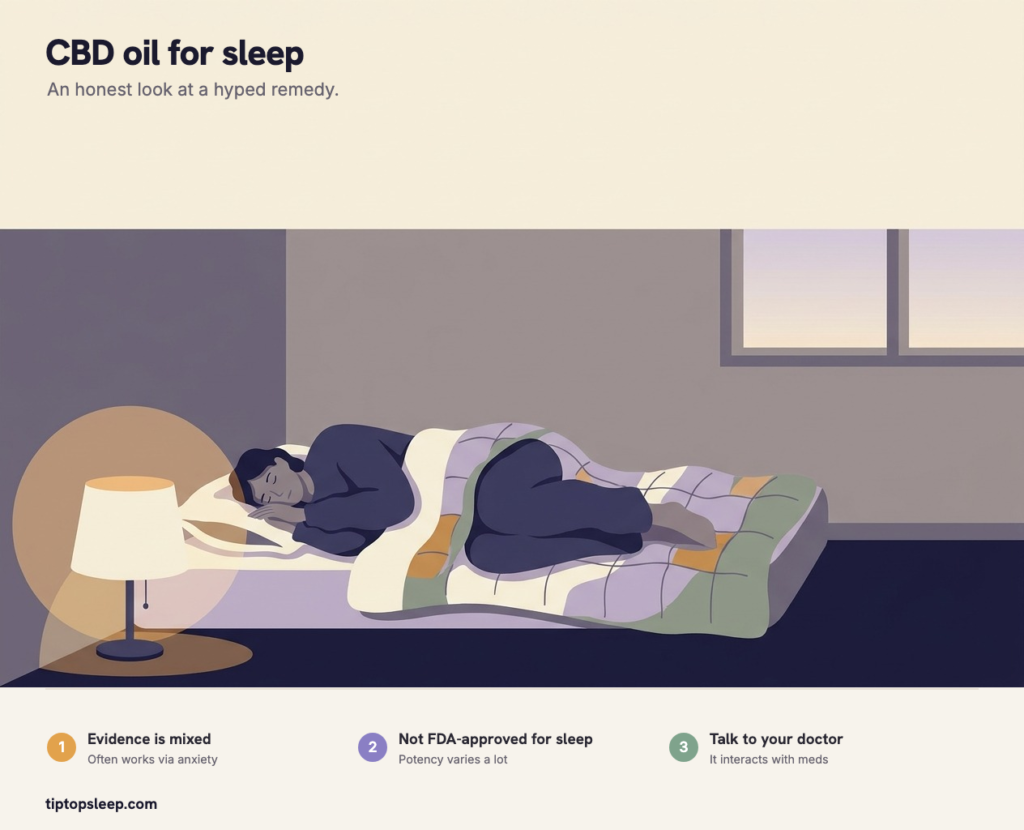
The honest answer is: there isn't strong proof that CBD oil improves sleep on its own. Research so far is limited and mixed, and much of the benefit people report may come from CBD easing anxiety rather than acting on sleep directly. The only FDA-approved CBD product is a seizure medication, not a sleep aid, and CBD oil sold as a supplement is unregulated, meaning dosing and potency on the label aren't guaranteed to match what's in the bottle. It's not a proven or first-line way to fix insomnia. Sleep habits and CBT-I are.
CBD oil comes up constantly when people ask me what to try after melatonin hasn't worked. There's something appealing about a dropper of oil under the tongue, it feels more "medical" than a gummy somehow. But the form doesn't change what the evidence actually says, and I'd rather walk you through what's known and what isn't than hand you a bottle to buy. I already covered CBD gummies for sleep in a similar way, and the honest picture for oil is nearly identical, with a few differences worth knowing if you're specifically considering a tincture.
Does CBD oil actually help you sleep?
Not in a way researchers can confirm with confidence. The Sleep Foundation's review of the evidence draws a careful line here: "Some people who use CBD for chronic pain report sleeping better. Currently, it is unclear whether these patients sleep better because of the pain relief or because CBD directly affects their sleep." That distinction matters more than it sounds. If CBD oil is helping, it may be doing so indirectly, by easing pain or anxiety that was keeping you up, rather than acting as a sleep aid in its own right.
On the anxiety point specifically, the Sleep Foundation notes that "given the potential positive outcomes of CBD treating anxiety, it is speculated that CBD may also help reduce the anxiety associated with insomnia." Speculated is the operative word. If your sleep problem is mostly a racing mind rather than a broken sleep switch, that's useful context before spending money on a tincture. It's also worth reading about the fear of not sleeping if anxiety about bedtime itself is a bigger factor than anything physical.
Is CBD oil FDA-approved for sleep?
No. The FDA is direct about this: "The FDA has approved only one CBD product, a prescription drug product to treat seizures associated with Lennox Gastaut syndrome (LGS), Dravet syndrome (DS), or tuberous sclerosis complex (TSC) in people one year of age and older." That product, Epidiolex, is a seizure medication, not a sleep aid, and it isn't what's in the tincture bottles sold as supplements.
Everything else marketed as CBD oil, including full-spectrum tinctures and drops, hasn't gone through that same FDA review. The FDA explains what that means in practice: these products "have not been evaluated by the FDA to determine what the proper dosage is, how they could interact with other drugs or foods, or whether they have dangerous side effects or other safety concerns." No one has verified the dose on the label, and no one has verified that the oil does what the marketing claims.
Can you trust the dose on a CBD oil label?
This is where oil has a real practical wrinkle that gummies don't: dosing is done by counting drops rather than eating a pre-measured piece, so it's easier to over- or under-dose without realizing it, and that's before you even get to whether the label is accurate. The Sleep Foundation cites an analysis of 84 CBD products sold online that found real gaps between label and contents: "One analysis of 84 CBD products sold online showed that 26% of the products contained less CBD than the label said, while nearly 43% of the products contained substantially more CBD than the label said."
In practice, that means a bottle labeled "1,000mg" might contain meaningfully less, wasting your money, or meaningfully more, raising your odds of side effects or interactions you didn't plan for. Because oil dosing is already imprecise (drops vary in size depending on the dropper and how full the bottle is), inaccurate labeling compounds the problem. The Sleep Foundation notes that "the FDA doesn't regulate dosing of non-drug CBD products," so there's no official number to fall back on either. If you do try a CBD oil, a third-party Certificate of Analysis (COA) confirming actual tested CBD content and low or non-detectable THC is the closest thing to a reliable answer on what's actually in the bottle.
What are the real risks and safety concerns?
CBD oil isn't risk-free just because it's sold in the supplement aisle. The FDA's consumer guidance is blunt: "CBD can cause liver injury." It also flags interaction risk with other medications: "CBD can affect how other drugs you are taking work, potentially causing serious side effects." CBD is processed by some of the same liver enzymes as a long list of common prescription drugs, including blood thinners, so combining a daily tincture with existing medication isn't something to guess about.
Combining CBD oil with anything else that makes you drowsy adds to that risk. The FDA warns that "use of CBD with alcohol or other drugs that slow brain activity, such as those used to treat anxiety, panic, stress, or sleep disorders, increases the risk of sedation and drowsiness, which can lead to injuries." None of this means CBD oil is dangerous for everyone, but it's not a casual, no-downside purchase either.
- Legality and THC content vary. Legal limits differ by country and state, and mislabeled oils (see above) can put you over a legal or drug-tested threshold without you knowing.
- Pregnancy and breastfeeding. CBD isn't established as safe in pregnancy or while breastfeeding, and it's generally advised to avoid it in both situations.
- It's not a substitute for treating the actual sleep problem. If insomnia is ongoing, consistent habits and CBT-I have a far stronger evidence base than a tincture.
Should I try CBD oil for sleep, or skip it?
I can't give you a firm yes or no, and I don't think anyone honestly can right now. If you're considering it, treat it as a "talk to your doctor or pharmacist first" decision, especially if you take regular medication, are pregnant or breastfeeding, or have liver concerns. If you get the go-ahead, look for a product with a real third-party COA, start at the lowest labeled dose, and measure it the same way each time rather than eyeballing drops.
Where I'd actually put effort first is the stuff with a stronger track record: a consistent sleep hygiene routine, addressing anxiety about sleep directly, and only then, cautiously, treating something like CBD oil as one small piece alongside those habits rather than a replacement for them. If you want a comfort item to add to your nightstand while you sort that out, our Sleep Toolkit covers the better-evidenced options, like magnesium and melatonin.
Frequently asked questions
Is CBD oil the same as hemp seed oil?
No, and they're often confused. CBD oil is extracted from the flowers, leaves, and stalks of the hemp plant and contains cannabidiol. Hemp seed oil comes from the seeds of the plant and typically contains little to no CBD. If a product is marketed for relaxation or sleep, check the label to confirm it's actually CBD oil, not hemp seed oil.
How many drops of CBD oil should I take for sleep?
There's no established, doctor-verified dose for sleep specifically, and the FDA doesn't regulate dosing for non-drug CBD products. Because labeled potency is often inaccurate, counting drops from an unverified bottle is a weak way to dose anything. This is a question for a doctor or pharmacist, not a number to copy from a website.
Can CBD oil interact with my medication?
Yes. CBD can affect how the liver processes other drugs, which can change how those medications work in your body. Anyone on regular medication, especially blood thinners or anything with a grapefruit interaction warning, should check with a doctor or pharmacist before trying CBD oil.
Is CBD oil legal everywhere?
Legality and allowed THC content vary by country and by state, and it changes over time. Mislabeled products can also contain more THC than stated, which can matter for legal or workplace drug-testing thresholds. Check your local regulations rather than assuming.
Related reading:
- Best CBD Gummies for Sleep
- What Is Better for Sleep, Indica or Sativa?
- Best Magnesium for Sleep
- Sleep Hygiene Checklist
- Sleep Toolkit - better-evidenced options we actually recommend, like magnesium and melatonin
Sources & review: This article reflects publicly available guidance from the U.S. Food and Drug Administration on cannabis and CBD products, and the Sleep Foundation's review of CBD and sleep research. It is not medical advice and doesn't replace guidance from your doctor or pharmacist, especially if you take other medications, are pregnant or breastfeeding, or have an existing health condition. Talk to a healthcare provider before trying any CBD product.
📥 Free: The Post-Surgery Sleep Recovery Kit
Our 2-page PDF - the safe sleep position for your surgery, how to set up your bed, a night-by-night recovery timeline, and the red flags worth calling your doctor about. We'll email you the download link.
By subscribing you agree to our Privacy Policy.