

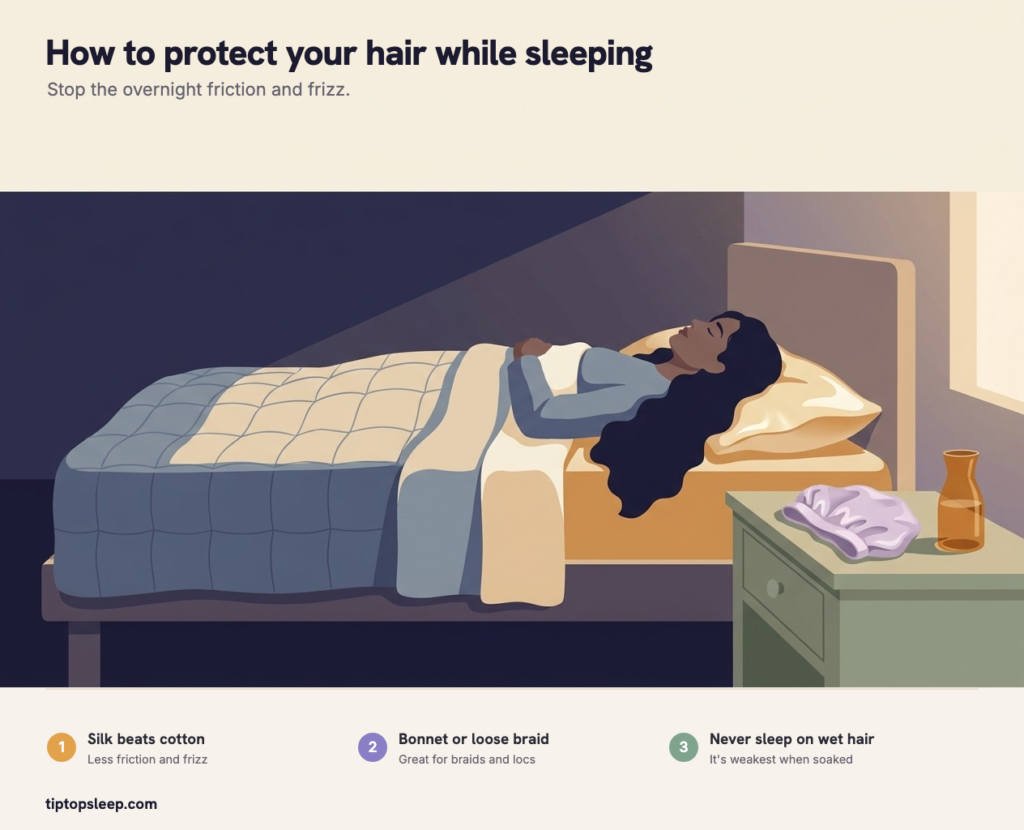
Protect your hair overnight by cutting down friction: sleep on a silk or satin pillowcase (or wear a satin bonnet or scarf), keep hair in a loose style instead of a tight elastic, and never go to bed with hair that's soaking wet. Braids and locs need their own approach - a satin bonnet or scarf over the style protects both the hairstyle and your edges, and dreads specifically should never be tied down tight or slept on while still wet.
I used to wake up with a rat's nest no amount of brushing could fix, and it took me years to realize the problem wasn't my hair, it was my pillowcase. Cotton grabs at hair all night long, and eight hours of that adds up to breakage, frizz, and split ends you didn't do anything to deserve. The fix is mostly about what your hair touches while you sleep, not some elaborate routine, and it works whether you have curls, braids, locs, or straight fine hair that tangles if you look at it wrong.
Why does hair get damaged while you sleep?
It comes down to friction and moisture, both working against you for hours at a time.
- Friction against the fabric. Cotton fibers are rough at a microscopic level. Every time you shift positions, hair drags against the pillowcase, and that repeated rubbing roughs up the outer cuticle layer, which shows up as frizz, tangles, and eventually breakage.
- Moisture loss. Cotton is absorbent, so it pulls moisture out of your hair (and skin) overnight. Dry hair is more brittle and more prone to snapping.
- Tangling from movement. Everyone moves more in their sleep than they think. Loose strands catch on rough fabric and on each other, and by morning you're detangling damage that didn't need to happen.
The American Academy of Dermatology addresses this directly in its guidance on curly hair care: "you can pull your hair into a loose ponytail on top of your head (resembling a pineapple) or a loose braid before sleeping to preserve your curls and reduce friction against your pillowcase, which can make your hair frizzy and easier to break." They add that "styling your hair in twists and using satin or silk bonnets or pillowcases may also reduce friction and preserve your hairstyle." That's the whole strategy in two sentences: reduce friction, and keep the style loose.
What's the single best fix for overnight hair damage?
Switch your pillowcase. It's the change that helps every hair type without requiring you to do anything differently once you're actually asleep.
- Silk or satin instead of cotton. Both are smoother than cotton, so hair glides across the surface instead of catching on it. Less catching means less breakage and less morning frizz.
- Satin holds up better day to day. It's more affordable than silk, machine-washable on a delicate cycle, and gives you most of the same friction-reducing benefit.
- Silk is more absorbent. True mulberry silk still beats cotton, but it isn't as moisture-neutral as satin, so if you have very dry hair, satin is often the more practical everyday choice.
If you'd rather not swap your whole pillowcase, a satin or silk bonnet or scarf does the same job for your hair specifically. It's also the better option if you share a bed and don't want to redo the whole pillow situation.
How should I sleep with braids or another protective style?
Protective styles are meant to last, and a bit of nighttime care is what actually makes them last.
- Cover them with a satin bonnet or scarf every night, not just occasionally. This is what actually protects the style, cuts down frizz around your hairline, and keeps loose baby hairs from catching on your pillow.
- Tie the scarf snug but not tight. You want the bonnet secure enough to stay on, not tight enough to pull at your edges - constant tension there over weeks is how edges thin out.
- Don't leave a protective style in too long. Braids, twists, and similar styles are meant to come out and give your scalp a break, generally within 6-8 weeks depending on the style and how your scalp handles it. Leaving them in longer than intended increases matting and tension at the root.
- Moisturize your scalp underneath. A light oil at the roots a couple of times a week keeps the scalp from drying out while it's covered.
How should I sleep with locs or dreads?
Locs have their own overnight needs, separate from loose hair or braids.
- Use a satin bonnet or pillowcase to cut down on lint, frizz, and the fuzzy "baby hairs" that stick up along mature locs. Cotton is especially bad for locs because it snags on the textured surface.
- Never sleep on locs that are soaking wet. Wet locs against a pillow all night invite mildew and a musty smell, since the inside of a loc dries much slower than the surface. Let them air-dry most of the way, or use a hooded dryer, before bed.
- Avoid retwisting too tight right before bed. A fresh, tight retwist put under a snug bonnet for eight hours adds unnecessary tension at the root. Give a fresh retwist a little time to settle before covering it tightly.
- Loosely pineapple or wrap longer locs on top of the head rather than letting them spread out and press against the pillow all night.
What about wet hair, fine hair, or color-treated hair?
- Never sleep on soaking-wet hair. Hair is at its weakest when wet, since the strand swells and the cuticle lifts, making it far more prone to snapping under the friction of a pillow. If you shower at night, let hair get to damp rather than dripping before bed - fully wet all night is the combination to avoid, though completely air-drying every night isn't realistic for everyone either.
- Fine hair tangles fast. A loose braid or low bun keeps strands from crossing and knotting overnight, without the tight pull of a ponytail elastic.
- Color-treated hair loses moisture faster. Silk or satin's lower absorbency matters even more here, since color processing already leaves hair more porous and prone to dryness.
- Skip the microfiber towel-turban to bed, but do use one right after washing. A microfiber towel is far gentler than terry cloth for the initial dry-down, which means less friction damage before your hair even reaches the pillow.
What should I avoid when it comes to hair and elastics at night?
- Tight elastic bands. Standard rubber-style elastics grip and pull at the hair shaft, and that constant tension overnight is a common cause of breakage right where the band sits.
- High, tight ponytails. Sustained pulling at the hairline and temples over months and years is linked to traction alopecia, thinning caused by repeated tension rather than natural shedding.
- Falling asleep with hair loose and uncontained if you're a restless sleeper - it tangles more than a loose braid or bonnet would.

Mulberry Silk Pillowcase for Hair and Skin
A genuine mulberry silk pillowcase with a hidden zipper closure, so it stays put through the night instead of bunching up. This is the easiest swap if you want friction protection without changing anything about how you actually sleep - it works for every hair type and helps skin too.

Satin Sleep Bonnet, Wide Band (3-Pack)
Sized generously for braids, locs, and thicker curly styles, with a wide elastic band that stays secure without pressing tight at the hairline. Having a few on hand means one is always clean, which matters if you're covering your hair every single night.
Want more of what's actually worth having on your nightstand? Our Sleep Toolkit rounds up the gear we trust, without the hype.
Frequently asked questions
Is satin or silk better for protecting hair while sleeping?
Both are far better than cotton because they're smoother and cause less friction. Satin is slightly less absorbent, which can matter more for dry or color-treated hair, and it's usually cheaper and easier to wash. Silk is the more luxurious option but needs gentler care. Either one is a real upgrade from cotton.
Can I sleep with braids in without covering them?
You can, but a satin bonnet or scarf noticeably cuts down on frizz, protects your edges from friction, and keeps the style looking fresh for longer. If you're investing time in a protective style, covering it at night protects that investment.
How often should I retwist or redo my protective style?
Most protective styles are meant to come out within about 6-8 weeks, depending on the style and how your scalp responds. Leaving them in much longer increases matting and tension. Retwisting locs specifically is usually spaced out more, and it's worth following your loctician's specific timeline rather than a generic rule.
Is it really that bad to sleep with wet hair?
Wet hair is weaker and more prone to breaking under the friction of a pillow, so it's worth avoiding when you can. That said, letting hair dry to damp rather than forcing it fully dry every single night is a reasonable middle ground for most hair types - soaking wet against a pillow all night is the specific combination worth skipping.
Related reading:
- How to Sleep After a Keratin Treatment
- Anti-Aging Sleep Pillows, Best Picks to Defy Wrinkles
- How Often Should You Change Your Pillowcase?
- How to Sleep With Earrings Comfortably
- Sleep Toolkit - the gear we actually recommend for situations like this
Sources & review: Guidance on friction, protective styling, and satin or silk bonnets and pillowcases is checked against the American Academy of Dermatology. This is general hair-care and beauty-sleep information, not medical advice, and it doesn't replace guidance from your stylist, loctician, or dermatologist for hair or scalp concerns specific to you.
📥 Free: The Post-Surgery Sleep Recovery Kit
Our 2-page PDF - the safe sleep position for your surgery, how to set up your bed, a night-by-night recovery timeline, and the red flags worth calling your doctor about. We'll email you the download link.
By subscribing you agree to our Privacy Policy.