

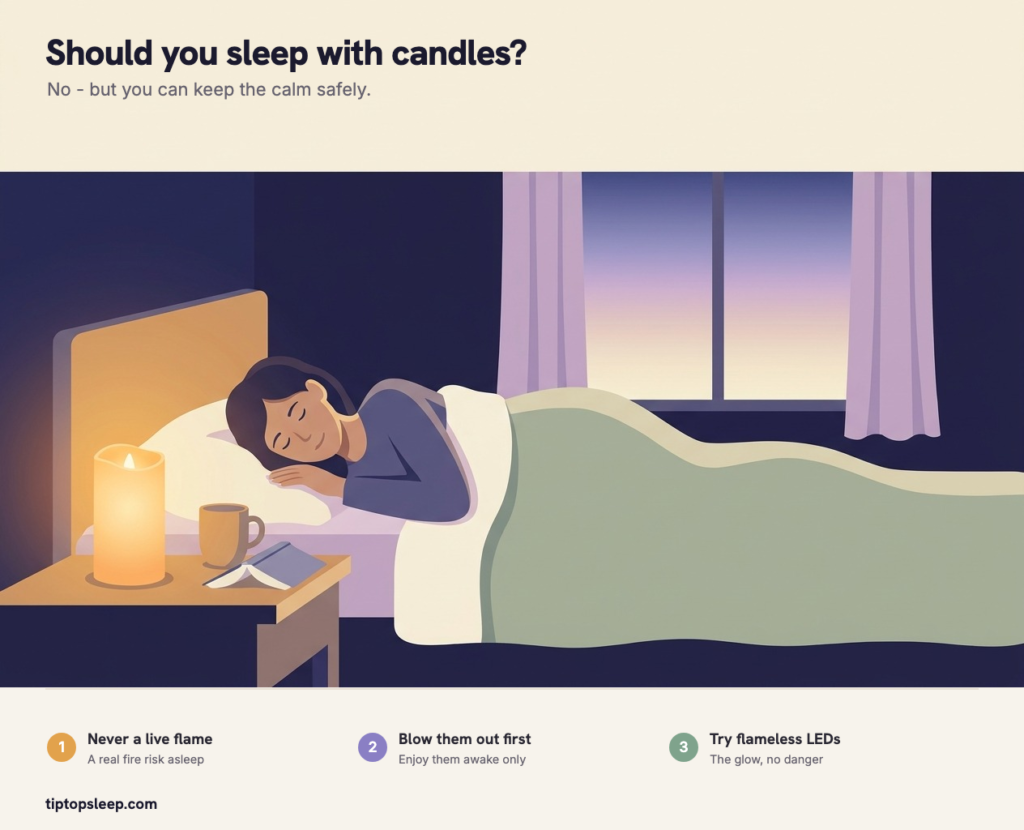
No. You should never fall asleep with a candle burning - not "contained" in a jar, not "just for a few minutes." Unattended candles are a major cause of home fires, and fire-safety authorities are explicit that bedrooms are one of the worst places for it to happen. The good news: you can still have the calm, flickering, scented ritual you actually want - just with a flameless candle, a diffuser, or a warm lamp instead of a live flame once you're ready to sleep.
I understand the appeal completely. There's something about a lit candle that makes a bedroom feel calmer - the soft light, the faint scent, the ritual of blowing it out before bed. I used to keep one going most nights while I read. But "should I be sleeping with candles lit" has one honest answer, and it isn't a comforting one: no. Here's exactly why, and what to do instead so you don't lose the part of the ritual that actually helps you wind down.
Why you should never fall asleep with a candle burning
A candle is an open flame sitting on a surface, and once you're asleep, nobody is watching it. That's the whole problem. Fire-safety authorities aren't being cautious for the sake of it - unattended candles are a documented, significant cause of home structure fires every year, and bedrooms show up disproportionately in the data. The American Red Cross, citing National Fire Protection Association (NFPA) research, puts it plainly:
"So one iron-clad rule is to never use candles in the bedroom - or in any other room where people might fall asleep."
That same source cites NFPA research finding that more than one-third of home candle fires start in the bedroom, and 35% of candle-fire deaths happen there too - a room where you're horizontal, covered in flammable bedding, and, if you've fallen asleep, unable to notice smoke or catch a tipped-over candle before it spreads.
How does a lit candle actually start a fire while you sleep?
It doesn't take much. A few ordinary things go wrong, usually together:
- Something too close catches. A curtain stirred by a draft, a shifted blanket, a stack of books - candle fires most often start when flammable material ends up near the flame, easy to miss while you sleep.
- The candle gets knocked over. A pet jumping onto the nightstand, an unsteady surface - a "contained" glass jar candle can still tip.
- The wick burns unevenly. A long or crooked wick drips wax and can flare larger than intended, especially past the first couple of hours.
- Nobody is there to stop it. This is the real root cause. Every candle safety rule exists to reduce risk while someone is present to react. None of it works if you're asleep.
But I actually want candles for calm before bed. What do I do instead?
This is the part that matters, because the urge behind the question is a good one. You're not chasing danger - you're chasing calm, scent, and a softer light to wind down by. You can have all of that without a flame anywhere near your pillow.
- Blow your real candles out before you get into bed - not when you feel sleepy, before. Make it part of the same routine as brushing your teeth, so it happens every single night without you having to remember.
- Switch to a flameless LED candle for the last stretch of your evening. Modern ones flicker convincingly, run on a timer, and give you the same warm glow with zero fire risk - genuinely the easiest fix, since you don't have to change the ritual, just the flame.
- Get your scent from a diffuser instead of a flame. An essential-oil or reed diffuser gives you the same wind-down cue without heat or an open flame involved at all.
- Dim a bedside lamp instead of relying on candlelight. A warm, low bulb gives a similarly cozy feel and you can safely leave it on while you drift off, which you can never do with a candle.
- Build a short wind-down routine around whichever you choose. Same time, same light, same few minutes of quiet - the ritual is what actually signals to your body that it's time to sleep, not the fact that it's specifically a flame.
None of this means giving up candles altogether. Enjoy them while you're awake and in the room - reading on the sofa, in the bath, watching something before bed. The rule is simple: candles are for when you're awake to watch them, never for when you're asleep.
The safest way to burn a candle at all (while you're awake)
If you do burn real candles earlier in the evening, a few habits cut the risk, again per Red Cross/NFPA guidance: keep the flame at least 12 inches from anything that can burn, use a candle snuffer rather than blowing it out (blowing can send sparks or hot wax flying), trim the wick to about a quarter inch before each burn, never leave it unattended even briefly, and keep candles and matches out of reach of children and pets.
All of that still comes back to the same bottom line: the moment you're not awake to watch it, the candle needs to be out.
Our pick: the glow without the fire risk
If part of your evening routine is watching a flame flicker while you unwind, this is the closest safe substitute I've found - no smoke, no wax, no risk of falling asleep with something burning.

Nimiko Flameless LED Candles with Remote & Timer
A set of realistic flickering LED candles with a remote and a built-in 2/4/6/8-hour timer, so they turn themselves off automatically instead of relying on you to remember. That's the whole point - you get the warm, flickering look with nothing to blow out and nothing that can start a fire while you sleep.
For the rest of what's worth having in a calm, safe bedroom setup, see our Sleep Toolkit.
Frequently asked questions
Is it safe to sleep with a candle lit if it's in a glass jar?
No. A glass jar reduces some risk but doesn't remove it - jars can still be knocked over, and the glass itself can get hot enough to crack or ignite a surface underneath. Once you're asleep, nobody is there to catch any of that.
Can you leave a candle burning overnight if you're not sleeping?
Only if you are genuinely awake and in the room the entire time. The moment you doze off, even briefly, it's an unattended flame. If there's any chance you'll fall asleep, put it out first.
Are flameless candles actually a good substitute?
Yes. Modern flameless LED candles flicker convincingly, come with timers so they shut off on their own, and give you the same warm light and evening ritual without an open flame anywhere near your bedding.
What should I do if I've fallen asleep with a candle burning before?
Don't do it again, and take it as a cue to move to flameless candles for anything near bedtime. If you woke to find wax pooled, a scorch mark, or a strong smoke smell, it's worth having your smoke alarms checked and considering a safer bedside setup going forward.
Related reading
- Why Not to Have Red Lights On at Night
- Best Color Noise for Sleep
- How to Sleep Through a Thunderstorm
- Sleep Toolkit - the gear worth having
Sources & review: Fire-safety guidance researched and checked against the American Red Cross, citing National Fire Protection Association (NFPA) data. This is general safety information, not a substitute for your local fire department's guidance or manufacturer instructions - always follow the safety instructions that came with your candles.
📥 Free: The Post-Surgery Sleep Recovery Kit
Our 2-page PDF - the safe sleep position for your surgery, how to set up your bed, a night-by-night recovery timeline, and the red flags worth calling your doctor about. We'll email you the download link.
By subscribing you agree to our Privacy Policy.