

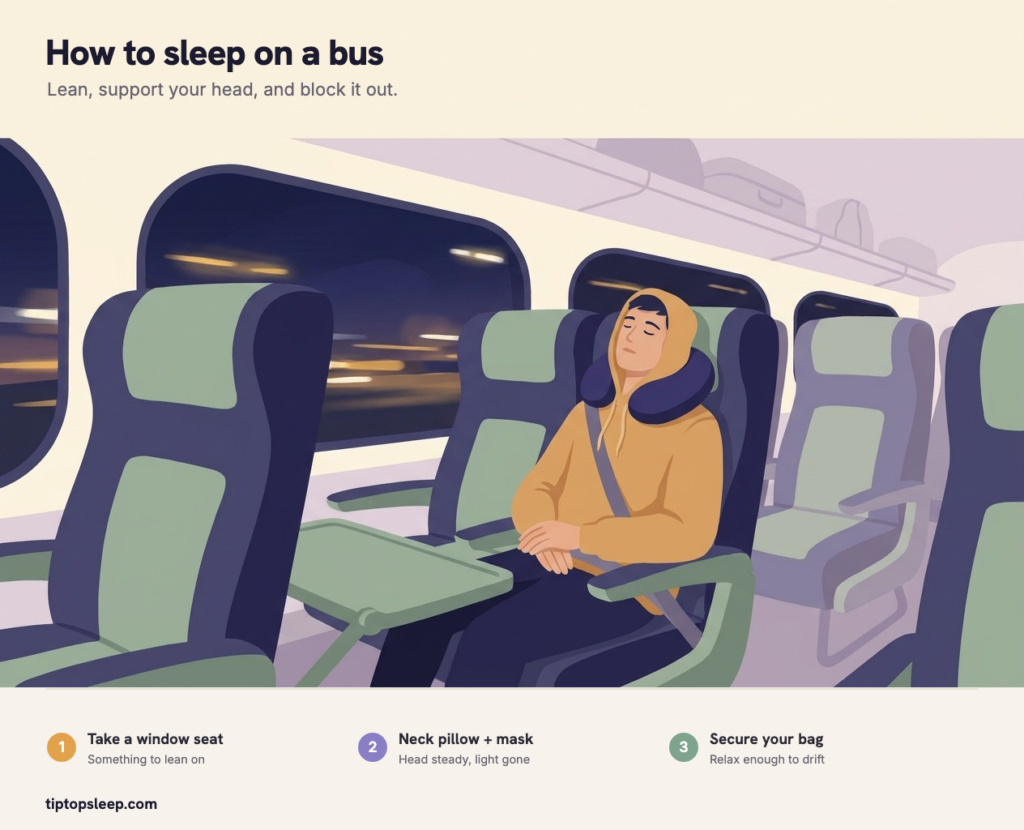
Book a window seat away from the back row so you have something to lean on and control over the window shade. Bring a neck pillow so your head doesn't loll into the aisle, and use an eye mask and earplugs or headphones to shut out headlights and engine noise. Dress in layers, keep your seatbelt on, and stop worrying about your bag - a good under-seat lock lets you actually relax.
I've done enough overnight coach trips to know the difference between a night that wrecks you and one you barely notice. Buses are honestly one of the harder places to sleep - you're upright, the engine drones, the bus stops and starts, and every headlight from the other direction sweeps across your eyelids. None of that means you're doomed to arrive exhausted. A handful of small, deliberate choices make an outsized difference. Here's what actually works, in the order I'd do them.
Where should you sit to sleep well on a bus?
Seat choice does more work than any product you can buy. Get to the station early or book ahead so you're not stuck with whatever's left.
- Window seat. You need a wall to lean your head against, and you want control over the shade so you're not fighting oncoming headlights all night.
- Avoid the very back row. On most coaches the back row sits over or near the engine, doesn't recline as far, and catches the most vibration and noise.
- Stay away from the door and the wheel wells. Seats near the boarding door get cold drafts and foot traffic every time someone gets on or off; seats over the wheels feel every pothole harder.
- Middle of the bus, if you can choose. It's usually the smoothest ride and the furthest from both the engine and the door.
What should you bring to actually fall asleep?
This is the same logic I use for sleeping on a plane - you're trying to solve the same three problems: your head has nothing to rest on, it's too bright, and it's too loud. A coach adds a fourth: it stops.
- A neck pillow. Sitting upright for hours without support means your head drops forward or lolls sideways every time you actually drift off, which is exactly what keeps waking you back up. The Sleep Foundation notes that "a neck or travel pillow can help provide comfort when sleeping in a car since it often requires resting in an upright position, leading to an unsupported head and neck during the night" - the same logic applies directly to a coach seat.
- An eye mask. Overhead reading lights, phone screens, service-station stops, and headlights from the opposite carriageway all interrupt sleep even with your eyes closed. A simple contoured mask blocks nearly all of it.
- Earplugs or noise-cancelling headphones. Engine drone is a steady, low rumble that your brain can tune out, but the sudden noises - a door hissing open, someone's phone call, the driver's announcement - are what actually wake people up. Earplugs flatten both.
- Layers, not just a jacket. Coach air conditioning runs cold at night and drivers rarely adjust it per passenger. A hoodie or light blanket you can add or remove beats a single heavy coat you're stuck with either way.
How do you get comfortable enough to actually relax?
Comfort on a bus is less about the seat and more about not fighting your own body for two hours.
- Recline as far as the seat and courtesy allow. Even 15-20 degrees back changes how your neck sits. Ask the person behind you before dropping it fully if the bus is full - it's a small courtesy that avoids a tap on the shoulder later.
- Keep your seatbelt fastened. Beyond the obvious safety reason, an unfastened belt means part of your brain stays half-alert to sudden braking. Buckled in, you can actually let go.
- Secure your bag before you settle in. Stow valuables under the seat in front of you or in a bag with a cable lock, and keep only what you need within reach. You won't relax into sleep if part of you is listening for someone near your backpack.
- Skip the last coffee. Caffeine has a half-life of five to six hours, so a coffee at the terminal before an evening departure can still be working on you at 1am. Switch to water for the last stretch before boarding.
What about the stops?
Overnight coaches usually make one or two rest stops, and they're the part people forget to plan for. The interior lights come on, the doors open, and cold air rolls in - all things that can drag you out of a deep sleep even if you don't get off. If you know your route has a stop, keep your eye mask on and earplugs in through it rather than pulling them out "just in case," and use the stop itself, if you're awake anyway, to stretch your legs and use the bathroom so you're not doing it mid-journey.
Frequently asked questions
What is the best seat for sleeping on a bus?
A window seat away from the very back row and away from the boarding door. The window gives you something to lean against and control over the shade; avoiding the back and the door means less noise, less vibration, and no cold draft every time someone boards.
How do you stop your neck hurting after sleeping on a bus?
Use a neck pillow before you fall asleep, not after your neck already hurts. A contoured travel pillow keeps your head from dropping forward or sideways, which is the main cause of the stiff-neck feeling after an overnight coach.
Is it safe to sleep on a moving bus?
Yes, with your seatbelt fastened. Keep valuables secured and out of sight, and if you're travelling alone at night, sitting nearer the driver or other passengers rather than an isolated back row is a reasonable precaution.
Should I take a sleeping pill for an overnight bus?
Be cautious. Anything that sedates you deeply can make it hard to wake for stops, board checks, or your own stop, and on an already-noisy, jolting bus you're more likely to wake groggy and disoriented than well rested. A neck pillow, mask, and earplugs solve most of the problem without that trade-off.
Related reading

Zionclicks Memory Foam Travel Neck Pillow
An adjustable memory-foam neck pillow with a flatter back panel, so it supports your head without pushing it forward when you lean back - exactly the problem on a reclined coach seat. Packs down small enough to live in a daypack.
Want the fuller kit for any trip? See our Sleep Toolkit for the masks, pillows and gear worth actually packing.
Sources & review: Guidance here is general comfort advice, researched against travel-sleep information from the Sleep Foundation. It is not medical advice; if you have a sleep disorder or health condition that affects safe travel, check with your doctor before an overnight journey.
📥 Free: The Post-Surgery Sleep Recovery Kit
Our 2-page PDF - the safe sleep position for your surgery, how to set up your bed, a night-by-night recovery timeline, and the red flags worth calling your doctor about. We'll email you the download link.
By subscribing you agree to our Privacy Policy.