

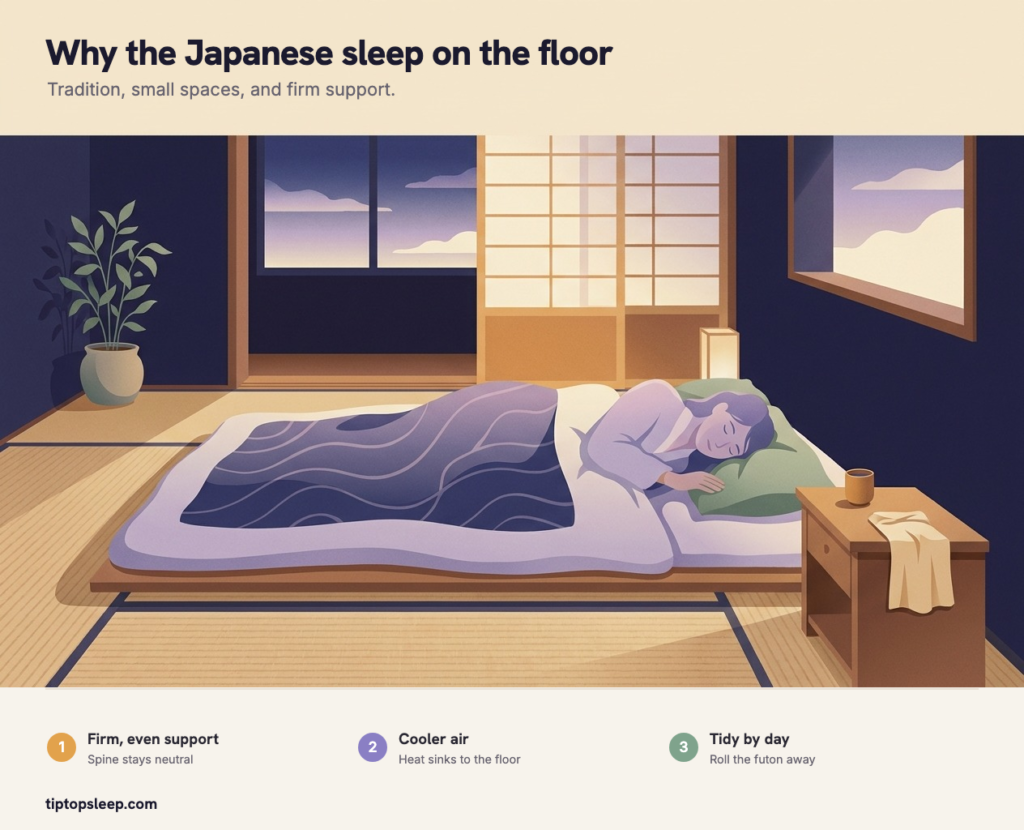
Japanese floor sleeping comes from centuries of tatami-mat and futon culture, not a health fad: a thin shikibuton is laid on tatami at night and folded away by day, which suits small homes and lets the bedding air out. People who like it report firm, even support and cooler nights. The evidence that it's actually "better for your back" than a good mattress is thin and mixed - firmness preference is personal, and it's not a great fit for anyone with mobility issues, joint pain, or a cold, damp floor.
I get asked about this one a lot: is it true the Japanese sleep on the floor, and is it secretly the answer to a bad back? I've dug into where the custom comes from and what's fair to claim about the health side, because a lot of what circulates online overstates the "cure for back pain" angle.
Do Japanese people actually sleep on the floor?
Yes, though "on the floor" undersells it. Traditional Japanese bedding is a system, not a bare floor: a base of tatami (woven rush-straw mats, about an inch thick) topped with a shikibuton - a thin, quilted mattress, usually 2-4 inches, filled with cotton or a cotton-foam blend. On top goes a lighter quilt, the kakebuton, and often a smaller, firmer pillow. It's closer to a padded mat than to sleeping directly on hardwood.
Why did this become the norm in Japan?
A few practical and cultural threads wove together over centuries:
- Tradition and tatami culture. Tatami flooring dates back over a thousand years and shaped how rooms were used - the same floor space serves as a living room by day and a bedroom by night, which only works if the bedding can be moved.
- Space-saving in small homes. Japanese homes and apartments, especially in cities, are compact. A futon that folds up and slides into a closet frees the room completely - there's no bed frame permanently eating floor space.
- Airing and storage as a daily ritual. The shikibuton is meant to be aired daily, traditionally hung over a balcony rail or beaten to release moisture, then folded into the closet (oshiire) during the day. This is the main way the bedding stays dry and hygienic without a raised bed frame letting air circulate underneath.
- Practical roots. A low mat that packs away suited multi-purpose rooms, high humidity, and (in earthquake-prone regions) avoiding heavy furniture that can fall or block an exit.
What are the claimed benefits?
Ask someone who likes their futon and you'll typically hear:
- Firm, even support. A shikibuton on tatami is much firmer than a plush mattress, and some people find that keeps their spine in a more neutral position, particularly if they're used to a mattress that's sagged in the middle.
- Cooler air near the floor. Warm air rises, so a lower sleeping surface can feel cooler on a hot night compared to a tall, insulated mattress that traps body heat.
- Minimalism and a clear room. No bed frame, no permanent furniture footprint - just floor space you get back every morning.
Is floor sleeping actually better for your back?
This is where I want to be straight with you: the honest answer is "it depends on you," not "yes, obviously." The Sleep Foundation puts it plainly when discussing mattress firmness: "No one firmness level performs optimally for all sleepers." Support and firmness aren't the same thing either - a surface can feel firm without actually supporting your spine's natural curve, and what counts as supportive depends heavily on your body weight, shape, and preferred sleep position.
So a firm shikibuton isn't a universal fix. Side sleepers often find a hard floor mat presses uncomfortably into the hip and shoulder, with little give to cushion those points. People with joint pain, arthritis, or reduced mobility often struggle simply getting up off a low mat, which matters more day to day than the mattress itself. A genuinely bare floor with no futon at all is a different story again - no cushioning, no insulation from cold or damp, and not something I'd recommend.
What I'd take from this: if you already prefer a firm mattress, or you've been sleeping on something worn out and saggy, trying a proper Japanese-style futon setup is a reasonable, low-cost experiment. If you have chronic back pain, a spinal condition, or trouble getting up from a low surface, this isn't the place to start - talk to your doctor or a physiotherapist first, the same way we'd only recommend learning to sleep on your back once it's the right move for your situation specifically.
How to try it safely, without wrecking your sleep
If you're curious, here's how to do it properly rather than just dragging a duvet onto the carpet:
- Use a real futon or shikibuton, not a bare floor. You want a few inches of cushioned, quilted padding under you - enough to take the edge off a hard surface without turning into a soft mattress.
- Keep it aired out. Fold it up and let air reach both sides most days, or prop it over a chair for an hour. Bedding left flat on a floor, especially a cold or damp one, is exactly the setup that grows mould underneath - this single habit is the difference between a fresh futon and a mouldy one.
- Add a rug or mat underneath if your floor is hard or cold. Tatami itself provides some insulation; carpet or a thin underlay does the same job on wood or tile.
- Give it two to three weeks before judging it. Any change in sleep surface takes adjustment. If your back, hips, or shoulders feel worse rather than better after a few weeks, that's your answer - go back to what worked, or try a medium-firm option instead of the firmest end of the scale.
- Skip it if you have real mobility limits. Getting down to and up from a floor-level bed is genuinely harder on ageing knees, hips, or after certain surgeries. A firmer mattress on a normal frame gets you the support without the floor.
If you'd rather adjust firmness without committing to a whole floor setup, our Sleep Toolkit rounds up the mattress toppers, wedges, and other gear we actually recommend for dialing in support and temperature.

Zelladorra Japanese Floor Mattress
A quilted, roll-up shikibuton-style mat with a washable cover and its own storage bag - the easiest way to actually try this properly instead of sleeping on a bare floor. Folds away in minutes, which is half the point of the original custom.
Frequently asked questions
Is it healthy to sleep on the floor?
It can be, for the right person. A proper futon setup gives firm, even support that some people prefer, especially side-by-side with a worn-out mattress. It's not automatically healthier than a good mattress, and it's not a good fit for anyone with mobility issues or joint pain that makes getting up off the floor difficult.
Do all Japanese people sleep on futons?
No. Western-style beds and mattresses are common in modern Japan too, especially in newer apartments. The tatami-and-futon setup is a long tradition that's still widely used, particularly in older homes, but it's not universal anymore.
What's the difference between a futon and a shikibuton?
In Japan, "futon" refers to the whole bedding set. The shikibuton is specifically the mattress part that goes on the floor; the kakebuton is the quilt on top. In the West, "futon" usually just means the fold-out sofa-bed, which is a different thing entirely.
Will sleeping on the floor fix my back pain?
Don't count on it. Firmness preference is individual, and there's no solid evidence that floor sleeping specifically resolves back pain. If you have ongoing back pain, that's worth raising with your doctor rather than solving with a change of sleep surface alone.
Related reading
Sources & review: Researched against mattress-firmness guidance from the Sleep Foundation. This is general information, not medical advice - if you have a back condition or mobility concerns, check with your doctor before changing how or where you sleep.
📥 Free: The Post-Surgery Sleep Recovery Kit
Our 2-page PDF - the safe sleep position for your surgery, how to set up your bed, a night-by-night recovery timeline, and the red flags worth calling your doctor about. We'll email you the download link.
By subscribing you agree to our Privacy Policy.