

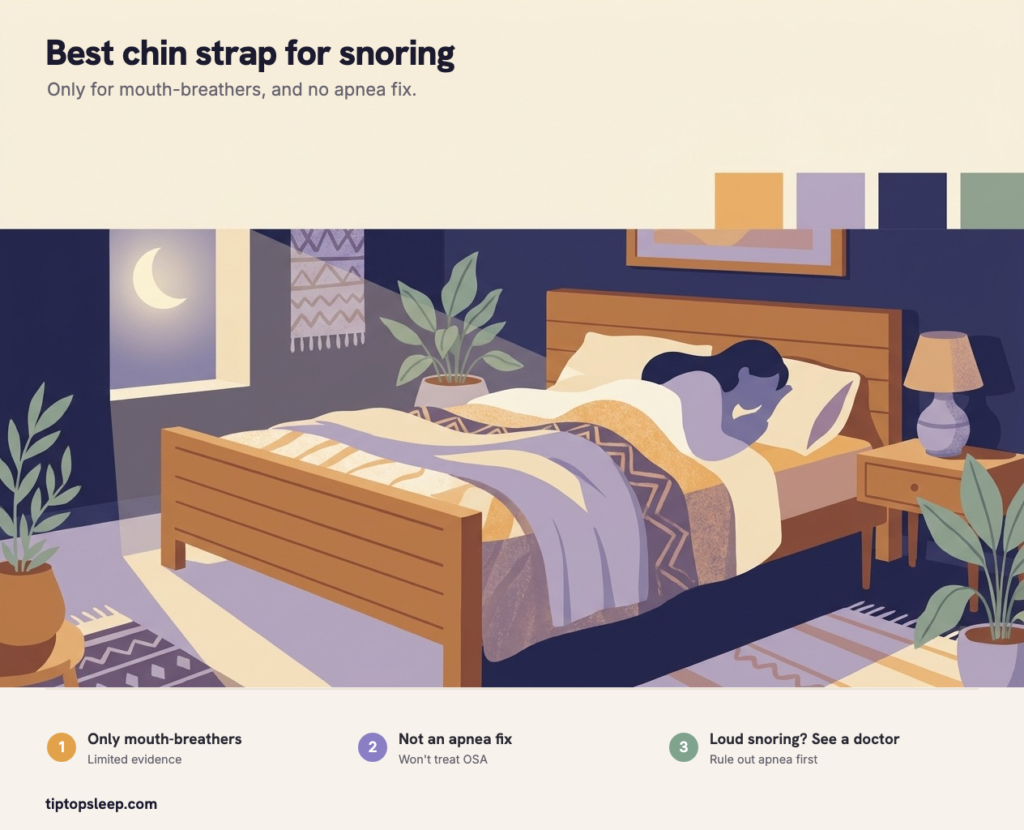
A chin strap wraps under your jaw and over your head to hold your mouth closed while you sleep, which nudges you toward breathing through your nose instead. It can offer mild relief for simple snoring that's caused by mouth breathing - but the evidence it works is limited, it does nothing for nose-based snoring, and it is not a treatment for obstructive sleep apnea. If you snore loudly and also gasp, choke, or feel sleepy during the day, see a doctor before trying gear.
My husband went through a phase of trying every snoring gadget on the internet, and the chin strap was the one that actually got worn more than once - mostly because it was cheap and didn't feel like sleeping with something jammed in his mouth. It didn't fix everything, though, and it wouldn't have, because a chin strap only addresses one specific cause of snoring. Here's what it actually does, who it might help, and - just as important - who it can't help.
How does a chin strap actually work?
A chin strap is a band of stretchy fabric that goes under your chin and up around your head, like a soft sling. Its only job is mechanical: it holds your jaw and mouth closed so you can't breathe through an open mouth while you sleep. The idea is that with your mouth shut, air is forced through your nose instead, which tends to produce less of the throat vibration that causes snoring.
That's the entire mechanism. It doesn't widen your airway, doesn't reposition your tongue or jaw the way a mouth guard does, and doesn't treat any underlying cause. It just closes the mouth. Which means how well it works depends entirely on why you're snoring in the first place.
Who might actually get some benefit from a chin strap?
- Simple mouth-breathing snorers. If you snore mainly because your mouth falls open at night, and you don't have signs of sleep apnea, a chin strap addresses that specific habit directly.
- People who already sleep with their mouth open for other reasons - like mild, uncomplicated snoring with no daytime symptoms - and want a low-cost, low-commitment option to try first.
- CPAP users dealing with mouth-leak. Some people already on CPAP therapy use a chin strap alongside their mask to stop air escaping through the mouth, which is a different use case from treating snoring on its own.
Sleep Foundation is upfront about how narrow this benefit is: "Chin straps are designed to help keep the mouth closed during sleep, which may reduce snoring in people who primarily breathe through their mouth. Some people find them helpful, but research on their effectiveness is limited." That's an honest summary - mild potential upside, thin evidence, and a very specific type of snorer it's aimed at.
Who should skip a chin strap entirely?
- Nose snorers. If your snoring comes from nasal congestion, a deviated septum, or allergies, forcing your mouth shut does nothing - it can even make breathing harder if your nose is already partly blocked. Treating the congestion itself matters more here than any mouth device.
- Anyone with signs of obstructive sleep apnea (OSA). This is the big one. A chin strap does not treat OSA, and using one instead of getting evaluated can delay a diagnosis that matters for your health.
- People with jaw pain, TMJ issues, or claustrophobia around the face and head - a strap that clamps the jaw shut all night can aggravate these.
The research on chin straps and sleep apnea specifically is not ambiguous. A 2014 study in the Journal of Clinical Sleep Medicine tested a chinstrap alone against a full sleep study and concluded plainly: "A chinstrap alone is not an effective treatment for OSA. It does not improve sleep disordered breathing, even in mild OSA, nor does it improve the AHI in REM sleep or supine sleep. It is also ineffective in improving snoring." In that study, the breathing-disruption count (AHI) was actually slightly worse with the chin strap than without it. Sleep Foundation echoes the same point: chin straps "are unlikely to resolve snoring caused by nasal obstruction, excess throat tissue, or obstructive sleep apnea, and they shouldn't be considered a substitute for medical treatment when sleep apnea is suspected."
When should I see a doctor instead of trying a chin strap?
Loud, occasional snoring with no other symptoms is usually just snoring. But certain signs point toward something a strap can't fix. The NHS is direct about this - see a GP if "you feel sleepy during the day, your breathing stops and starts while you sleep, or you make gasping or choking noises while you sleep", since these can mean sleep apnea, which the NHS notes "can be serious if not treated." A partner reporting pauses in your breathing is worth taking seriously even if you feel fine in the morning - you're not awake to notice it happening.
If any of that sounds familiar, a chin strap isn't the next step - a conversation with your doctor or a sleep study is. We've written more on what that process looks like in how sleep apnea is treated beyond CPAP, and on the condition itself in our sleep apnea guide.
What about comfort and fit?
- Adjustability matters more than material. A strap that's too tight around the jaw is genuinely hard to sleep in and can leave you sore; too loose and your mouth opens anyway partway through the night.
- Breathable fabric helps if you run warm at night - some straps trap heat against the jaw and neck.
- Address nasal congestion separately. If your nose is stuffy, forcing mouth-closure with a strap just makes breathing harder overall. Treating congestion (saline rinse, allergy management, a humidifier in dry air) matters alongside or instead of the strap.
- Give it a real trial, not one night. Like most sleep gear, the first night or two often feels strange. A week is a fairer test of whether it's actually reducing snoring and whether you can tolerate wearing it.
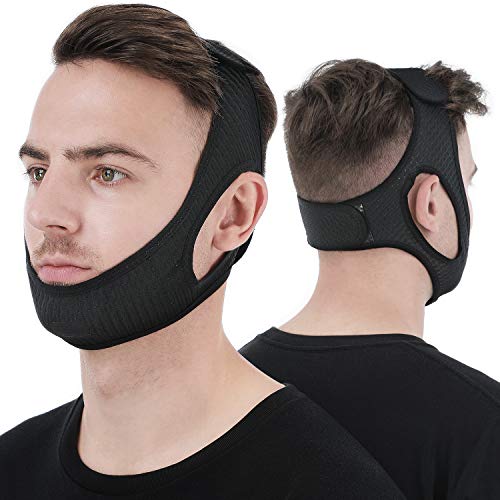
Vosaro Anti-Snore Chin Strap
A simple, adjustable strap worth trying only if your snoring is the open-mouth-breathing kind and you've ruled out sleep apnea - it's not a fix for congestion-based or apnea-related snoring. The maker's own product notes make the same point: it's built for snoring "caused by open mouth exhalation," not as a medical device. Treat it as a low-cost trial, not a guaranteed fix.
Trying to sort out what's actually worth buying for sleep problems in general? Our Sleep Toolkit is a more honest starting point than most gadget roundups.
Frequently asked questions
Do chin straps actually stop snoring?
Sometimes, and only for a specific cause: snoring from mouth breathing. Evidence for even that is limited, and chin straps do nothing for snoring caused by nasal blockage or airway obstruction.
Can a chin strap treat sleep apnea?
No. Research specifically shows a chin strap alone does not improve sleep disordered breathing or reduce breathing pauses in people with obstructive sleep apnea. If you have signs of OSA, see a doctor rather than relying on a chin strap.
Can I use a chin strap with a CPAP machine?
Some people do, to reduce air leaking from the mouth during CPAP therapy. That's a different purpose than using a chin strap alone to treat snoring or apnea - ask your sleep specialist whether it's appropriate for your setup.
Are chin straps safe to wear all night?
For most people without jaw or breathing problems, yes, though comfort varies. They're not appropriate if you have significant nasal congestion, since blocking mouth breathing without a clear nasal airway can make breathing harder, not easier.
Related reading:
- Best Snoring Mouth Guard
- How Do You Treat Sleep Apnea Without CPAP?
- Sleep Apnea Demystified: A Comprehensive Guide
- Best Sleeping Position for Sleep Apnea
- Sleep Toolkit - the gear we actually recommend, with honest limits included
Sources & review: Guidance here is checked against Sleep Foundation's snoring guidance, the NHS page on snoring symptoms, and the 2014 Journal of Clinical Sleep Medicine study "The Efficacy of a Chinstrap in Treating Sleep Disordered Breathing and Snoring". It is not medical advice and doesn't replace a proper evaluation - if you have signs of sleep apnea, please talk to your doctor.
📥 Free: The Post-Surgery Sleep Recovery Kit
Our 2-page PDF - the safe sleep position for your surgery, how to set up your bed, a night-by-night recovery timeline, and the red flags worth calling your doctor about. We'll email you the download link.
By subscribing you agree to our Privacy Policy.