

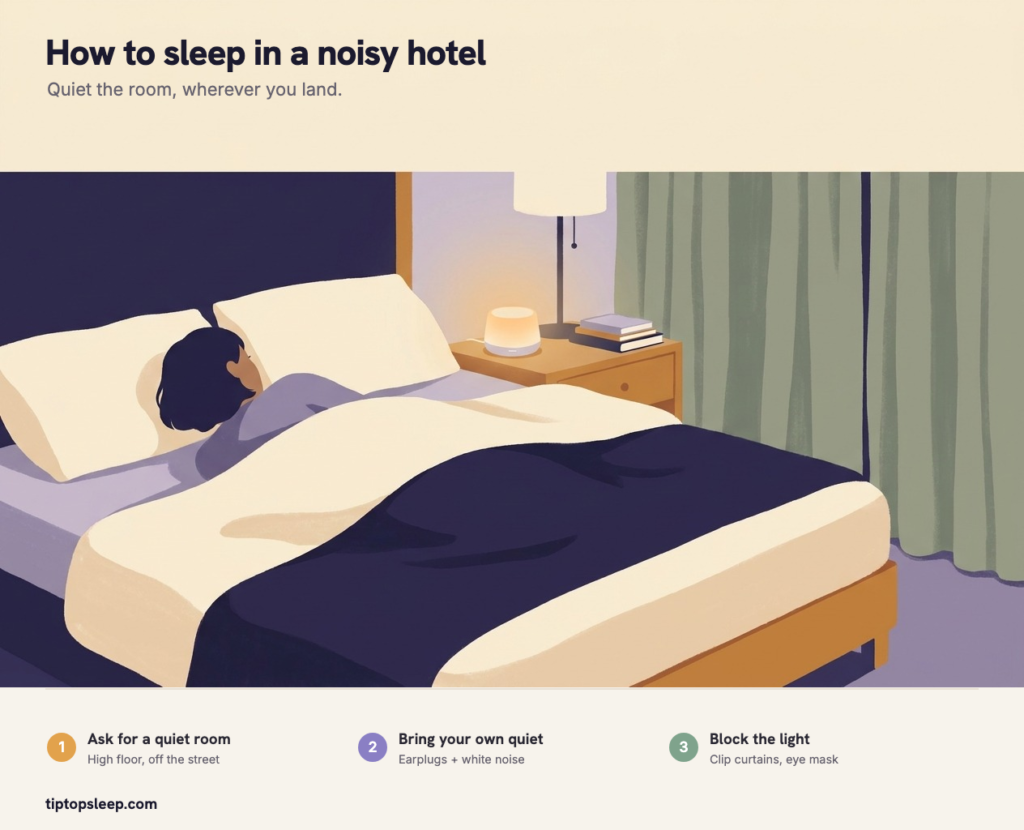
Request a quiet room when you book AND again at check-in (high floor, away from elevators, ice machines, the street, and any bar or event space). Pack earplugs or a small white noise machine as backup, use the room's AC fan as free white noise if you forget, and seal light under the door with a rolled towel plus an eye mask. Booking a quiet room prevents most of the problem; the gear handles what's left.
I've stayed in hotel rooms directly above a nightclub and directly next to an ice machine that reloaded itself every forty minutes, all night, like clockwork. Neither trip taught me anything I couldn't have avoided with one phone call before I arrived. A noisy hotel room is almost always a booking problem first and a gear problem second, so that's the order I'll go in here.
How do I book a quiet hotel room in the first place?
Most hotel noise complaints trace back to room assignment, and room assignment is negotiable if you ask before you show up.
- Book directly and call ahead. Online bookings get assigned rooms automatically. A phone call to the front desk, ideally the day before or the morning of arrival, lets you ask specifically for a quiet room and gives a real person a reason to remember your request.
- Ask for high floors, away from the elevator and ice machine. Elevator motors and ice machines are two of the most common noise complaints in hotel reviews, and they're both avoidable if you ask for a room that isn't near either.
- Avoid street-facing and ground-floor rooms. Traffic, delivery trucks, and smokers gathering by the entrance are a nightly pattern in ground-floor rooms facing the road.
- Steer clear of rooms near bars, restaurants, or event spaces. If the hotel has a rooftop bar, ballroom, or late-night restaurant, ask for a room on a different floor or wing entirely.
- Check recent reviews for noise complaints. Guests are specific: "thin walls," "loud AC," "street noise" are all searchable phrases in review text, and they tell you more than the hotel's own room descriptions ever will.
Say you're a light sleeper when you call. It sounds like oversharing, but hotels field this request constantly and it's the fastest way to get bumped away from a known problem room.
What should I do at check-in if the booking wasn't enough?
- Repeat the request at the desk. Whoever books your room and whoever checks you in are often different systems, so ask again in person.
- Ask what's near your assigned room. A front desk agent can usually tell you if you're next to a stairwell, ice machine, or connecting door before you've unpacked a single bag.
- Request a room change if it's already loud. Hotels would rather move you once than deal with a bad review later.
- Note the room number if it's a keeper, so you can request it by number on a return trip.
What noise-blocking gear should I actually pack?
Even a well-booked room can have noise you didn't anticipate, so a small kit earns its space in a carry-on.
- Earplugs. Foam and soft silicone earplugs block a meaningful amount of noise and pack down to nothing. If you've never found a pair comfortable enough to sleep in, our best earplugs to sleep with guide covers the shapes that actually stay in overnight.
- A small white noise machine or phone app. A steady, even sound gives your brain something predictable to tune out against, instead of straining to identify every creak, door, or voice in the hallway.
- An eye mask. Hotel blackout curtains vary wildly in quality, and hallway light under the door is a separate problem entirely (more on that below).
- Noise-cancelling headphones or earbuds, if you already own a pair. They're bulkier than earplugs but useful for frequent travelers who also want them on the flight there.
The Sleep Foundation notes that "ear plugs are an effective tool as long as they don't interfere with your ability to sleep," which is really the whole test: if a pair is comfortable enough that you forget you're wearing it, it's doing its job.

Dreamegg D11 Max Portable White Noise Machine
Small enough to clip to a suitcase strap and run off its own battery, so you're not hunting for a hotel outlet at midnight. It gives you a genuine, even white noise sound instead of relying on the room's AC unit to cooperate, which makes it the one thing in this list I'd actually pack over leaving it to chance.
Prefer to build your own kit? Our Sleep Toolkit rounds up the travel gear we actually trust, including the right color noise for sleep if white noise alone doesn't do it for you.
Can I use the room itself as a white noise source?
Yes, and it's free. Most hotel room air conditioning or heating units run at a steady, even hum that works like a white noise machine if you leave it running overnight instead of switching it off. Ceiling fans do the same job. Sleep Foundation research on white noise found that "researchers are hopeful that the steady hum of white noise might reduce a sleeper's sensitivity to unpredictable noises from the environment," and one study they cite found "adults fell asleep 38% faster while listening to white noise." A hotel AC unit isn't scientifically calibrated, but the principle holds: a constant, predictable sound is easier to tune out than random hallway footsteps or a door slamming three rooms down.
If your room doesn't have one, a phone app with a downloaded white noise track (don't rely on hotel wifi holding up all night) or the machine above covers the same ground.
How do I fully blackout a hotel room?
Hotel blackout curtains are inconsistent. Some genuinely block every bit of light; others leave a bright gap down the middle or along the edges where the curtain meets the wall.
- Clip the curtains shut. Bring a couple of small binder clips or use the hotel's own clothes hangers to pin the curtains together at the gap, which is almost always where the light gets in.
- Use an eye mask as a backup, not a first resort. It's more comfortable to fix the actual light leak than to rely on a mask all night, but pack one anyway for rooms where clipping doesn't fully solve it.
- Deal with the light under the door. Hallway lighting is often the last gap people think of. Roll a bath towel and lay it along the bottom of the door, which blocks both light and a surprising amount of hallway noise at the same time.
How do I handle noisy neighbors or hallway disruptions?
- Put out the "Do Not Disturb" sign the moment you settle in, not just when you're trying to sleep. It also discourages housekeeping knocks at inconvenient times the next morning.
- Call the front desk if a neighboring room is loud. Hotels would rather intervene quietly than have a dispute escalate at 2am. You don't need to confront anyone yourself.
- Ask to move if it doesn't stop. One disruptive night is enough reason to request a different room, especially if you've got early flights or meetings ahead.
What about jet lag and caffeine making hotel noise feel worse?
Noise sensitivity goes up when you're already sleep-deprived from travel, so managing jet lag and caffeine timing makes the tactics above work better, not just more pleasant.
- Cut caffeine earlier than you would at home. A coffee that felt fine at 3pm at home might land much closer to your body's evening in a new time zone.
- Get daylight exposure on arrival. A few minutes outside helps reset your body clock faster, so you're less likely to be wide awake at 3am listening to every sound in the building.
- Crossing more than a couple of time zones? Our how to beat jet lag guide covers the timing in more detail than fits here.
Frequently asked questions
Should I call the hotel or just book online for a quiet room?
Do both. Book online, then call the hotel directly close to your arrival date to request a quiet room away from elevators, ice machines, and street noise. A phone request reaches a real person who can flag your room assignment.
Do earplugs or white noise work better for hotel noise?
They solve different problems. Earplugs reduce the volume reaching your ear, which helps with sudden sounds like doors or voices. White noise masks background sound so your brain has less to react to. Many travelers use both.
Is it rude to ask hotel staff to quiet down other guests?
No. Front desk staff deal with noise complaints regularly and would rather resolve it than let it escalate. The other guests are often unaware of the noise they're making anyway.
What's the single best thing to pack for a noisy hotel?
Comfortable earplugs. They work regardless of what kind of noise you encounter and take up almost no space. A portable white noise machine is a strong second.
Related reading:
- Best Earplugs to Sleep With
- What Is the Best Color Noise for Sleep?
- How to Sleep on a Plane
- How to Beat Jet Lag
- Sleep Toolkit - the travel gear we actually recommend
Sources & review: Noise and sleep research checked against Sleep Foundation: How Noise Can Affect Your Sleep Satisfaction and Sleep Foundation: What Is White Noise?. This is general travel and comfort advice, not medical advice, based on firsthand hotel-stay experience.
📥 Free: The Post-Surgery Sleep Recovery Kit
Our 2-page PDF - the safe sleep position for your surgery, how to set up your bed, a night-by-night recovery timeline, and the red flags worth calling your doctor about. We'll email you the download link.
By subscribing you agree to our Privacy Policy.