

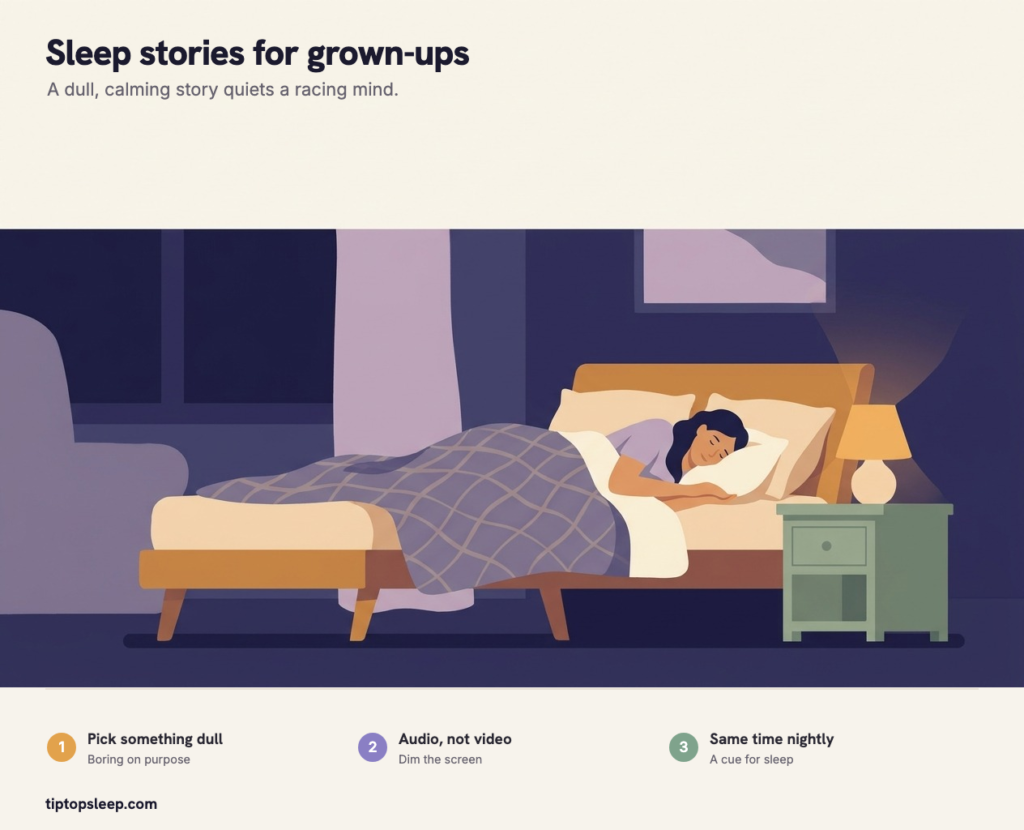
Bedtime stories work for adults for the same reason they work for kids: a calm, low-stakes voice gives your busy mind something dull and predictable to follow instead of tomorrow's to-do list. Listen (don't watch), keep the screen dark or off, pick something familiar and slightly boring, and set a sleep timer so it switches off on its own. Most people notice it easier to drift off within 15-20 minutes.
I get why grown adults feel a bit silly typing "bedtime stories for adults" into a search bar at midnight. I've done it myself, more than once, during a stretch when my own medication was keeping me at three or four hours a night. It isn't childish. It's one of the few sleep tricks that actually does something useful to a mind that won't switch off - and there's a simple reason it works.
Why does listening to a story help you fall asleep?
Insomnia is rarely a body problem at 11pm - it's a mind problem. Your body is tired; your brain is still running through the day's leftover worries, tomorrow's schedule, or a conversation you keep replaying. A story interrupts that loop. It gives your attention somewhere gentle to go that isn't your own problems, and because a good sleep story is deliberately slow, repetitive and low on plot tension, it doesn't wake you back up the way a thriller or an argument with yourself would.
This is really just a form of the distraction and relaxation work that's already part of standard insomnia treatment. As the Sleep Foundation puts it, "relaxation techniques like breathing exercises, progressive muscle relaxation, and guided imagery are a common component of CBT-I, and learning to relax may help counteract worries about sleep that are common in people with symptoms of psychophysiological insomnia." A narrated story does something similar - it occupies the part of your brain that would otherwise be rehearsing your worries, without asking anything difficult of you.
You don't need to follow the plot, and you barely need to stay awake for the ending. That's the point.
Who does this actually help?
- People with a racing mind at bedtime. If your problem is thoughts, not the mattress, a story gives them somewhere else to go.
- Anyone easing off sleeping pills or reluctant to start them. A story costs nothing and has no next-day grogginess or dependency risk.
- Shift workers and frequent travellers trying to fall asleep at an unfamiliar hour or in an unfamiliar bed - a familiar narrator's voice can substitute for the routine you don't currently have.
- Anyone recovering from surgery or illness who's spending more hours than usual lying awake and wants something calming that doesn't involve a screen.
It won't fix sleep apnea, chronic pain, or a genuinely disrupted schedule - those need their own fixes. If you're also dealing with a lot of night waking from a specific cause, our guide on worrying about not sleeping tackles the anxiety side directly.
How do you actually use a sleep story so it works?
- Listen, don't watch. Audio only. Video keeps your eyes open and your brain visually engaged, which is the opposite of what you want. Turn your phone screen off or face-down once the story starts.
- Pick something dull on purpose. The best sleep stories are gentle, repetitive, and low on stakes - a slow walk through a garden, not a courtroom drama. If you find yourself wanting to know what happens next, it's the wrong story.
- Choose a calm, unhurried narrator. Pace matters more than the words. A slow, low voice reads as safe to a tired brain; a fast or animated one does not.
- Set a sleep timer. Most apps and podcast players let you set audio to stop after 15-45 minutes so it doesn't keep playing (and potentially waking you) at 3am.
- Use the same one for a while. A story you've already heard once or twice works better than a new one, because you're not straining to follow it. Familiarity is a feature here, not a downside.
- Keep the room dark. Even a dim phone screen face-up on the nightstand can leak enough light to matter - audio-only lets you keep the room properly dark the whole time.
Where do you find bedtime stories for adults?
You don't need to pay for anything to try this. Free options include story-focused podcasts (search "sleep stories" or "bedtime stories for adults" in any podcast app), YouTube channels with slow-paced narrated stories, and audiobook apps you may already have through your local library. If you like the format enough to want more variety and offline downloads, paid sleep apps such as Calm and Headspace both build large libraries of sleep stories with professional narrators, and they're worth a look if the free options run thin. Classic audiobooks work too - a book you already know well, read slowly, does the same job as a purpose-made sleep story.
For the audio side of things, our guide to color noise is a useful companion if you want something to fall back on for the nights a story isn't holding your attention.
The one thing that makes this easier
Earbuds are uncomfortable to sleep on, and a phone speaker at low volume doesn't stay put as you shift positions through the night. A flat, soft headband with the speakers built in solves both problems - you can lie on your side without anything digging into your ear, and the story keeps playing wherever your head ends up.

MUSICOZY Sleep Headphones Headband
A soft, flat spandex-nylon headband with thin built-in Bluetooth speakers - no hard earbuds pressing into your ear on a pillow, and it pairs with any app or podcast you're using for your story.
Want the full kit? See our Sleep Toolkit for the other gear worth having on your nightstand.
Frequently asked questions
Are bedtime stories for adults actually a real thing, or just a marketing gimmick?
They're real, and the mechanism behind them (distraction and relaxation reducing bedtime worry) is the same one used in standard insomnia treatment. They aren't a clinically studied therapy on their own, but the underlying idea - giving a racing mind somewhere calm to go - is well established.
Should I watch a video or just listen to audio?
Audio only. Video keeps your eyes open and adds light and visual stimulation, both of which work against falling asleep. Turn the screen off and just listen.
What if I keep losing track of the story?
That's normal, and honestly the goal. You're not meant to follow the plot to the end - if you're drifting off partway through, the story did its job.
Do I need a paid app, or will free options work?
Free podcasts, YouTube, and audiobooks you may already own all work the same way. Paid apps like Calm or Headspace mainly add variety, offline downloads, and professionally produced narration - nice to have, not required.
Related reading
- Fear of Not Sleeping - Stop Worrying About Not Sleeping
- What Is the Best Color Noise for Sleep?
- How to Beat Jet Lag (2026)
- How to Sleep Through a Thunderstorm
- Sleep Toolkit
Sources & review: Guidance here is general comfort and sleep-hygiene advice, researched against relaxation and distraction techniques described by the Sleep Foundation. It is not medical advice and does not replace treatment for a diagnosed sleep disorder - if poor sleep is persistent or severe, talk to your doctor.
📥 Free: The Post-Surgery Sleep Recovery Kit
Our 2-page PDF - the safe sleep position for your surgery, how to set up your bed, a night-by-night recovery timeline, and the red flags worth calling your doctor about. We'll email you the download link.
By subscribing you agree to our Privacy Policy.