


Keep pressure off your ears: sleep on your back, or on the side away from a fresh piercing, and try a travel pillow with a cut-out hole so your ear rests in open air instead of against the mattress. Choose small, flat, smooth studs with backs that are snug but not tight. If your piercings are fully healed, the simplest fix is often to just take the earrings out before bed.
I get why you're still wearing them to bed - a fresh piercing you're not allowed to remove yet, or a pair of studs you just don't want to fuss with every night. I've done both: babysat a piercing through its first few weeks, and on plenty of ordinary nights just fallen asleep with my everyday studs still in. The trick is keeping weight and friction off your ear, not fighting your pillow all night.
Why do earrings hurt when you sleep?
Your ear has almost no cushioning of its own - it's mostly cartilage and thin skin sitting right on a pillow for six to eight hours. Add an earring post or back into that equation and you get a hard pressure point that digs in every time you roll onto that side. For a new piercing, that pressure can slow healing or nudge the jewelry out of position. For an old, healed piercing, it's usually just uncomfortable rather than risky - but a snagged hoop or a stud pressed sideways all night can still leave you sore in the morning.
What's the best sleep position for earrings?
Keep the ear with jewelry off the pillow entirely if you can manage it:
- Back sleeping is the easiest fix - neither ear touches anything. If you're not used to it, a pillow under your knees makes it more comfortable to hold the position.
- Side sleeping on the opposite ear works if you have a piercing on only one side, or if one ear is new and the other is healed.
- A pillow with a hole cut into it lets you keep side-sleeping without pressure on either ear - useful if you genuinely can't sleep on your back, or if both ears have jewelry in.
If you're managing this while healing from a piercing, it's worth reading our full guide on how to sleep with a new piercing for the healing-specific timeline. And if back-sleeping doesn't come naturally, learning to sleep on your back is a habit you can build over a couple of weeks, the same way you'd adjust to any new position.
What kind of earrings are safest to sleep in?
The jewelry itself matters almost as much as the position:
- Small and flat beats big and dangly. Studs sit closer to the ear and snag less than hoops or drop earrings, which can twist, catch on hair or bedding, and pull at the piercing.
- Flat-back or disc-back posts are worth switching to if you're regularly sleeping in earrings - no butterfly back sticking out to press into your neck or scalp.
- Check that the backing isn't too tight. Snug enough that the earring won't fall out, loose enough that it isn't clamped against your skin all night. A tight backing is often the real cause of morning soreness, not the position.
- Avoid hoops and dangly earrings for sleep if you can, especially with long or textured hair - they're the pieces most likely to get caught and tugged.
A pillow that keeps pressure off the ear
You can prop a folded towel against your usual pillow, but it slips and flattens through the night. A dedicated travel pillow with a hole cut through the centre is more reliable - your ear rests in the open gap instead of against foam, so nothing presses on the piercing or the jewelry at all.
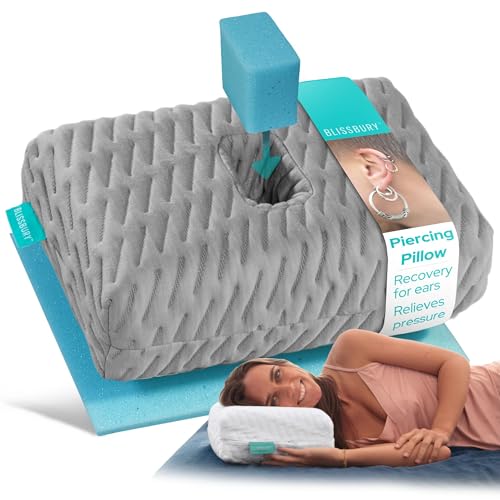
BLISSBURY Ear Piercing Pillow
A compact memory-foam pillow with a cut-out centre, so your ear rests in open air instead of against the mattress. Packs small enough for travel too - handy if you're managing a fresh piercing away from home.
Want more of what's actually worth buying for better sleep? See our Sleep Toolkit for the pillows, masks and other gear we'd genuinely recommend.
Keep it clean if the piercing is still healing
Bedding picks up oil, sweat and bacteria fast, and a healing piercing is more vulnerable to that than skin that's already closed over. The Association of Professional Piercers' aftercare guidance notes that "clean bedding and pillow cases are important," and specifically recommends what's sometimes called the t-shirt trick: "You can use the t-shirt trick: slip your pillow in a large, clean t-shirt." A satin or smooth pillowcase helps too - your ear glides rather than catches, which means less tugging on the jewelry overnight.
The same guidance is direct about not removing new jewelry to "give it a rest," which is tempting when an earring feels uncomfortable at night: "Leave jewelry in at all times. Even well-healed piercings can shrink or close in minutes!" If a fresh piercing is bothering you, the fix is a better pillow and looser hair, not taking the earring out.
When can you just take earrings out for sleep?
Once a piercing is fully healed, the simplest solution is often to stop wearing earrings to bed at all. Earlobe piercings typically finish initial healing in a matter of months, and after that most people can remove studs overnight without any risk to the hole - it's a matter of comfort and habit from there. Cartilage piercings (helix, tragus, conch) take much longer to heal and are more prone to irritation if disturbed, so be more cautious about leaving jewelry out until you're confident it's settled.
If you sleep in earrings out of habit rather than necessity, hoops and dangly styles are the ones to retire first - they carry the most snag risk for the least benefit. Save them for daytime, and keep flat studs for bed.
Signs of irritation or infection to watch for
A little tenderness or redness right after getting a new piercing is normal. These are not, and are worth checking with a piercer or doctor:
- Increasing pain, swelling, or redness spreading beyond the piercing site, especially after the first few days.
- Warmth around the piercing, or a fever.
- Thick, yellow or green discharge (a small amount of clear or whitish fluid while healing is normal).
- A piercing that's visibly shifted position, or jewelry that feels loose or embedded.
When in doubt, get it looked at rather than waiting it out.
Frequently asked questions
Is it bad to sleep with earrings in every night?
Not inherently, once a piercing is fully healed - plenty of people do it for years without issue. The main risks are pressure soreness and snagging, both of which are largely solved by choosing flat, smooth studs and keeping the ear off the pillow where you can.
Can sleeping on earrings make a piercing close?
Pressure alone won't close a piercing, but it can irritate it, push the jewelry off-angle, or slow healing in a new piercing. A closed piercing is almost always caused by leaving the jewelry out too long, not by sleeping in it.
Should I sleep in hoop earrings?
It's best avoided if you can help it. Hoops catch on hair and bedding more easily than studs, and a snagged hoop can tear the piercing. Switch to small flat studs for bed and save hoops for daytime.
How long until I can take a new piercing out at night?
It depends on the piercing type and your own healing, so follow your piercer's specific timeline rather than a generic rule. Earlobes generally heal faster than cartilage; until your piercer confirms it's healed, leave the jewelry in continuously, including overnight.
Related reading
- How to sleep with a new piercing
- Learning to sleep on your back
- Best sleeping position for lower back pain
- The Sleep Toolkit
Sources & review: Aftercare guidance researched against the Association of Professional Piercers. This is general comfort advice, not medical advice, and doesn't replace guidance from your own piercer or doctor - always follow the specific aftercare instructions you were given, especially for a new piercing.
📥 Free: The Post-Surgery Sleep Recovery Kit
Our 2-page PDF - the safe sleep position for your surgery, how to set up your bed, a night-by-night recovery timeline, and the red flags worth calling your doctor about. We'll email you the download link.
By subscribing you agree to our Privacy Policy.