

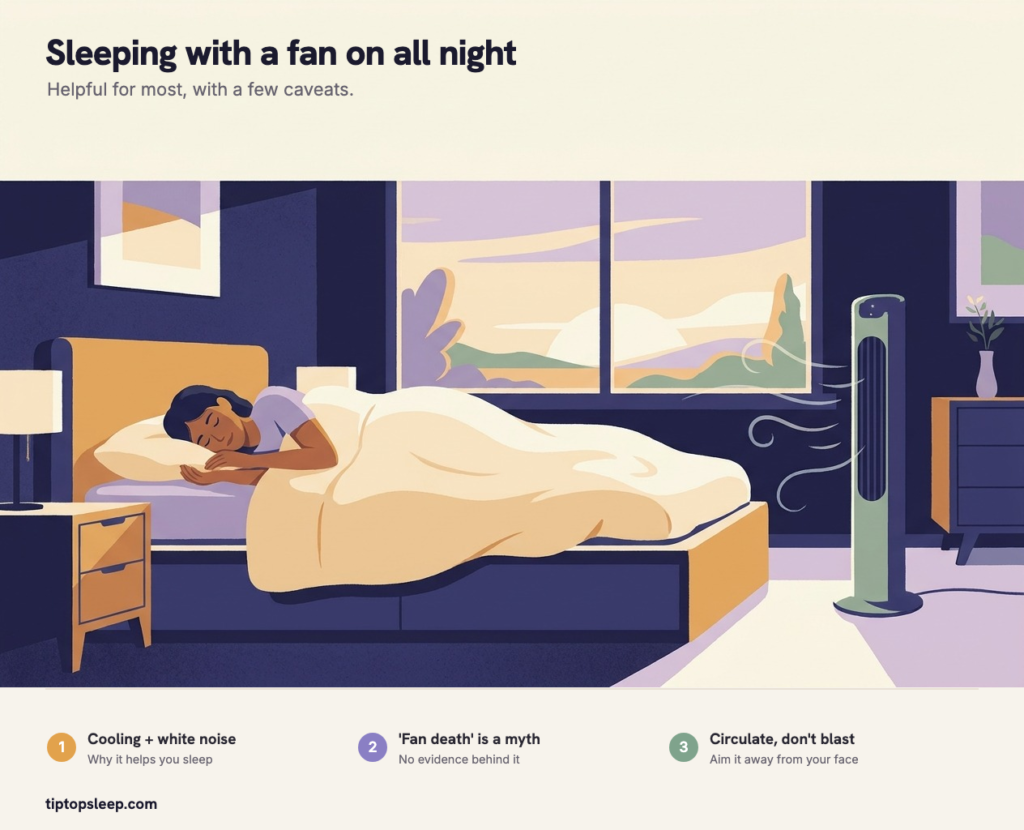
For most people, sleeping with a fan on all night is fine and often helpful - it cools the room, masks disruptive noise, and keeps air moving. The viral idea that a fan can "kill you" overnight (Korea's old "fan death" myth) has no scientific basis. The real downsides are smaller: dry eyes or a dry throat, stirred-up dust that can bother allergies, and stiff muscles if cold air blows directly on you for hours. Point it to circulate the room instead of blasting your face, and you get the benefits without the drawbacks.
I've slept with a fan running every summer of my life, and I still get asked, only half-jokingly, whether it's going to kill me. It won't. But that question is doing a disservice to the actual, much more boring list of things worth knowing before you leave one running until sunrise - so let's go through what's real and what's internet noise.
Is it actually bad to sleep with a fan on all night?
No, not for the vast majority of healthy adults. A fan doesn't remove oxygen from a room or create some dangerous airless pocket around your bed - it just moves the air that's already there. The Sleep Foundation lists "using a fan or air conditioner in hot climates" as a legitimate way to hit the ideal sleep temperature range, which it puts at roughly 65 to 68degF (18.3 to 20degC). That's not a warning label, that's a practical recommendation.
Where a fan can genuinely work against you is in specific, avoidable situations: pointed straight at your face for eight hours, never cleaned, or run in a room that's already too dry or too dusty. Those are fixable problems, not reasons to swear off fans altogether.
What is the "fan death" myth, and should I worry about it?
If you've seen the claim that a fan running overnight in a closed room can cause death, that idea traces back to a decades-old belief in South Korea, where some media outlets and even government health advice once warned that fan-induced hypothermia, asphyxiation, or "facial paralysis" could occur while sleeping. It spread internationally as a piece of odd trivia and still resurfaces on social media every summer.
It doesn't hold up. A fan simply circulates existing air - it doesn't consume oxygen, and running one in a bedroom with a door or window that isn't hermetically sealed poses no asphyxiation risk. The mechanisms proposed over the years (freezing you to death, suffocating you, some kind of "wind chill" effect strong enough to be lethal) aren't supported by how fans or human physiology actually work. It's a myth worth retiring, not a risk worth losing sleep over.
What are the real downsides of sleeping with a fan on?
None of these are dangerous, but they're worth knowing so you can avoid them:
- Dry eyes, skin, or throat. Moving air speeds up evaporation. If the fan blows directly across your face all night, you may wake up with dry or irritated eyes, a scratchy throat, or drier skin than usual.
- Stirred-up dust and allergens. A fan that hasn't been cleaned in a while - especially a ceiling fan - can kick dust, pollen, and pet dander into the air right as you're trying to breathe easy. For allergy or asthma sufferers, this is the downside that matters most.
- Muscle stiffness. Cold air blowing directly on one part of your body for hours can leave muscles feeling tight or achy, particularly in the neck and shoulders, the same way sitting under an air vent all day can.
Every one of these comes down to positioning and maintenance, not the fan itself.
How do I sleep with a fan on without the downsides?
- Don't aim it directly at your face or body. Point it across the room, at a wall, or up toward the ceiling so it circulates air instead of blasting one spot for hours. Some ceiling fans include a reverse or "winter mode" that pushes air upward for gentler, indirect circulation.
- Use oscillation if your fan has it. A sweeping fan distributes airflow around the room instead of concentrating it on you.
- Set a timer. If the noise itself is what disrupts you once you've already cooled down, a built-in timer lets the fan run for the first hour or two of sleep and then switch off.
- Keep it clean. Wipe down blades, grilles, or intake vents every couple of weeks during heavy-use season. This matters even more for ceiling fans, which collect dust when idle for months.
- Add moisture back if the air feels too dry. A humidifier running alongside the fan can offset the drying effect, especially in already-dry climates or during winter heating season.
- If you have allergies, be extra deliberate. Keep the fan a few feet from the bed, clean it more often than you think you need to, and consider closing windows so it isn't just recirculating pollen from outside.

DREO Bladeless Tower Fan
This is the style of fan I'd actually want next to a bed: no exposed blades to catch dust in odd corners, a rated noise floor low enough not to become its own sleep disruptor, a dedicated sleep mode, oscillation so it circulates instead of blasting one spot, and a removable grille that makes the "keep it clean" advice above easy to actually follow.
Looking for more gear that's actually worth having in the bedroom? Our Sleep Toolkit rounds up what we trust for situations like this one.
Frequently asked questions
Can a fan running all night actually kill you?
No. This comes from South Korea's old "fan death" myth, which has no scientific backing. A fan only moves air around a room; it doesn't remove oxygen or create a dangerous condition while you sleep.
Is a fan or air conditioner better for sleep?
Both can work. A fan is generally cheaper to run and adds helpful white noise, but it doesn't actually lower room temperature the way an AC does - it just moves air and helps sweat evaporate. On very hot nights, AC (or a fan alongside it) will cool the room more effectively.
Why does sleeping with a fan on give me a dry mouth or throat?
Moving air speeds up evaporation from exposed skin and mucous membranes. If the airflow is aimed directly at your face, it can dry out your eyes, nose, and throat overnight. Redirecting the fan or adding a humidifier usually solves this.
Can a fan make my allergies worse?
It can, if the fan itself is dusty or if it's stirring up allergens already in the room. Regular cleaning and keeping the fan a bit further from the bed usually prevents this.
Related reading:
- How to Sleep When It's Hot
- Benefits and Risks of Using a Humidifier While Sleeping
- What Is the Best Color Noise for Sleep?
- Tips to Help You Sleep When It's Windy Outside
- Sleep Toolkit - the gear we actually recommend for situations like this
Sources & review: Temperature and cooling guidance checked against the Sleep Foundation's bedroom environment guide. Background on the "fan death" myth drawn from historical and encyclopedic coverage of the claim's South Korean origins. This is general comfort information, not medical advice - if you have asthma, severe allergies, or another condition affected by airflow or dust, talk to your doctor about what's right for your bedroom setup.
📥 Free: The Post-Surgery Sleep Recovery Kit
Our 2-page PDF - the safe sleep position for your surgery, how to set up your bed, a night-by-night recovery timeline, and the red flags worth calling your doctor about. We'll email you the download link.
By subscribing you agree to our Privacy Policy.