

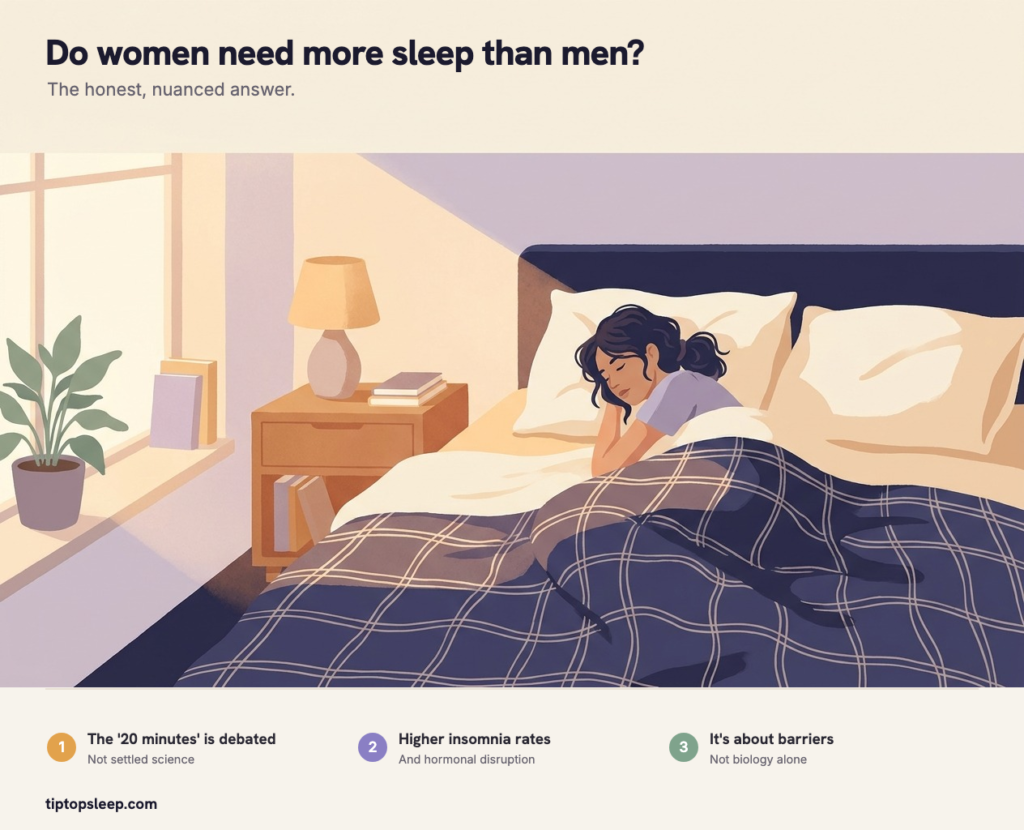
Not exactly - the science on women needing more sleep than men is genuinely mixed, and the popular "20 minutes more" claim is more media headline than settled fact. What's better supported is that women report insomnia at higher rates than men, hormonal shifts (periods, pregnancy, perimenopause and menopause) disrupt women's sleep at specific life stages, and women more often carry the mental load of interrupted nights - caring for kids, waking first, going to bed last. The honest framing isn't "women biologically need more sleep." It's "women often face more barriers to getting the sleep they need."
I see the "women need more sleep" claim shared constantly, usually with a specific number attached - 20 extra minutes, like sleep is a prescription you can measure out. I wanted to know where that number actually came from before I repeated it, and what I found was more interesting than the headline: a real researcher, a real (small) study, and a media cycle that turned "slightly greater need" into "women need 20 minutes more" as settled fact. Here's what the evidence actually shows.
Where does the "women need 20 minutes more sleep" claim come from?
It traces back to Jim Horne, a sleep researcher formerly at Loughborough University's Sleep Research Centre, who studied a group of roughly 210 middle-aged adults. His theory, in his own words, was that "women's brains are wired differently... so their sleep need will be slightly greater," because "women tend to multitask - they do lots at once and are flexible - and so they use more of their actual brain than men do." The idea is that heavier daytime cognitive use means more brain recovery is needed overnight.
That's a hypothesis, not a settled finding. It's based on one research group's interpretation of a modest sample, and "slightly greater need" got flattened into a specific, confident number by outlets repeating each other rather than the original study. Sleep Foundation's own analysis, based on broader survey data, puts the actual average gap much smaller - closer to 11 minutes, not 20. Worth knowing before you treat either number as a target to hit.
What does the research actually say about women and sleep?
Two things are well supported, and they're less about total sleep quantity and more about sleep disruption:
- Women report insomnia more often than men. Sleep Foundation states plainly that when it comes to insomnia, "women are 40 percent more likely to suffer from it than men." That's a real, well-documented gap - not a multitasking theory, but a consistent finding across sleep research.
- Women tend to spend more time in deep sleep. Sleep Foundation also notes that "women tend to take longer to fall asleep, and to spend more time in restorative slow-wave deep sleep than men." More time in deep sleep isn't necessarily "worse" or "better" - it's a documented difference in sleep architecture, not proof of a higher total need.
So the honest read: women aren't necessarily wired to require more total hours. But they're more likely to have their sleep interrupted, harder to fall into, or cut short by things that are specific to being a woman at particular life stages.
How do hormones actually affect women's sleep?
This is where the evidence is strongest, and it's tied to specific, well-understood biological events rather than a vague "women need more" claim:
- Menstrual cycle. Sleep Foundation reports that "one-third of women experience cramps, headaches, and bloating that cause sleep disturbances during their menstrual cycle." Hormonal shifts across the cycle affect body temperature and mood, both of which influence sleep quality.
- Pregnancy. Sleep gets harder as pregnancy progresses: "Women are more likely to have sleep troubles during pregnancy, especially during their third trimester when symptoms of RLS, OSA, pain, and incontinence are more frequent."
- Perimenopause and menopause. This is the biggest hormonal disruptor by far. Sleep Foundation notes that "hot flashes and night sweats disrupt sleep, and are experienced by 75 to 85 percent of women with menopause." If you're navigating this stage, our guide on how to sleep during menopause goes deeper into what actually helps with night sweats and the insomnia that often comes with them.
Notice none of this is about needing more sleep in the abstract - it's about specific windows in a woman's life where the body actively works against a full night.
Is it mental load, not biology, driving the sleep gap?
This might be the most underrated part of the conversation. A lot of what gets framed as "women need more sleep" is really "women's sleep gets interrupted or shortened by caregiving and household responsibilities more often than men's does." Waking for a crying baby, being the one who gets up early to start the day, or lying awake running through tomorrow's to-do list isn't a hormone - it's a workload, and it lands unevenly.
If you're in the newborn stretch specifically, that's less "sleep hygiene tips" territory and more survival mode - our piece on surviving newborn sleep deprivation is written for exactly that season. And if low mood is tangled up with your sleep troubles, it's worth knowing the relationship goes both ways - see can depression cause sleep problems for how the two interact.
So should women actually try to sleep more than men?
Not as a rule based on gender alone. The more useful question isn't "am I getting 20 more minutes than my partner," it's "am I getting the 7-9 hours adults generally need, and is anything specific - hormonal, situational, or just the sheer load of the day - cutting into that." A solid, boring sleep hygiene routine does more for most people than chasing a headline number ever will. Our sleep hygiene checklist is a good place to start if you're not sure where the gap actually is.
Want more of what's worth having on your nightstand for better sleep in general? Our Sleep Toolkit rounds up the gear we trust.
Frequently asked questions
Do women really need 20 minutes more sleep than men?
That specific number comes from one researcher's theory (Jim Horne, formerly of Loughborough University) based on a study of around 210 people, and it's been repeated as fact far more often than the evidence supports. Broader survey data from Sleep Foundation puts the real average gap closer to 11 minutes. Treat it as a loose, debated estimate, not a target.
Why do women get insomnia more than men?
It's not fully understood, but the pattern is consistent: Sleep Foundation reports women are about 40 percent more likely to experience insomnia than men, with contributing factors including hormonal shifts, higher rates of anxiety and depression, and disrupted sleep from caregiving responsibilities.
Does menopause really disrupt sleep that much?
Yes - this is one of the most well-documented hormonal sleep disruptors. Hot flashes and night sweats affect an estimated 75 to 85 percent of women going through menopause, and many also develop new sleep-disordered breathing during this stage.
Is the "women multitask more so need more sleep" theory proven?
No. It's a hypothesis from one research group, not a broadly replicated scientific consensus. It's reasonable to mention as one possible explanation, but it shouldn't be presented as settled fact.
Related reading:
- How to Sleep During Menopause
- Can Depression Cause Sleep Problems
- Sleep Hygiene Checklist
- Surviving Newborn Sleep Deprivation
- Sleep Toolkit - the gear we actually recommend
Sources & review: Claims here are checked against Sleep Foundation's guide to women and sleep, including insomnia prevalence, sleep architecture differences, and hormonal life-stage effects. The "20 minutes more" theory is attributed to sleep researcher Jim Horne and presented as a debated hypothesis, not established fact. This is general information, not medical advice - talk to your doctor about persistent sleep problems, especially around pregnancy or menopause.
📥 Free: The Post-Surgery Sleep Recovery Kit
Our 2-page PDF - the safe sleep position for your surgery, how to set up your bed, a night-by-night recovery timeline, and the red flags worth calling your doctor about. We'll email you the download link.
By subscribing you agree to our Privacy Policy.