

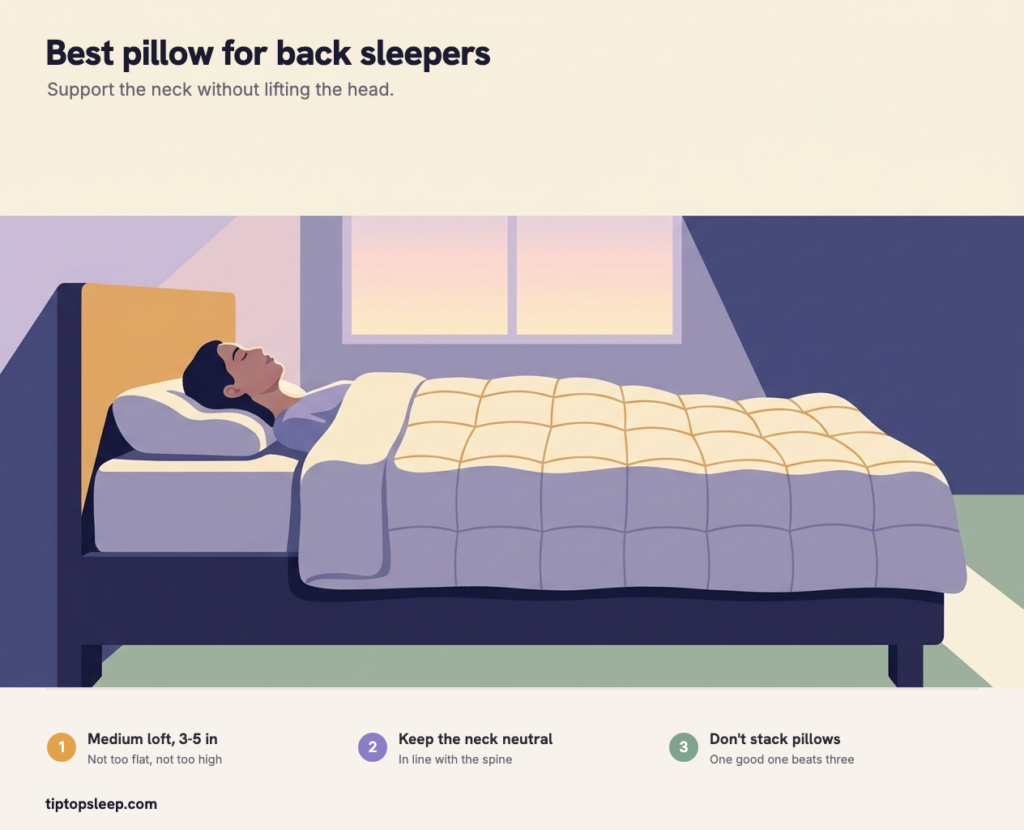
Back sleepers do best with a medium-loft pillow, roughly 3 to 5 inches thick, that fills the gap under your head and neck without tipping your chin toward your chest. Too flat and your head tilts back, straining your neck. Too high and your neck flexes forward all night. A contoured or medium-firm memory-foam pillow tends to hold that shape best, and a small pillow under the knees can take pressure off your lower back too.
I get asked about this one a lot, because back sleeping sounds like the "correct" position everyone should aim for, and then people buy a pillow that makes it worse. Usually it's not the sleeping position that's the problem, it's the pillow fighting against it. Here's what actually matters when you're choosing one.
Why does pillow height matter so much for back sleepers?
When you're on your back, your head, neck, and spine should stay roughly in a straight line, the same alignment you'd have standing with good posture. Your neck has a natural forward curve, and the pillow's job is to support that curve without pushing your head out of position in either direction.
- Too flat, and your head tilts back. Sleep Foundation's guidance on pillow loft is direct about this: "If a pillow is too flat, your head might tilt back and put pressure on your neck." You wake up with that dull ache at the base of your skull.
- Too high, and your neck flexes forward. The same problem in reverse - your chin drops toward your chest all night, which strains the muscles at the back of your neck instead of letting them rest.
- Medium loft is the sweet spot. Sleep Foundation notes that "back sleepers tend to prefer medium-loft pillows, which are those that measure between 3 and 5 inches thick." That range keeps your head level with your spine instead of angled either way.
If you're newer to back sleeping altogether - it's a position a lot of people have to learn rather than fall into naturally - our guide to learning to sleep on your back covers the adjustment period, which usually has more to do with comfort habits than the pillow itself.
What kind of pillow actually works for back sleeping?
Loft is the number that matters most, but the material and shape decide how well a pillow holds that loft through the night.
- Contoured or cervical pillows. These have a built-in dip for your head and a slightly raised ridge that cradles the neck's curve. They tend to suit back sleepers well because the shape does the alignment work for you, rather than you having to guess at the right amount of fluffing.
- Memory foam. Solid or shredded memory foam holds its loft consistently, night after night, instead of flattening out by 2am the way some down or poly-fill pillows do. That consistency matters more for back sleeping than for side sleeping, because there's less margin before you tip into "too flat."
- Adjustable-fill pillows. Shredded memory foam you can add or remove lets you dial in the exact loft for your body - useful because "medium loft" isn't identical for everyone; it depends on your shoulder width, mattress firmness, and how your head sits relative to your spine.
- Avoid stacking two pillows. It's a common fix for "my pillow feels too flat," but two stacked pillows almost always overshoot into "too high," pushing your neck into forward flexion instead of correcting it. If one pillow feels flat, replace it or add a thin adjustable layer - don't double up.
Does a knee pillow or lumbar support actually help back sleepers?
Yes, and it's an easy thing to overlook because all the attention goes to the head pillow. Lying flat on your back leaves a small gap between your lower back and the mattress, since your spine has a natural inward curve there too. A slim pillow or rolled towel under your knees gently tilts your pelvis and takes some of that pressure off your lower back, which can matter if you wake up stiff even when your neck feels fine. If lower back discomfort is more your main issue than neck position, our guide to the best sleeping position for lower back pain goes into more detail on this, including a lumbar roll under the back itself.
Two pillows worth considering
Rather than a long ranked list, here are two real options that cover the two most common back-sleeper needs: a shaped pillow that does the alignment work automatically, and an adjustable one for anyone whose "right loft" is somewhere between standard sizes.

Royal Therapy Memory Foam Contour Pillow
A cervical-shaped pillow with a center dip for your head and a raised edge that supports the neck's curve, which suits back sleepers who want the alignment built into the shape rather than having to fluff a standard pillow into the right spot every night. The contour also means less shifting around trying to find a comfortable height.

Olive + Crate Adjustable Loft Shredded Memory Foam Pillow
Filled with shredded memory foam you can add or remove through a zipper, so you can dial in that medium-loft range for your own body instead of hoping a fixed-height pillow happens to fit. Useful if you've tried a standard pillow and it felt either a little flat or a little too propped-up.
For the rest of the gear we actually trust for better sleep, see our Sleep Toolkit.
Frequently asked questions
How thick should a pillow be for back sleepers?
Aim for medium loft, roughly 3 to 5 inches thick. That range keeps your head level with your spine instead of tilting your chin up or down.
Is memory foam or down better for back sleeping?
Memory foam generally holds its loft more consistently through the night, which matters for back sleepers because there's less room for error before a pillow feels too flat. Down can work too, but it compresses faster and may need re-fluffing partway through the night.
Should back sleepers use two pillows?
Usually not. Stacking pillows tends to push the head too high, flexing the neck forward instead of keeping it neutral. If one pillow feels too flat, it's better to replace it or use an adjustable-fill pillow than to add a second one underneath.
Do back sleepers need a knee pillow too?
Not everyone, but it can help. A thin pillow or rolled towel under the knees takes some pressure off the lower back by supporting its natural curve, which is worth trying if you wake up with lower back stiffness even when your neck feels fine.
Related reading:
- Learning to Sleep on Your Back (In 3 Easy Steps)
- Best Sleeping Position for Lower Back Pain
- How Often Should You Change Your Pillowcase?
- Best Lumbar Sleep Roll
- Sleep Toolkit - the gear we actually recommend for better sleep
Sources & review: Guidance here is general comfort information, checked against Sleep Foundation's guide to pillows for back sleepers. It is not medical advice - if you have ongoing neck or back pain, please see a healthcare provider rather than relying on a pillow change alone.
📥 Free: The Post-Surgery Sleep Recovery Kit
Our 2-page PDF - the safe sleep position for your surgery, how to set up your bed, a night-by-night recovery timeline, and the red flags worth calling your doctor about. We'll email you the download link.
By subscribing you agree to our Privacy Policy.