

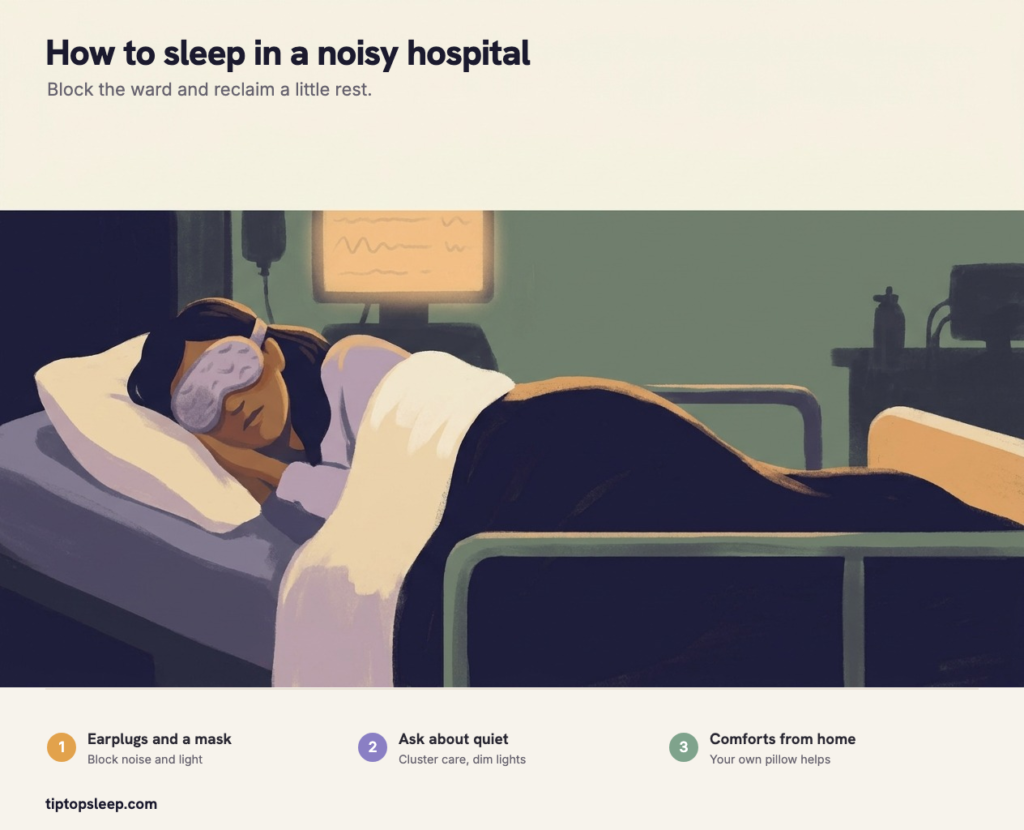
You can't stop the noise, lights and vitals checks in a hospital, but you can blunt them: bring soft reusable earplugs and an eye mask from home, add your own pillow or a small blanket, play low white noise through your phone, and ask the nurses directly about clustering care, dimming the lights, and timing your last meds for a longer stretch of quiet. Research on hospital patients backs this up - people who wore earplugs and an eye mask woke up less and got more deep sleep than those who didn't.
Nobody sleeps well in a hospital bed, and it isn't because you're a bad sleeper. It's the noise from the corridor, the beeping IV pump, the blood-pressure cuff at 4am, a roommate's TV, and the low hum of anxiety that comes with just being there. I've sat up with family through hospital nights, and I've been the patient myself, watching the clock and dreading the next vitals check. There's no fixing a hospital ward - but there's a lot you can do to protect what sleep you can get.
Why is it so hard to sleep in a hospital?
It's several things stacked together, not one. Corridors and nursing stations don't go quiet at night, and alarms on IV pumps, monitors and call bells go off at all hours - even when they're not for you, they wake you. Vital sign checks happen every few hours by design, so your sleep gets chopped into short pieces instead of one long stretch. Add a roommate you didn't choose, unfamiliar light under the door, and the ordinary worry of being unwell, and it's little wonder hospital sleep feels broken rather than restorative. None of this means you're doing anything wrong - it means the environment is working against you, so the fix has to be practical, not "try to relax more."
What actually helps you sleep through hospital noise?
The single biggest lever is blocking the noise and light before they reach you, rather than hoping the ward goes quiet. The Sleep Foundation cites a study where "hospital patients who wore earplugs and an eye mask woke up less often and experienced more deep sleep compared to a group of patients who did not." That's the whole strategy in one sentence: earplugs plus an eye mask, every night you're in there.
- Soft reusable earplugs. Foam ones work, but silicone or soft flanged earplugs are more comfortable against a hospital pillow, and you can reuse the same pair all week.
- An eye mask. Hospital corridors are never fully dark, and neither is a shared room with a roommate's TV or reading light on. A mask blocks it without asking anyone to turn anything off.
- White noise on your phone. A steady, low hum from a white noise app or fan sound masks the sudden, sharp noises - a cart wheel, a door, someone's monitor - that actually jolt you awake. The same Sleep Foundation review found that white noise broadcast into hospitalized patients' rooms improved their sleep quality over several nights.
- Something from home. Your own pillow, a small blanket, even your usual pajamas. It sounds minor, but familiar textures genuinely help you settle in an unfamiliar bed.
How do I get the hospital itself to help?
This is the part people forget: nursing staff can often adjust things for you, but only if you ask.
- Ask about clustering care. Many wards can group vitals checks, medication rounds and blood draws together where medically safe, so you get one longer uninterrupted stretch of sleep instead of being woken every ninety minutes.
- Ask about dimming lights. Corridor and room lights are often brighter than they need to be at 2am. A simple "could the lights be dimmed near my room overnight?" is a reasonable ask.
- Ask about medication timing. If a dose is due at an awkward hour and there's flexibility in the schedule, ask if it can shift so you're not woken mid-sleep.
- Ask about a quieter bed or side room. If a roommate's TV, visitors, or alarms are the real problem, ask whether a move is possible. It isn't always, but it's worth asking.
Being your own advocate here doesn't mean being difficult. It means being clear: "I'm having a hard time sleeping because of X - is there anything that can be adjusted?" Nurses hear this often and usually have more flexibility than patients assume.
Can I still wind down for sleep in a hospital bed?
Yes, and it's worth trying even though the setting is strange. Keep some version of your normal wind-down: dim your device screen in the last half hour, skip anything too stimulating on your phone, and do a few slow breaths once the lights are off. You won't get the same sleep as at home, and that's fine - the goal on a hospital night is protecting whatever rest is available, not a perfect night. During the day, get some natural light and stay upright where you're able to, since that daytime contrast helps your body still recognize "this is night" in a room that never fully goes dark.
What if I genuinely can't sleep at all?
Tell the nursing staff. A short run of very poor sleep is common around a hospital stay and usually isn't dangerous on its own, but ongoing insomnia can slow recovery and is worth flagging rather than quietly enduring. Staff may be able to review your medication timing or discuss short-term options with the team looking after you. If pain is what's keeping you up, say so specifically - "the pain is what's waking me" is more useful to a nurse than "I can't sleep."
The one thing that makes this easier
Of everything on this list, a proper pair of earplugs does the most work for the least effort. Foam ones from a drawer at home are better than nothing, but a soft, reusable pair designed for sleeping on your side is far more comfortable through a whole night in a hospital bed, and you can bring the same pair home afterward.

Loop Quiet 2 Reusable Earplugs
Soft, low-profile earplugs built to be comfortable lying on your side, which is exactly the problem with foam plugs in a hospital bed. Small enough to keep in a hospital bag and reuse every night of a stay - and afterward at home.
Want the rest of what I pack for a hospital stay or a rough night? See the full Sleep Toolkit for the masks, sound machines and other gear worth having.
Frequently asked questions
What can I ask nurses for to help me sleep?
Ask directly about clustering your vitals and medication checks into fewer visits, dimming the lights near your room overnight, and moving your medication schedule slightly if it's waking you at an awkward hour. It's a completely normal request.
Do earplugs and an eye mask really make a difference in hospital?
Yes - hospital patients who used both in one study woke up less often and got more deep sleep than patients who didn't. It's one of the few changes you can make entirely on your own, without needing anything from staff.
Is it normal to barely sleep in hospital?
It's extremely common, especially in the first night or two, or after a procedure where vitals checks happen more often. It doesn't mean something is wrong with you - the environment itself disrupts sleep for almost everyone.
What should I pack for better hospital sleep?
Soft reusable earplugs, an eye mask, your own pillow or a small blanket if you're allowed one, and your phone with a white noise app or some downloaded audio. Small, familiar comforts matter more than people expect.
Related reading
- How to Avoid Sleep Problems After Surgery
- How to Sleep When It's Hot
- What Is the Best Color Noise for Sleep?
- How to Sleep After Gallbladder Surgery
- Sleep Toolkit - the gear worth having
Sources & review: Guidance here is researched against the Sleep Foundation's research on noise and sleep, including studies on hospital patients using earplugs, eye masks and white noise. It is general information, not medical advice, and it doesn't replace guidance from your own care team - always raise sleep or pain concerns directly with your nurses and doctors.
📥 Free: The Post-Surgery Sleep Recovery Kit
Our 2-page PDF - the safe sleep position for your surgery, how to set up your bed, a night-by-night recovery timeline, and the red flags worth calling your doctor about. We'll email you the download link.
By subscribing you agree to our Privacy Policy.